Key takeaways
- A smaller crystal-accented ceiling fan with a close-to-ceiling or low-profile mount suits bedrooms and standard 2.4-meter ceilings, while a larger statement fixture with multiple tiers of crystal trim and a longer downrod suits entryways, dining rooms, and great rooms with…
A smaller crystal-accented ceiling fan with a close-to-ceiling or low-profile mount suits bedrooms and standard 2.4-meter ceilings, while a larger statement fixture with multiple tiers of crystal trim and a longer downrod suits entryways, dining rooms, and great rooms with higher ceilings where the fan doubles as the main light fixture.
As an Amazon Associate, we earn from qualifying purchases made through links on this page.
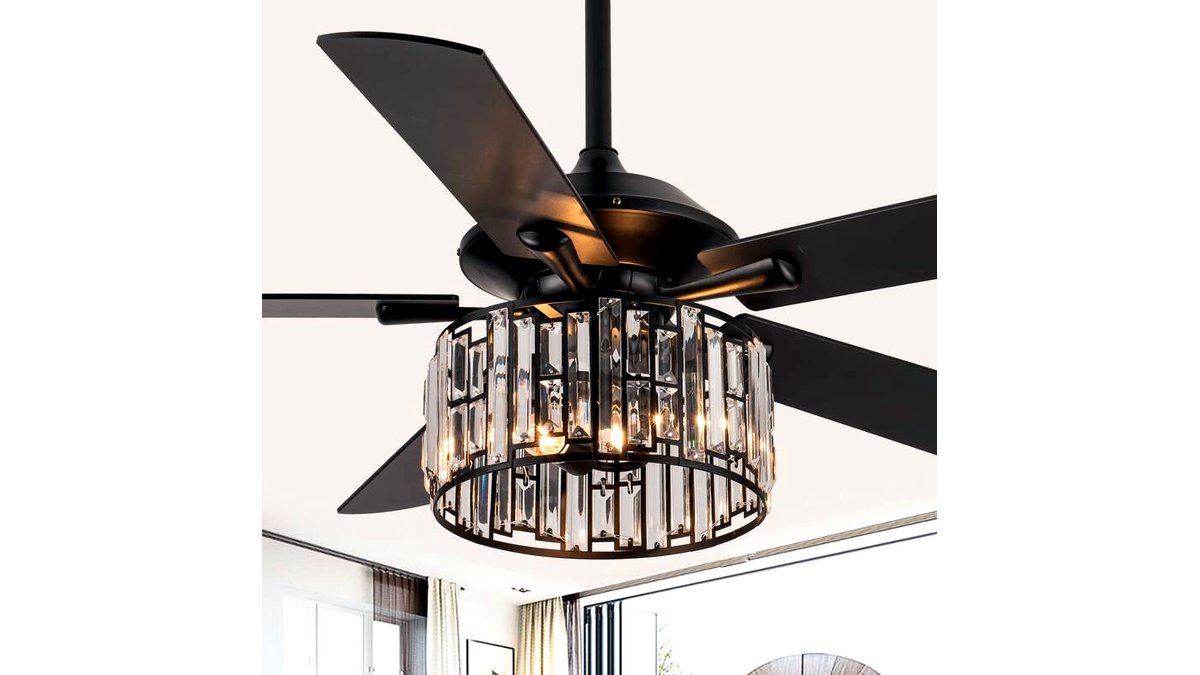
What Makes a “Black Crystal” Ceiling Fan Different
This style blends a traditional chandelier’s decorative crystal elements with a functional ceiling fan, usually finished in matte black, black nickel, or black-and-gold combinations. The blades are often finished to match or complement the black frame, and the crystal element can take several forms: a drum-style crystal shade around the light kit, hanging crystal strands beneath the motor housing, or a crystal-studded center medallion. Because the decorative hardware adds weight and visual bulk compared with a plain fan, mounting style and ceiling height matter more here than with a basic utility fan.
Buyers typically want this style for a specific room that needs both airflow and a finished, upscale look, such as a dining room, foyer, primary bedroom, or living room with a vaulted or standard ceiling. Matching the fan’s finish to existing black or matte-black hardware in the room, such as door handles, faucets, or light fixtures, is a common styling goal, so checking the exact black finish (matte, satin, or black nickel) against existing hardware photos is worth the extra minute before buying.
Picks by Style and Room Type
Compact Crystal-Accent Fans for Bedrooms
Smaller-diameter fans, generally in the 100 to 130 centimeter blade-span range, suit bedrooms and smaller dining areas. These typically use a simpler crystal accent, such as a small crystal finial or a light crystal ring around the light kit, keeping the visual weight proportional to a smaller room. A flush or close-to-ceiling mount works well under standard 2.4-meter ceilings where a hanging downrod would sit too low.
Drum-Shade Crystal Fans for Living and Dining Rooms
Mid-size fans with a fabric or frosted drum shade wrapped in crystal beading around the light kit are a common choice for living rooms and dining rooms. These usually pair a wider blade span, often 130 to 150 centimeters, with a downrod mount that can be adjusted or swapped for different ceiling heights, and many include a remote or wall control for fan speed and light dimming.
Chandelier-Style Statement Fans for Entryways and Great Rooms
The largest and most ornate versions use multiple tiers of hanging crystal strands or a full crystal chandelier body integrated above the fan blades, intended as the primary light fixture in a two-story foyer or great room. These fans typically need a longer downrod and benefit from being viewed from below, which is why they suit tall or vaulted ceilings rather than standard flat ceilings, where the extra visual height has nowhere to go.

At a Glance Comparison
| Style | Best For | Key Stated Specs | Limits |
|---|---|---|---|
| Compact crystal-accent fan | Bedrooms, small dining nooks | Smaller blade span, flush or short-downrod mount | Less dramatic look, limited airflow for larger rooms |
| Drum-shade crystal fan | Living rooms, standard dining rooms | Mid-size blade span, adjustable downrod, remote control common | Drum shade can diffuse light more than an open crystal design |
| Chandelier-style statement fan | Entryways, great rooms, vaulted ceilings | Largest blade span, long downrod, multi-tier crystal trim | Needs tall ceiling clearance, heaviest to install |
| Outdoor-rated black crystal fan | Covered patios, sunrooms | Damp or wet-rated motor, weather-resistant blades | Fewer ornate crystal options available at this rating |
Fit, Size, and Mounting Notes
Blade span should scale with room size: a fan that is too small for the room will struggle to move enough air, and one that is too large can feel visually overwhelming and move more air than needed in a small space. Ceiling fan sizing guides generally match room dimensions to a recommended blade-span range, so measuring the room before choosing a model is the most reliable step, especially with statement-style fans whose decorative hardware adds visual size beyond the blade span alone.
Mounting style depends on ceiling height and type. Flush or “hugger” mounts sit close to the ceiling and suit standard 2.4-meter ceilings or any room where headroom is limited. Downrod mounts hang the fan lower and allow better airflow in taller rooms, and many fans ship with a standard downrod that can be swapped for a longer or shorter one to match the actual ceiling height. Sloped or vaulted ceilings need a compatible sloped-ceiling mounting kit, which not every crystal fan includes by default, so checking the maker’s listed maximum slope angle against the actual ceiling pitch matters before ordering.
Weight is a practical consideration specific to this style: crystal-trimmed fans are generally heavier than plain fans because of the glass or acrylic crystal elements and added light-kit hardware, so confirming the ceiling junction box is rated for the fan’s stated weight, or adding a fan-rated electrical box, is a safety step the manufacturer’s installation manual will usually call out directly.
Pick X If…
| Choose This | If You… |
|---|---|
| Compact crystal-accent fan | Are furnishing a bedroom or small room under a standard ceiling |
| Drum-shade crystal fan | Want a living or dining room fan that also works as the main light |
| Chandelier-style statement fan | Have a vaulted ceiling or two-story entryway to fill visually |
| Outdoor-rated black crystal fan | Are installing on a covered patio or sunroom exposed to humidity |
| Remote or smart-control model | Want to adjust speed and light dimming without a wall switch nearby |
Alternatives Worth Considering
Buyers drawn to the look but worried about upkeep might consider a black fan with a single simple crystal finial rather than full crystal trim, which keeps most of the aesthetic with less glass to dust. A separate approach is to install a plain matte-black ceiling fan and hang a coordinating crystal pendant or chandelier nearby rather than combining both functions in one fixture, which also simplifies future fan replacement without losing the decorative light fixture. For rooms where airflow matters more than style, a standard black DC-motor fan without crystal trim offers quieter operation and often better energy efficiency, at the cost of the chandelier-like appearance.
Motor Type, Noise, and Long-Term Operating Cost
The motor hidden inside a decorative crystal housing matters as much as the visible design, since it determines noise level, airflow efficiency, and how smoothly the fan runs at low speeds. DC-motor fans, which use direct-current motors similar to those in modern ceiling fans across price tiers, generally run quieter and more efficiently than older AC-motor designs, and many offer a wider range of speed settings, including very low speeds useful for gentle overnight air circulation in a bedroom. AC-motor fans are typically less expensive but offer fewer speed steps and tend to use more electricity for the same airflow, which matters for a fan expected to run for long stretches in a living or dining room.
Balance and vibration are worth checking after installation, since a heavier, decoratively trimmed fan is more prone to wobble if the blades are not evenly weighted or the mounting bracket is not fully tightened. Most manufacturers include a balancing kit with small weights that clip to a blade to correct minor wobble, and following the included instructions to identify and correct an unbalanced blade reduces long-term wear on the motor and mounting hardware, as well as rattling among the crystal elements.
Frequently Asked Questions
Are black crystal ceiling fans harder to clean than plain fans?
Crystal elements and multi-tier designs generally collect more dust than a smooth plain fan blade or housing, simply because there is more surface area and more small gaps between crystal pieces. Regular light dusting with a soft brush or microfiber duster, following the manufacturer’s cleaning guidance, keeps the crystal from clouding over time.
Will a black crystal fan work with a sloped or vaulted ceiling?
Some models include or offer an optional sloped-ceiling mounting kit rated up to a specific angle listed by the maker, while others are designed for flat ceilings only. Checking the stated maximum slope angle against the actual ceiling pitch before purchase avoids an installation that will not sit level.
Do these fans come with a light kit included?
Most black crystal ceiling fans in this style include an integrated light kit, often built into the drum shade or crystal medallion, since the decorative crystal elements are usually designed around the light fixture rather than sold separately. Bulb type and included dimming compatibility vary by model and should be checked if a specific dimmer switch is already installed.
How much airflow do ornate crystal fans actually provide compared with plain fans?
Airflow depends mainly on motor size, blade pitch, and blade span rather than the decorative crystal trim itself, so a well-built ornate fan can move air as effectively as a plain fan of the same size and motor class. Buyers prioritizing airflow above appearance should compare the manufacturer’s stated airflow or CFM figures rather than assuming decorative styling reduces performance.
Can a black crystal ceiling fan be installed outdoors?
Only models specifically rated for damp or wet locations should be installed outdoors or in covered outdoor spaces, and the manufacturer’s listed rating should be checked before installation in any area exposed to moisture. Indoor-rated crystal fans are generally not built to resist the humidity and temperature swings of an outdoor or semi-exposed setting.
What ceiling height is needed for a large statement-style crystal fan?
Larger chandelier-style fans with long downrods and multi-tier crystal generally need more vertical clearance than standard 2.4-meter ceilings provide, which is why they are most often installed in vaulted ceilings, two-story foyers, or great rooms. Checking the fan’s total hanging height, including the downrod and light kit, against the actual ceiling height prevents the blades from hanging too low for safe clearance.