Key takeaways
- Compare the best camera inserts for mirrorless and DSLR kits, from padded cubes and a large DSLR insert to a hard-shell case and soft lens pouch sets.
A camera insert is a padded, divider-lined box that drops into a backpack, tote, or carry-on you already own and gives your camera the protection of a dedicated camera bag. It is the right answer when your favorite everyday bag carries better than any camera backpack, when you want to travel without advertising that you are carrying expensive gear, or when you would rather convert a bag you own than buy another one.
The catch is fit. An insert that is even slightly too large will fight the zipper of the host bag, and one that is too small lets gear slide around inside it. This guide covers five distinct approaches: a mainstream padded insert for a typical mirrorless kit, a large insert for a DSLR or full-frame kit with several lenses, a compact cube for one camera and one lens, a hard-shell case for when soft padding is not enough, and a set of soft lens pouches for carrying lenses loose.
As an Amazon Associate, we earn from qualifying purchases.
Quick answer
Begin with the Neewer Flexible Partition insert for a typical mirrorless kit. Choose the Tenba BYOB 13 for a full DSLR kit with several lenses, the Ape Case Cubeze ACQB33 for one camera and one lens, and the USA Gear HXS when crush protection matters most. Add the Neewer lens pouch kit for spare lenses, and measure your bag’s interior before ordering.
Neewer Flexible Partition Camera Padded Bag Insert (NW140S)
Specs
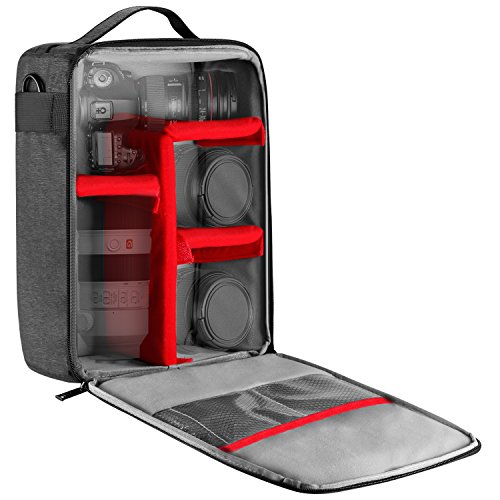
- Exterior 12.6 x 8.7 x 5.9 inches; soft nylon shell; flexible padded partitions; holds a DSLR or mirrorless body with up to four lenses or flashes, plus small accessories; about 1.2 lb; carry handle on top.
This is the mainstream option, shaped like a small handbag so it slides into a mid-size backpack, a roomy tote, or a messenger bag. Its padded partitions reposition to build compartments around a body, a standard zoom, and a couple of primes or a flash, so the layout can change with the kit. Because the walls are soft rather than framed, it flexes slightly when the host bag is overstuffed, forgiving in oddly shaped bags.
The top handle lets you lift the whole kit out in one motion, and the padded walls give honest bump and scratch protection for commuting and general travel.
Best for: Mirrorless and DSLR shooters with a standard one-body kit who want one insert for several everyday bags.
Limitation: The soft shell has no rigid frame, so it protects against bumps and scratches rather than crushing weight. If heavy items get stacked on your bag, choose the hard-shell pick below instead.
Tenba BYOB 13 Camera Insert

Specs
- Exterior 13.5 x 9.5 x 5.5 inches; interior 13 x 9 x 5 inches; about 1 lb; water-repellent nylon; padded dividers; fits a body with three to five lenses; mesh side pockets; removable shoulder strap; model 636-224.
The BYOB 13 is the large option, built for a full-frame DSLR or mirrorless body with a real lens collection: a standard zoom, a fast prime or two, and room for a telephoto or a flash. Its soft shell molds to the host bag’s shape instead of forcing the bag around a rigid box, and the generous dividers let long lenses lie along the insert while shorter glass gets its own bays.
Stretch mesh pockets on the outside hold a water bottle, a mini tripod, or small items that otherwise vanish inside a backpack. A removable shoulder strap lets it briefly work as a plain shoulder bag, though it is happiest inside something else, and the water-repellent shell shrugs off light rain.
Best for: DSLR and full-frame mirrorless shooters carrying three to five lenses who want one insert to convert a large backpack, duffel, or rolling carry-on.
Limitation: It needs a genuinely large host bag: at 13.5 inches wide it will not fit slim daypacks or most messenger bags, and in a half-empty bag it can slump.
Ape Case Cubeze ACQB33

Specs
- Exterior approximately 9.5 x 6.4 x 4.3 inches; padded nylon shell; high-visibility yellow interior; removable and adjustable padded dividers; drawstring closure; fits a camera with a lens attached plus small accessories.
The Cubeze line takes a different approach from zippered cubes: the top closes with a drawstring, and the collar folds down inside a bag so you reach straight in for the camera. For a one-camera, one-lens kit — a mirrorless body with a standard zoom or small prime attached — that open-top access is the fastest in this guide. The bright yellow interior is more than styling; lens caps and dark screws show up against it instead of disappearing into black padding.
The padding is thick for the size, the cube stands on a shelf as storage, and exterior pockets take a battery or card wallet. It disappears into the corner of a weekender or a large handbag, suiting photographers who only occasionally carry a camera.
Best for: A single camera with one lens attached, carried in a handbag, small tote, or the corner of a larger travel bag.
Limitation: The drawstring closure is quick but not weather-sealed, and the shallow depth rules out bodies with battery grips or long lenses mounted.
USA Gear HXS Hard Shell SLR Case
Specs
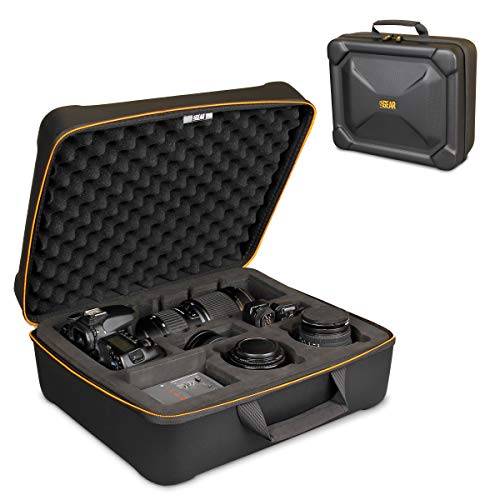
- Molded EVA hard shell, water-resistant finish; exterior approximately 14 x 12 x 5.5 inches; precision-cut foam for a camera body and up to three lenses; removable dual-layer foam tray with handle; egg-crate foam lid; dual zippers.
Every other pick here is soft. The HXS is the step up: a molded EVA shell that resists crushing pressure when a duffel gets stacked under other luggage, thrown in a trunk, or squeezed into an overhead bin. Inside, the foam is pre-cut into a body bay and lens slots, and the equipment tray lifts out by its handle to drop into a larger tote as a protective module.
Egg-crate foam in the lid keeps gear from shifting, and the dual zippers open the case flat. Used alone it reads as a compact equipment case; inside a soft duffel or weekender, it turns that bag into something close to a hard case for rough trips.
Best for: Travelers whose bags get stacked or handled by other people, and anyone who wants hard-case protection inside a bag they already own.
Limitation: The foam layout is fixed: it cannot be reconfigured the way hook-and-loop dividers can, and the rigid shell is the bulkiest option here relative to the kit it holds.
Neewer Camera Lens Pouches Kit (4 Sizes)

Specs
- Four neoprene pouches in small, medium, large, and extra-large sizes; thick plush neoprene padding; drawstring closures; orange interior lining; model 10090822.
The pouch kit abandons the box entirely. Each lens gets its own thick neoprene sleeve with a drawstring closure, and the wrapped lenses drop into whatever bag you are carrying that day, with no fixed insert footprint at all. The four sizes cover the usual spread from a small prime up to a large telephoto zoom, and the orange interior makes it easy to confirm a pouch is empty before you leave a location.
This suits photographers whose lens count changes constantly, or who split a kit across two bags. A pouch also adds a second layer of padding inside one of the inserts above, and the set folds flat in a drawer when not in use. Check the maker’s size chart against your longest lens first, since a drawstring pouch only protects a lens that fits inside with the cord pulled closed.
Best for: Lenses carried loose in ordinary bags, mixed kits that change daily, and extra padding for a prized lens inside another insert.
Limitation: Pouches protect individual lenses only: no structure for a camera body, and a drawstring can work loose if a pouch hangs upside down.
How to choose
Measure the host bag first. Open the bag you actually plan to use and measure its interior length, width, and depth with a tape, then compare those numbers with the insert’s exterior dimensions. Leave a small margin on every side: padded walls bulge when loaded, and a forced fit will eventually damage both insert and bag. Depth is the measurement buyers most often get wrong, because a body with a lens attached stands taller than expected.
Weigh divider flexibility against padding thickness. Fully adjustable hook-and-loop dividers, like those in the Neewer and Tenba inserts, let you rebuild the interior for each kit, but the panels are usually thinner. Fixed foam, like the tray in the USA Gear case, is thicker and more protective but locks you into one layout. A settled two-lens setup can live in foam; a rotating collection needs dividers that move.
Think about access and handles. Top-opening inserts suit backpacks, where you reach down from above. A drawstring collar, like the Ape Case design, is fastest inside a tote that stays open. A sturdy top handle matters more than it sounds: it is how you lift the whole kit out at security or at home. Check that lid and side pockets give batteries and cards a home.
Count the weight the insert adds. A large padded insert adds roughly a pound to your bag before any gear goes in, and a hard-shell case adds more; pouches add only a few ounces each. Carry the lightest structure that still matches the risks your bag actually faces.
Who should skip
Skip inserts entirely if fast access is your priority all day long. A dedicated camera backpack or sling with side access will always beat digging an insert out of a general-purpose bag, and frequent lens changers end up happier there. Also skip soft inserts for checked luggage or genuinely rough freight handling; that job belongs to a rigid equipment case. If you carry one small camera with a pancake lens, a full insert is overkill — a single pouch or wrap gives the protection you need. And if your bag’s interior measures smaller than every insert here, the honest answer is a different bag, not a forced fit.
Frequently Asked Questions
Will a camera insert fit in my everyday backpack or tote?
Usually, yes, provided the insert’s exterior dimensions are smaller than the bag’s interior in all three directions. Measure the inside of the bag rather than trusting advertised liter capacity. Tall, narrow backpacks suit tall inserts; wide totes suit handbag-shaped inserts like the Neewer. If the numbers are close, choose the smaller insert; a little spare room is far easier to live with than a zipper that will not close.
How much protection does a padded insert actually add?
An insert protects against the everyday hazards inside a bag: knocks against door frames, lenses grinding against each other, scratches from keys and zippers, and the jolts of a bag being set down hard. Thick padding and dividers handle those well. What it does not do is resist serious crushing force or a long drop onto concrete. If your bag will be stacked under heavy luggage or checked, move up to the hard-shell option or a rigid case.
Can I carry a camera insert on its own, without a host bag?
Some designs allow it in a pinch. The Tenba BYOB 13 includes a removable shoulder strap, and the Ape Case Cubeze and USA Gear HXS have handles, so all three can move between a car and a building on their own. Treat that as short-distance convenience, not a real carry system: inserts lack the weather sealing and strap comfort of a purpose-built camera bag, and a soft top leaves gear more exposed than most photographers would accept for a full day out.
Should I choose a soft insert, a hard-shell case, or lens pouches?
Choose based on what travels and what threatens it. A soft insert is the default for a body-and-lenses kit in a daily bag, for its balance of protection, weight, and flexible layout. A hard-shell case is for stacking, travel, and storage, where pressure from outside the bag is the main risk. Pouches are for individual lenses carried loose or split across bags. Many photographers end up with one insert for the main kit and a pouch set for overflow lenses.
Final verdict
For most mirrorless and DSLR owners, the Neewer Flexible Partition insert is the sensible default: flexible layout, moderate size, and a handy top handle. Step up to the Tenba BYOB 13 when the kit grows to several lenses, down to the Ape Case Cubeze ACQB33 when the kit shrinks to one camera and one lens, and across to the USA Gear HXS for rough trips. Keep the Neewer pouch kit in a drawer for the lenses that travel loose. Whichever you choose, measure the inside of your bag first — in this category, fit decides everything else.
Product and ASIN Reference
| Product | ASIN |
|---|---|
| Neewer Flexible Partition Camera Padded Bag Insert (NW140S) | B06XX9Y36G |
| Tenba BYOB 13 Camera Insert (636-224) | B00KT7G9UY |
| Ape Case Cubeze ACQB33 | B009GA6D2Y |
| USA Gear HXS Hard Shell SLR Case | B08NFH64Y5 |
| Neewer Camera Lens Pouches Kit (4 Sizes) | B073RGVP9T |