Key takeaways
- Compare the best carbon fiber tripods across travel, pro, budget, tall and ultralight classes, with honest notes on locks, load ratings and height.
Carbon fiber legs solve two problems at once: they cut the weight you carry, and they settle faster after a knock or a gust of wind than metal legs of similar size. That is why carbon has become the default material for serious travel, landscape and wildlife tripods, despite costing more than aluminum.
The catch is that carbon tripods are not interchangeable. A five-section travel model, a bowl-top systematic set of legs and a tall studio tripod behave very differently in the field. This guide picks one tripod in each of five distinct classes, explains what each design does well, and is frank about where each falls short.
As an Amazon Associate, we earn from qualifying purchases.
Quick answer
For most photographers, the Peak Design Travel Tripod in carbon fiber is the easiest recommendation: genuinely light, quick to set up, and stiff enough for mirrorless and DSLR kits. Wildlife and video shooters should look at the INNOREL RT90C, tall shooters at the Manfrotto 055 carbon, and hikers counting grams at the Ulanzi Zero Y.
Peak Design Travel Tripod (Carbon Fiber)
Specs
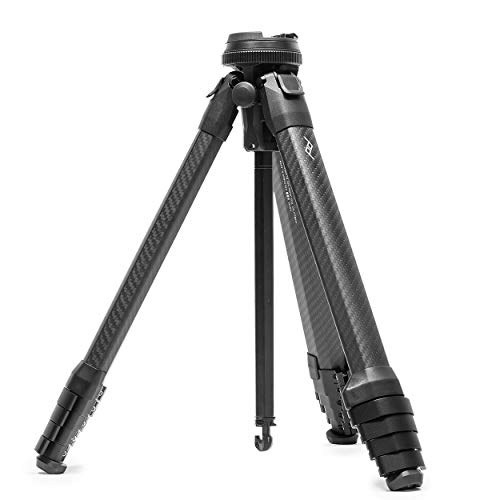
- 5-section carbon fiber legs; maximum height 60.1 in with the center column raised, 51.3 in with it down; minimum height 5.5 in; folds to 15.4 in; weight 2.81 lb; rated load 20 lb; integrated low-profile ball head; cam lever leg locks.
Peak Design rebuilt the travel tripod around packed size. The legs nest against a shaped center column, so the folded package is barely wider than a water bottle, yet it reaches a useful working height. Setup is fast: cam levers flip open with one hand, and the low-profile ball head uses a single adjustment ring rather than a cluster of knobs.
This suits travelers and mirrorless users who fly with their kit and want a tripod that disappears into a bag but behaves like a proper support, handling standard zooms and moderate telephotos calmly.
The honest limitation is the head. The single-ring design is clever but slower to fine-tune than a conventional ball head, the clamp works best with Peak Design plates, and the legs are not the right base for a heavy 150-600mm zoom at full extension.
INNOREL RT90C Carbon Fiber Bowl Tripod

Specs
- 4-section carbon fiber legs with a 40 mm top tube; maximum height 63 in; folds to 23.2 in; weight about 6.5 lb; rated load 88 lb; flat CNC mounting plate and 75 mm bowl adapter; no center column; spike feet and carry bag included; head sold separately.
The RT90C is built in the systematic style: a wide, flat top casting with no center column that accepts the included 75 mm bowl for a video fluid head, or a large ball head or gimbal on its flat plate. Thick 40 mm top tubes make it the stiffest platform in this guide, and the legs spread to three angles for slopes, rocks and shorelines.
It suits wildlife photographers running long telephotos on gimbals, birders with spotting scopes, and video shooters who level the head in a bowl rather than by adjusting legs. If your camera package is heavy and your exposures long, this class of tripod removes support from your list of worries.
Be realistic about the trade-offs: at roughly 6.5 lb before a head, this is a tripod you carry to a spot rather than all day; the headline load figure is a static laboratory number; and the fit and finish sits a step below the premium European systematic legs it imitates.
Neewer N55C Carbon Fiber Tripod

Specs
- 4-section carbon fiber legs; maximum height 66 in; weight 3.5 lb; rated load 26.5 lb; ball head with Arca-type plate included; converts to a monopod; carry bag included.
The N55C is the long-running budget answer to a fair question: how much carbon tripod can you get without paying brand-name money? You get genuine carbon fiber legs, a working height tall enough for most adults, a basic ball head in the box, and a monopod conversion for crowded viewpoints where tripods are banned.
It suits beginners moving up from a flimsy kit tripod, occasional travelers, and anyone who wants carbon legs for weekend landscape work without committing to a premium system. With a mirrorless camera or entry-level DSLR and a standard zoom, it is noticeably steadier than bundled aluminum tripods.
The limitations are real, though. Treat the 26.5 lb rating as optimistic and keep working loads to a camera and a moderate lens; the thinnest leg sections flex when the tripod is fully extended, especially in wind; and the included head is functional rather than refined, with clunkier movement than a standalone head. Budget carbon varies more in quality control, so check the locks and joints on arrival.
Manfrotto MT055CXPRO4 Carbon Fiber Tripod

Specs
- 4-section carbon fiber legs; maximum height 66.9 in, or 55.1 in with the center column down; minimum height 3.5 in; folded length 24 in; weight 4.6 lb; safety payload 19.8 lb; Quick Power flip locks; center column converts to horizontal; Easy Link socket; head sold separately.
The 055 carbon is the tall photographer’s tripod. At full extension it lets tall shooters work without stooping and puts the camera above most crowds. Its signature trick is the Q90 column: pull the center column up and it flips horizontal, giving you a boom for overhead product shots, flat lays and macro work without tools or disassembly.
It suits studio and product photographers, tall landscape shooters, and macro work over a subject. The flip locks are quick, glove-friendly and easy to service, and the Easy Link socket accepts arms for lights, monitors or microphones.
The honest limitations: it is legs only, so budget for a head; the 19.8 lb safety payload looks low next to rivals’ inflated claims, and while the tripod is genuinely strong, very heavy rigs belong on systematic legs; a horizontal column is a lever, so a weighty camera hanging off it flexes and creeps if you rush the setup; and at 24 in folded it is a checked-bag tripod, not a carry-on one.
Ulanzi Zero Y Carbon Fiber Travel Tripod

Specs
- 5-section carbon fiber legs; weight 2.4 lb; maximum height 61.7 in with the center column raised, 52.2 in with it down; minimum height 6 in; folds to 16.7 in; flip leg locks; integrated ball head with an Arca-Swiss clamp; ball head rated to 11 lb maximum.
Designed with COMAN, the Zero Y folds its legs tight against a shaped center column and weighs just 2.4 lb, light enough to strap to a daypack and forget. It still stands over five feet tall with the column raised, drops low for macro work, and its standard Arca-Swiss clamp fits existing plates and L-brackets without adapters.
It suits hikers, backpackers and travel photographers running mirrorless kits, where every hundred grams competes with water, food and layers. For a camera with a standard zoom or fast prime, it is a capable support you will actually bring along.
Now the limitation, the clearest lesson in this guide about load ratings. The headline figure is a static load number for the column and hook; the integrated ball head is rated to 11 lb at most, and in practice it is happiest with about half that once a lens overhangs the clamp. The head cannot be removed or upgraded, and the slim final sections flex in gusty wind at full height. Match it to light kits and it shines; hang a pro body and a long zoom on it and you have bought the wrong tripod.
How to choose
Sections, folded length and stiffness. Every extra leg section shortens the folded package but adds a joint, and joints are where flex lives. Three- and four-section legs are the stiffness-first choice for long lenses and studio work; five-section legs fold small enough for carry-on bags but their thinnest tubes need respect, especially in wind.
Twist locks versus flip locks. Twist locks, as on the INNOREL, seal better against grit, keep the leg profile clean and work silently, but you cannot see at a glance whether one is loose. Flip locks, as on the Manfrotto and Ulanzi, are faster, glove-friendly and visually confirm their state, but they can snag, need occasional tension adjustment and add bulk. Neither is better in the abstract; pick based on whether you shoot more in sand and surf, or in cold and haste.
Load ratings, read skeptically. No shared industry standard governs tripod payload figures, and brands variously quote the legs, the head, or a static load that says little about holding a lens steady at an angle. Treat every number as a rough class marker, not a promise. A better guide is top tube diameter and design: thick tubes, few sections and no center column mean real stiffness. Keep your camera and longest lens comfortably under the rating, and remember the head is usually the weaker link, as the Zero Y shows.
The center column trade-off. A center column buys height and, on models like the Manfrotto, horizontal reach for overhead work. It also raises the camera on the least stable part of the tripod, a lever arm in wind. Column-free systematic legs like the INNOREL give up that convenience for maximum rigidity. Landscape and wildlife shooters should favor column-free legs or keep the column down; if you shoot products and flat lays, a convertible column earns its place.
Why carbon settles faster than aluminum. Carbon fiber composite absorbs vibration energy internally instead of ringing like a metal tube, so after a tap, a head adjustment or a shutter release, a carbon tripod returns to stillness noticeably sooner. It is also lighter for the same stiffness and kinder to bare hands in freezing weather. The material is not magic, though: a skinny carbon leg still flexes more than a fat aluminum one, so tube diameter matters as much as material.
Who should skip
Skip carbon fiber entirely if your tripod never leaves a home studio; a heavy aluminum stand is cheaper and just as steady indoors. Skip the travel models here if your main lens is a long telephoto; no five-section travel tripod holds one properly in wind. Skip legs-only models like the Manfrotto and INNOREL if you do not already own a head, because the total cost climbs quickly. And skip the ultralight class if your camera package includes a battery grip and fast zooms; the small saving in carried weight is not worth soft frames.
Frequently Asked Questions
Is carbon fiber actually more stable than aluminum, or just lighter?
Both, with a caveat. Carbon’s main stability advantage is damping: it absorbs vibration faster, so images settle sooner after you touch the camera. For equal tube diameters it is also stiffer for its weight. But geometry beats material, so a thick aluminum tripod will outperform a skinny carbon one. Buy carbon for the weight saving and damping, and still choose generous tubes.
How many leg sections should I choose?
Choose the fewest sections that fold short enough for how you transport the tripod. Four sections suit most photographers, balancing stiffness with a manageable folded length. Five sections make sense when the tripod must fit a carry-on or small backpack. Three sections are the stiffness-first option for studio and long-lens work.
Can a carbon fiber tripod hold a long telephoto lens?
Yes, if it is the right class of tripod. A systematic design with thick tubes, no center column and a proper gimbal head, like the RT90C in this guide, handles large telephotos well. Travel tripods are the wrong tool: their ratings may technically cover the weight, but thin sections and small heads let the lens nod and vibrate, costing sharpness on the shots that matter most.
How should I clean carbon legs after beach or desert use?
Extend the legs, rinse them with fresh water to remove sand and salt, and dry them fully before collapsing. Grit in a lock scores tubes and makes locks gritty, so twist-lock legs benefit from an occasional strip-down and wipe per the maker’s instructions. Avoid lubricants on the tubes unless the manufacturer specifies one, and store the tripod dry.
Final verdict
Match the class to the job and carbon fiber rewards you every time you carry it. The Peak Design Travel Tripod is the best all-round answer for photographers who move. The INNOREL RT90C is the value route into genuinely systematic legs for long lenses and video. The Neewer N55C proves carbon need not be expensive, as long as you respect its limits. The Manfrotto MT055CXPRO4 serves tall shooters and studio work, and the Ulanzi Zero Y is the one to strap to a pack when grams decide what comes along. Choose by your longest lens and your longest walk, in that order.
Product and ASIN Reference
| Product | ASIN |
|---|---|
| Peak Design Travel Tripod (Carbon Fiber) | B085BQTQMN |
| INNOREL RT90C Carbon Fiber Bowl Tripod | B07H8V8WWM |
| Neewer N55C Carbon Fiber Tripod | B00NSEKEMO |
| Manfrotto MT055CXPRO4 Carbon Fiber Tripod | B00IQ7PUKY |
| Ulanzi Zero Y Carbon Fiber Travel Tripod | B0B8SNSDHM |