Key takeaways
- Compare the best camera audio recorders for video, from portable handheld and XLR models to compact stereo, camera-mounted and budget field recorders.
A camera microphone has to work from wherever the camera happens to be, which is rarely the best place to hear a voice. A standalone recorder solves that problem in two ways. It can sit close to the person speaking while the camera stays back for the framing, and it records to its own memory card, so the sound does not depend on a camera input, a cable staying seated, or the camera keeping its audio settings through a long shoot day.
This guide covers five recorders that suit video work in different ways: a simple handheld model for dialogue and ambience, a four-track recorder with XLR inputs, a compact multi-microphone stereo recorder, a camera-mounted unit built for mirrorless and DSLR rigs, and a simpler budget field recorder. Each pick is described from its listing details, including inputs, recording formats and battery type.
As an Amazon Associate, we earn from qualifying purchases.
Quick answer
The Zoom H1essential is the top pick for most video creators. Its built-in X/Y stereo microphones, 32-bit float recording and USB microphone mode capture clear dialogue and ambience to a memory card, while its small handheld body is simple to place close to a speaker or mount near the camera.
Zoom H1essential Stereo Handy Recorder

The H1essential is the straightforward choice for creators who want better sound without building a larger rig. Its built-in X/Y stereo microphones record the scene in front of the recorder, which suits interviews, talking pieces to camera, event coverage and room ambience. Placed on a small stand near a speaker, or held just out of frame, it hears far more voice and far less room echo than a camera microphone across the room.
The listing highlights 32-bit float recording. That format gives the file a very wide range between quiet and loud sounds, so a sudden laugh or raised voice is less likely to ruin a take, and quiet passages can be lifted in editing without bringing up as much noise. The recorder also works as a USB microphone, which makes it useful at a desk for voiceovers.
For video use, the method is simple. Record on the H1essential, record the camera sound as a guide track, then align the two in your editor using a clap at the head of the take. Its small body also fits in a jacket pocket for travel days when a full audio kit would stay at home.
Specs
- Microphones: Built-in X/Y stereo microphones
- Recording: 32-bit float WAV recording to memory card
- Interface: USB microphone mode
- Power: 2 AAA batteries, per the listing details
- Intended users, per the listing: Musicians, podcasters and filmmakers
Zoom H4essential 4-Track Handy Recorder

The H4essential is the pick for creators who plug in their own microphones. Alongside its built-in stereo microphones, it has two XLR/TRS combo inputs, so a shotgun microphone, a handheld interview microphone or a pair of wired lavalier microphones with suitable adapters can each record to separate tracks. Separate tracks matter in editing, because each voice can be balanced on its own instead of being locked into a single mixed file.
The listing states four tracks of 32-bit float recording, and that the combo inputs support phantom power and professional line-level input. Phantom power is what many condenser microphones need to work at all, so its presence is the dividing line between a recorder that accepts a wide range of video microphones and one that only accepts a few. The built-in microphones handle up to 130 dB SPL according to the listing, which covers loud events and close, forceful speech.
It also works as a USB audio interface, listed as a 4-in and 2-out connection, so the same unit can feed a computer for streaming or voiceover work. For a two-person interview filmed on one camera, this is the most complete recorder in this guide: one microphone per person, and every source kept apart for the edit.
Specs
- Microphones: Built-in stereo microphones
- Inputs: 2 XLR/TRS combo inputs with phantom power and line-level support
- Recording: 4 tracks of 32-bit float recording, WAV format
- Interface: USB audio interface, 4-in and 2-out
- Display: 2-inch screen, per the listing
- Power: 2 AA batteries, per the listing
- Headphone connection: 3.5 mm jack
Zoom H2essential Multi-Mic Handy Recorder

The H2essential takes a different approach to stereo. Instead of one fixed microphone pair, its listing describes three built-in microphones: two cardioid microphones facing front and rear, plus a bi-directional microphone that hears from the sides. That arrangement lets the recorder capture different pickup patterns, including mono, stereo and surround style recording, which suits creators who record both dialogue and the atmosphere of a place in the same session.
For video, that flexibility is useful on travel and documentary days. Point the recorder at a speaker for a focused voice recording, then turn it toward a market or a shoreline to gather the ambience that will sit under B-roll. The listing states 32-bit float recording, so those changing levels are captured with a wide range.
The listing also lists a USB Type-C connection, a 3.5 mm headphone jack and support for very large memory cards. There are no XLR inputs here, so this is a recorder for people who prefer built-in microphones and simple placement over a wired microphone kit. Choose it when the sound of the location itself is a large part of the story.
Specs
- Microphones: 3 built-in microphones, with front, rear and side pickup
- Recording patterns: Mono, stereo and surround options, per the listing
- Recording: 32-bit float, WAV format
- Interface: USB Type-C
- Headphone connection: 3.5 mm jack
- Power: 2 AA batteries, per the listing
- Battery life: 11 hours, per the listing
Tascam DR-70D 4-Channel Portable Audio Recorder
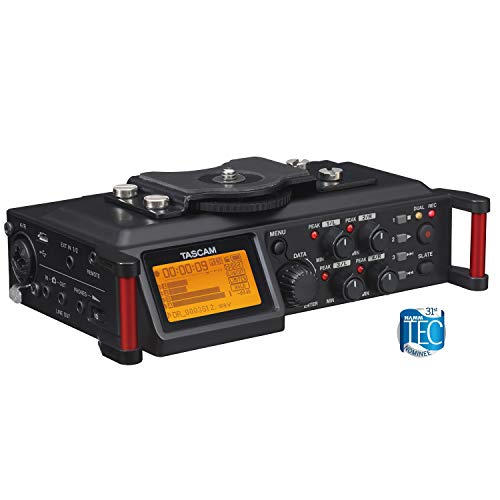
The DR-70D is built specifically for camera work. Its flat body is designed to sit between a camera and a tripod, or to mount above or below the camera, and the listing describes camera input and output connections that let the recorder and camera pass audio between them. The camera can therefore record a guide track fed from the recorder, which makes aligning the recorder files in the edit much easier.
Inside, it is a four-channel recorder with four XLR/TRS combo inputs and two built-in microphones. Four inputs cover a demanding small-crew setup: a boom microphone, two lavalier receivers and a spare channel, each on its own track. The listing also names a limiter and a high-pass filter. A limiter guards against sudden loud peaks, and a high-pass filter reduces low rumble from wind, traffic and handling.
The listing states recording up to 96 kHz and 24-bit in WAV and BWF formats. This is the largest and most rig-focused recorder in this guide, and it suits mirrorless and DSLR shooters who already use XLR microphones and want the recorder to live on the camera rather than in a pocket.
Specs
- Inputs: 4 XLR/TRS combo inputs
- Microphones: 2 built-in microphones
- Recording: 4-channel recording, WAV and BWF formats, up to 96 kHz and 24-bit
- Camera connections: Camera input and camera output jacks, per the listing
- Mounting: Tripod threads on the base, camera attachment and shoe mount on top
- Processing: Limiter and high-pass filter, per the listing
Tascam DR-05XP 2-Channel Portable Handheld Recorder

The DR-05XP is the simpler, lower-cost route into separate audio recording. It is a two-channel handheld recorder with built-in omnidirectional condenser microphones, and its listing states that those microphones handle sound levels up to 125 dB SPL. Omnidirectional microphones hear sound from all around the recorder, which suits round-table conversations, room tone and general location ambience, and is forgiving about exactly where the recorder points.
Its recording specification is stronger than its simple shape suggests. The listing describes WAV recording at 44.1, 48 and 96 kHz in 16-bit, 24-bit and 32-bit float, plus MP3 recording, to memory cards up to 512 GB. A 3.5 mm stereo input accepts an external microphone with plug-in power, so a wired lavalier microphone can be added later without replacing the recorder.
It also functions as a 2-in and 2-out USB-C audio interface for recording to a computer. The listing states up to 17.5 hours of operation from two AA batteries. For a creator buying a first recorder to pair with a camera, that combination of long battery life, card recording and an external microphone input covers the essentials without the size or complexity of the multi-input models above.
Specs
- Microphones: Built-in omnidirectional condenser microphones, up to 125 dB SPL
- Inputs: 3.5 mm stereo microphone and line input with plug-in power
- Recording: WAV at 44.1, 48 and 96 kHz in 16-bit, 24-bit and 32-bit float, plus MP3
- Media: microSD, microSDHC and microSDXC cards up to 512 GB
- Interface: USB Type-C, 2-in and 2-out audio interface
- Power: 2 AA batteries, up to 17.5 hours per the listing
How to choose
Begin with the microphone question. If the built-in microphones will do most of the work, a handheld stereo recorder is enough, and placement becomes your main skill: close to the voice, away from hard walls, and shielded from wind. If you already own, or plan to buy, XLR microphones, choose a recorder with XLR/TRS combo inputs and phantom power, because those two features decide which microphones you can use at all.
Next, count your sources. One speaker needs one good track. Two speakers are far easier to edit when each has a separate track, and a camera-mounted multi-channel recorder earns its size when a boom and lavaliers run at the same time.
Then think about how the files will meet the picture. A camera guide track, a clap at the head of each take, and consistent file naming make syncing routine. Battery type matters on location too: recorders that run on AA or AAA cells are easy to feed during a long day, while USB power suits desk work. Finally, check the format. WAV files at 48 kHz suit video editing, and 32-bit float gives extra protection against loud peaks when you cannot watch levels closely.
Who should skip
Skip a standalone recorder if your videos are short, filmed close to the camera, and made in quiet rooms. In that situation a camera-mounted microphone may be all the upgrade you need, and a separate recorder only adds a syncing step to every clip.
Skip the multi-input XLR models if you do not own XLR microphones and have no plan to buy them. The extra inputs and size bring nothing to a workflow built on built-in microphones. Skip the camera-mounted DR-70D if you shoot handheld and travel light, since a rig recorder changes how the camera handles. And skip every recorder here if you are not willing to sync audio in editing at all, because separate recording always adds that step.
Frequently Asked Questions
Why not just use the camera microphone?
A camera microphone records from the camera position, so it hears the room, the camera handling and any noise near the camera along with the voice. A recorder placed close to the speaker captures a clearer voice with less room sound, and the camera track can still be kept as a guide for syncing.
What does 32-bit float recording do for video sound?
Listings for several recorders in this guide state 32-bit float recording. That format captures a very wide range between quiet and loud sounds, so sudden peaks are less likely to clip and quiet dialogue can be raised in editing. It does not replace good microphone placement, but it makes levels more forgiving.
How do I sync recorder audio with video?
Record the camera sound as well, make a sharp sound such as a clap that both the camera and the recorder can hear at the beginning of the take, then line up that peak in your editing software. Many editors can also align clips automatically using the camera guide track.
Which recorder suits a two-person interview?
Choose a model with separate inputs and tracks, such as the H4essential with its two XLR/TRS inputs or the DR-70D with four. One microphone per person, each on its own track, lets you balance the two voices in editing instead of accepting whatever balance was captured in the room.
Final verdict
For most creators, the Zoom H1essential is the right first recorder: small, simple, and built around clear stereo capture with 32-bit float files. Move to the H4essential when XLR microphones enter your kit, and to the Tascam DR-70D when the recorder should live on the camera and run several microphones at once. The H2essential suits location and ambience work, while the Tascam DR-05XP covers the essentials for less, with long battery life and an external microphone input.
Product and ASIN Reference
| Product | ASIN |
|---|---|
| Zoom H1essential Stereo Handy Recorder | B0CSL4PXDV |
| Zoom H4essential 4-Track Handy Recorder | B0CSLDLKZJ |
| Zoom H2essential Multi-Mic Handy Recorder | B0DJPQXJ46 |
| Tascam DR-70D 4-Channel Portable Audio Recorder | B00OY6718K |
| Tascam DR-05XP 2-Channel Portable Handheld Recorder | B0DTJVLCFT |