Key takeaways
- The best zoom lenses for everyday and travel photography: five versatile Canon RF and Sony E-mount picks covering wide, standard, and telephoto.
A good zoom lens is the most useful piece of glass most photographers own. One lens can cover a street scene at 24mm, a portrait at 85mm, and a distant detail at 200mm or beyond, which means fewer lens changes, less dust on the sensor, and a lighter bag when you are walking all day. For everyday shooting and travel, that flexibility matters more than owning a shelf of specialised primes.
The best zoom lenses balance range, aperture, size, and autofocus speed. A constant aperture keeps exposure predictable as you zoom, a wide maximum aperture helps in dim light, and a compact, weather-sealed body survives rain and dust. The five lenses below cover the most useful zoom classes for Canon RF and Sony E-mount cameras, from a wide-angle zoom to a superzoom that replaces an entire kit bag.
As an Amazon Associate, we earn from qualifying purchases.
Quick answer
The Canon RF 24-105mm f/4L IS USM is the best all-round choice, with a useful range, a constant f/4 aperture, and stabilisation in a weather-sealed body. Sony shooters should look at the Tamron 28-200mm for the most range in the smallest package, while the Tamron 17-28mm is the pick for wide landscapes and interiors.
Canon RF 24-105mm f/4L IS USM

Specs
- Focal length: 24-105mm; Maximum aperture: f/4; Mount: Canon RF; Weight: 695g; Filter size: 77mm; Image stabilisation: Yes; Minimum focus distance: 0.45m.
The Canon RF 24-105mm f/4L IS USM is the classic do-everything zoom for Canon mirrorless cameras, and it earns the top spot because its range covers almost every scene a traveller meets. At 24mm it is wide enough for architecture, interiors, and landscapes, and at 105mm it reaches far enough for portraits, details, and moderate wildlife. The constant f/4 aperture means exposure does not change as you zoom, which keeps shooting simple in changing light.
The L-series glass delivers sharp results across the frame, with contrast and colour that hold up in large prints. The Nano USM motor is fast and quiet, and the image stabilisation helps when shooting handheld in dim churches, museums, and evening streets. Weather sealing adds confidence in rain and dust on a lens that stays on the camera all day.
At 695g it balances well on full-frame Canon bodies, and its 77mm filter thread takes a polariser or neutral-density filter for landscapes. If you own a Canon RF camera and want one lens that handles everyday life and travel without compromise, this is the natural first choice.
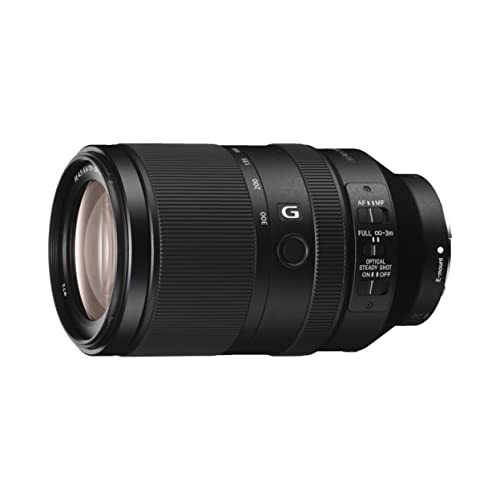
Sony FE 70-300mm f/4.5-5.6 G OSS
Specs
- Focal length: 70-300mm; Maximum aperture: f/4.5-5.6; Mount: Sony E; Weight: 856g; Filter size: 72mm; Image stabilisation: Yes, Optical SteadyShot; Minimum focus distance: 0.9m.
The Sony FE 70-300mm f/4.5-5.6 G OSS is the telephoto zoom in this roundup, and it is the lens to choose when your subjects are far away. At 300mm it brings distant wildlife, athletes, and architectural details close enough to fill the frame, while the 70mm end is short enough for portraits and tighter street scenes. The variable aperture keeps it reasonably compact for its reach, and the built-in Optical SteadyShot steadies the view at the long end.
Sony’s Nano AR coating reduces flare and ghosting when shooting toward the sun. It focuses down to 0.9m across the zoom range, so it can also handle flowers and small details, and a focus-hold button and a focus-range limiter on the barrel give extra control when tracking moving subjects.
The trade-off for all that reach is size and weight: at 856g this is the heaviest lens here, and it needs a reasonably sized camera bag. It also has a narrower maximum aperture than the f/2.8 lenses in this roundup, so it works best in good light or on a camera that performs well at higher sensitivities. For Sony shooters who want real telephoto reach without stepping up to a much larger professional telephoto zoom, this lens is the sensible middle ground.
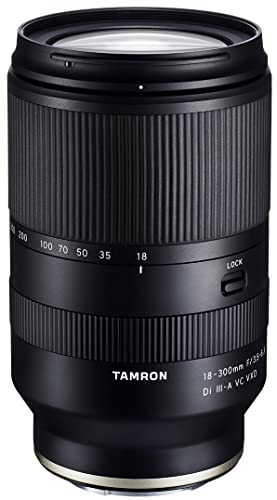
Tamron 18-300mm f/3.5-6.3 Di III-A VC VXD
Specs
- Focal length: 18-300mm, about 27-450mm equivalent on APS-C; Maximum aperture: f/3.5-6.3; Mount: Sony E, APS-C; Weight: 620g; Filter size: 67mm; Image stabilisation: Yes, Vibration Compensation; Zoom ratio: 16.6x.
The Tamron 18-300mm f/3.5-6.3 Di III-A VC VXD is the superzoom of this roundup, and it is the most versatile single lens you can put on an APS-C Sony camera. Its 16.6x zoom ratio runs from a genuinely wide 18mm to a 300mm telephoto, which translates to roughly 27-450mm in full-frame terms. That means one lens can shoot a landscape at breakfast, a portrait at lunch, and a distant bird at dinner, with no lens changes at all.
The VXD motor focuses quickly and quietly, and Vibration Compensation steadies the view at the long end. Despite the huge range, it weighs only 620g and uses 67mm filters, so it fits a small day bag. It also focuses to 0.15m at the wide end, which suits flowers, food, and detail shots.
No superzoom is optically perfect, and this lens asks for a few compromises in exchange for its range. The variable aperture narrows to f/6.3 at the long end, so low-light telephoto work needs higher sensitivities, and the lens is designed for APS-C sensors rather than full-frame bodies. Within those limits, it is the best one-lens travel solution here for Sony APS-C shooters who pack light.
Tamron 17-28mm f/2.8 Di III RXD

Specs
- Focal length: 17-28mm; Maximum aperture: f/2.8; Mount: Sony E, full-frame; Weight: 420g; Filter size: 67mm; Image stabilisation: No; Minimum focus distance: 0.19m.
The Tamron 17-28mm f/2.8 Di III RXD is the wide-angle zoom in this roundup, and it is the lightest lens here at just 420g. Its constant f/2.8 aperture is fast for a wide zoom, which makes it a strong choice for interiors, night skies, and dimly lit streets, where a slower wide zoom would struggle. The 17mm end is wide enough for sweeping landscapes, tight architecture, and dramatic foregrounds, while 28mm is a natural wide-normal focal length for everyday scenes.
The RXD motor focuses quickly and almost silently, and the lens focuses to 0.19m at the wide end, for near-macro detail with a wide perspective. At 99mm long it fits a jacket pocket, and its 67mm filter thread matches the other Tamron lenses here, so one set of filters covers several lenses.
There is no image stabilisation in this lens, so handheld shooting in very low light relies on the camera body or a higher sensitivity setting. Its zoom range is also short, which is the nature of a wide zoom: it does not reach standard or telephoto focal lengths, so it works best as a second lens alongside a standard zoom rather than as your only lens. For Sony shooters who love wide perspectives, it is one of the best value wide zooms available.
Tamron 28-200mm f/2.8-5.6 Di III RXD

Specs
- Focal length: 28-200mm; Maximum aperture: f/2.8-5.6; Mount: Sony E, full-frame; Weight: 575g; Filter size: 67mm; Image stabilisation: No; Minimum focus distance: 0.19m at the wide end; Length: 117mm.
The Tamron 28-200mm f/2.8-5.6 Di III RXD is the compact travel zoom in this roundup, and it is the most remarkable piece of engineering here. It packs a 28-200mm range into a lens only 117mm long and weighing 575g, and it opens to f/2.8 at the wide end, the fastest aperture of any all-in-one zoom of its kind. For a traveller who wants one lens on a full-frame Sony camera, this is the closest thing to having it all.
It focuses to 0.19m at 28mm, giving a useful close-up ability for food, flowers, and details. The range covers wide street scenes, portraits at 85mm, and moderate telephoto at 200mm. It fits a small bag with a camera body and a spare battery, and it is light enough to carry all day.
The compromises are modest: the aperture narrows to f/5.6 at 200mm, and there is no built-in stabilisation, so low-light telephoto work depends on the camera body. The 28mm wide end is also not as wide as a dedicated wide zoom, so very tight interiors and vast landscapes may need something wider. Even so, for a one-lens travel kit on Sony full-frame, this lens is hard to beat, and it is the pick for photographers who would rather shoot than swap lenses.
How to choose
Start with your camera mount, because a lens is only useful if it fits your body. Canon RF lenses fit Canon RF cameras and Sony E-mount lenses fit Sony Alpha cameras, and there is no practical adapter that makes a native lens from one system work well on the other. Check the mount in the specifications before anything else, and confirm whether a lens is designed for full-frame or APS-C sensors.
Next, think about the focal lengths you actually use. A standard zoom around 24-105mm covers most everyday scenes, a telephoto zoom around 70-300mm suits wildlife and sports, and a superzoom covers everything in one lens at the cost of a narrower aperture. If you shoot mostly in low light, a constant f/2.8 aperture is worth the extra size and weight; if you travel light, a compact all-in-one zoom matters more.
Weight and size deserve real attention, because the best lens is the one you carry. A 420g wide zoom that lives in your bag beats a heavier lens left at home. Finally, consider autofocus and stabilisation: a quiet, fast motor helps with video and moving subjects, and stabilisation matters most at telephoto focal lengths.
Who should skip
Skip a general-purpose zoom if you already know you shoot one focal length most of the time. A portrait photographer who lives at 85mm, a landscape shooter who lives at 16mm, or a sports photographer who needs a long, fast telephoto will get better results from a specialised prime or a professional telephoto zoom than from any lens in this roundup.
Also skip the superzoom and all-in-one classes if maximum image quality is your priority: a superzoom trades a little sharpness and a narrower aperture for its huge range. If your camera uses a different mount, such as Nikon Z, Fujifilm X, or Micro Four Thirds, none of these lenses will fit your body, so look for the equivalent zoom in your own system.
Frequently Asked Questions
What zoom range is best for travel photography?
A range starting around 24mm and reaching at least 105mm covers most travel scenes, from architecture and landscapes to portraits and details. A superzoom or all-in-one lens that reaches 200mm or 300mm adds wildlife and distant subjects without a lens change.
Can I use a Sony E-mount lens on a Canon RF camera?
No, not in any practical sense. Sony E-mount and Canon RF lenses use different mounts, different flange distances, and different electronic communication, so they are not interchangeable. Choose lenses made for your camera system, and check the mount in the specifications before buying.
Is a constant aperture zoom worth the extra size and weight?
For many photographers, yes. A constant aperture such as f/2.8 or f/4 keeps exposure steady as you zoom, which simplifies shooting in manual mode and keeps video exposure consistent. It also gathers more light at the long end than a variable-aperture lens. If you shoot mostly in daylight or value a light bag, a variable-aperture zoom is lighter and still capable.
Do I need image stabilisation in a zoom lens?
It helps most at telephoto focal lengths, where small movements are magnified, and in low light, where slower shutter speeds are needed. Wide-angle lenses benefit less, since shake is less visible at short focal lengths. Many modern bodies have in-body stabilisation, but a lens with its own stabilisation still helps for video or on a body without it.
Final verdict
The Canon RF 24-105mm f/4L IS USM is the best zoom lens for most everyday and travel photographers, thanks to its useful range, constant aperture, and weather-sealed build. Sony shooters get the most versatility per gram from the Tamron 28-200mm f/2.8-5.6 Di III RXD, which covers wide to telephoto in a genuinely compact package, while the Tamron 18-300mm f/3.5-6.3 Di III-A VC VXD is the one-lens answer for APS-C cameras. Add the Sony FE 70-300mm f/4.5-5.6 G OSS when reach matters, and the Tamron 17-28mm f/2.8 Di III RXD when wide perspectives are your priority.
Product and ASIN Reference
| Product | ASIN |
|---|---|
| Canon RF 24-105mm f/4L IS USM | B07H489XDQ |
| Sony FE 70-300mm f/4.5-5.6 G OSS | B01DLMD7DK |
| Tamron 18-300mm f/3.5-6.3 Di III-A VC VXD | B09DP27V2S |
| Tamron 17-28mm f/2.8 Di III RXD | B07TP4YM1F |
| Tamron 28-200mm f/2.8-5.6 Di III RXD | B08B34HWKV |