Key takeaways
- Compare the best wide angle lenses for landscapes and travel trips, from full-frame and APS-C zooms to a moderate prime and a budget wide option.
A wide angle lens changes how a place feels in a photograph. Foregrounds grow larger, skies open up, and a tight viewpoint can hold far more of the scene than a standard lens allows. For landscapes, a rock or a stream close to the camera can lead the eye toward distant peaks. For travel, whole squares, markets, and hotel rooms can fit into a single frame.
The five lenses below cover the main ways photographers buy wide glass today. There is a full-frame wide zoom for Sony E mount, an APS-C wide zoom for smaller Sony bodies, an ultra-wide zoom for Canon RF mount, a moderate wide prime for Sony E mount, and a budget wide prime for Canon RF mount. Every section names its mount, because a lens only helps if it fits the camera you already own. None of these picks is a fast prime built for night-sky work; this guide is about daylight landscapes, city scenes, interiors, and travel.
As an Amazon Associate, we earn from qualifying purchases.
Quick answer
The Sony FE 16-35mm f/2.8 GM II is the top pick for most full-frame landscape and travel photographers. Its 16-35mm range covers sweeping vistas and tighter street scenes in one lens, the constant f/2.8 aperture handles dim interiors, and the Sony E mount body stays compact enough to carry all day on a trip.
Sony FE 16-35mm f/2.8 GM II
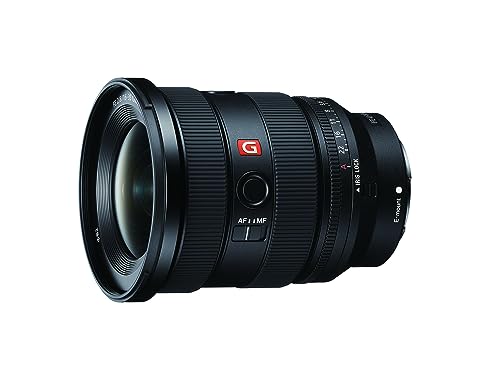
The Sony FE 16-35mm f/2.8 GM II takes the first spot because it covers the focal lengths landscape and travel photographers use most, without asking them to swap lenses at every viewpoint. At 16mm it is wide enough for grand valleys, coastlines, and large buildings. At 35mm it settles into a natural view for streets, people in a setting, and detail scenes. That single range can carry an entire day of sightseeing.
Specs
- Mount: Sony E mount
- Format: Full-frame
- Focal length: 16-35mm zoom
- Maximum aperture: f/2.8 constant
- Filter diameter: 82mm
- Model: SEL1635GM2
A constant f/2.8 aperture matters more for travel than for tripod landscapes. Inside museums, churches, stations, and restaurants, the wider opening gathers more light and keeps shutter speeds workable. The lens also accepts front filters through its 82mm thread, a practical point for landscape work: a circular polarizer can be fitted and removed in seconds.
Build and handling suit travel use. The G Master line is Sony’s professional tier, and this second version was made smaller and lighter than the lens it replaced, which matters when a camera bag has to stay within an airline carry-on limit. Autofocus is fast and quiet, so the same lens can record video clips without drawing attention to itself.
Choose this lens if you shoot a full-frame Sony body and want one wide zoom that can stay on the camera for most of a trip. It is the most complete package here, and the one the other picks should be measured against.
Sony E PZ 10-20mm f/4 G

APS-C cameras need their own wide zooms, because a full-frame 16mm lens behaves like a much longer lens on a cropped sensor. The Sony E PZ 10-20mm f/4 G solves that for Sony’s smaller bodies. Its 10-20mm range gives the same field of view as a 15-30mm lens on full-frame, so landscapes regain their sweep and small rooms stop feeling cramped.
Specs
- Mount: Sony E mount
- Format: APS-C
- Focal length: 10-20mm zoom, 15-30mm equivalent view
- Maximum aperture: f/4 constant
- Filter diameter: 62mm
- Weight: 178 g as listed
- Minimum focus distance: 0.20 m with autofocus as listed
Size is the headline here. At 178 grams as listed, this is a lens that disappears into a day bag, which suits the way APS-C cameras are used on trips: carried for hours, pulled out often, and rarely set on a tripod. The power zoom design changes focal length with a smooth motor drive rather than a turning ring alone, a layout aimed at video shooters who want slow, even zooms while recording. The internal design also means the lens does not grow longer as it zooms.
The f/4 maximum aperture is the honest trade-off. In daylight and in bright interiors it is plenty, and for tripod landscapes stopped down it is no limitation at all. In a dim hall without support, a stabilized body or a higher sensitivity setting will do more of the work. For APS-C Sony owners who travel light, that trade is usually worth it.
Canon RF 10-20mm f/4 L IS STM

Some scenes need more width than a 16mm lens can give. The Canon RF 10-20mm f/4 L IS STM goes to 10mm on full-frame, a field of view so wide that a whole cathedral interior, a canyon rim, or a tight waterfall gorge can fit without stitching frames together. It is the ultra-wide option in this guide, built for Canon’s RF mount.
Specs
- Mount: Canon RF mount
- Format: Full-frame
- Focal length: 10-20mm zoom
- Maximum aperture: f/4 constant
- Image stabilization: Yes, IS in the lens name as listed
- Minimum focus distance: 0.25 m as listed
- Weight: About 570 g as listed
Working at 10mm takes care. Straight lines near the edges stretch, and a careless tilt makes buildings lean hard, so this lens rewards a level camera and deliberate framing. Used well, it creates foreground drama no other pick here can match: a single boulder close to the lens can dominate the lower frame while the background stays fully visible.
The built-in image stabilization helps handheld travel shooting, where tripods are often banned or impractical. Filters are the compromise at this width: the front element is too curved for ordinary screw-in filters, so filtration relies on rear gel filters, as listed for this model. Those who want the widest rectilinear view Canon offers for RF mount will accept it gladly.
Tamron 24mm f/2.8 Di III OSD M 1:2
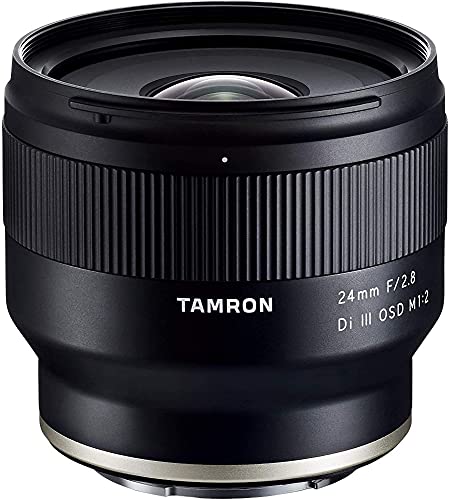
Not every wide photograph needs an extreme angle of view. The Tamron 24mm f/2.8 Di III OSD M 1:2 is a moderate wide prime for Sony E mount, and 24mm is a classic travel focal length: wide enough for landscapes and interiors, yet natural enough that people and buildings keep believable proportions. For photographers who find ultra-wide images hard to compose, this gentler view is often easier to use well.
Specs
- Mount: Sony E mount
- Format: Full-frame
- Focal length: 24mm prime
- Maximum aperture: f/2.8
- Filter diameter: 67mm
- Weight: 215 g as listed
- Maximum magnification: 1:2 as listed in the model name
The close-focus ability is the surprise strength. A 1:2 magnification at 24mm lets a flower or a piece of carved stone fill the foreground while the landscape behind it stays recognizable, a near-far style wide primes do better than any zoom. At 215 grams as listed, it also turns a full-frame body into a discreet walk-around kit.
As a fixed focal length lens, it asks the photographer to move rather than zoom. Travelers who own a standard zoom and want one small wide prime for landscapes, interiors, and close foreground work will find this the most natural fit.
Canon RF 16mm f/2.8 STM

The Canon RF 16mm f/2.8 STM is the budget wide option, and it earns its place by giving Canon RF owners a true ultra-wide view in a lens small enough to live in a jacket pocket. At 16mm on full-frame it covers broad landscapes, large interiors, and group scenes in tight spaces, and on an APS-C RF body it behaves like a moderate wide lens instead.
Specs
- Mount: Canon RF mount
- Format: Full-frame
- Focal length: 16mm prime
- Maximum aperture: f/2.8
- Filter diameter: 43mm
- Weight: 165 g as listed
That weight figure is the story. A 165-gram lens removes the usual excuse for leaving wide glass at the hotel, so it tends to be present for the unplanned moments that make travel albums: a sudden viewpoint, a narrow alley at dusk, a room that deserves a record. The f/2.8 aperture helps in dim interiors, and the STM motor keeps autofocus smooth and quiet for video.
The compromises are those of a simple prime. There is no zoom range, no image stabilization in the lens, and edge quality at wide apertures reflects its simple design. Stopped down for landscapes, it delivers the wide view most owners bought it for. As a first wide lens for an RF body, it is an easy recommendation.
How to choose
Begin with your mount and sensor size, because they decide everything else. Sony E mount appears three times here in two formats, and Canon RF mount twice, and none of these lenses can cross between systems. APS-C owners should look at the Sony 10-20mm first, since its range was designed for their sensor. Full-frame owners should decide how wide they truly need to go.
Next, weigh zoom range against size. A 16-35mm zoom covers the widest set of everyday subjects. A 10-20mm zoom serves drama and tight spaces but demands more care with distortion. A prime such as the 24mm or 16mm trades flexibility for a smaller bag and a simpler way of working.
Then think about light and support. Constant-aperture zooms and f/2.8 primes help in dim interiors and at the edges of the day. If most of your landscapes are made on a tripod in good light, aperture matters less than range, filter fit, and weight. Finally, check filter threads: front filters are simple on four lenses here, while the Canon 10-20mm relies on rear gel filters.
Who should skip
Skip this whole category if your photography centers on wildlife, sport, or portraits. Wide lenses make distant subjects small, and a telephoto or standard prime will serve those subjects far better. Skip the ultra-wide zooms if you dislike stretched edges and leaning verticals, because managing those effects is part of every frame at 10mm to 14mm.
Skip the primes if you know you will miss zooming, for example on a fast-moving tour with no time to change position. Skip the APS-C Sony zoom if you plan to move to a full-frame body soon, since its coverage is made for the smaller sensor. And skip every pick here if your main goal is photographing the night sky: these lenses were chosen for landscapes and travel in ordinary light, not for that specialized work.
Frequently Asked Questions
How wide is wide enough for landscapes?
For most full-frame landscapes, 16mm is wide enough to include a strong foreground and a full background in one frame. Wider lenses, down to 10mm, help in gorges, forests, and interiors, but they need more care with tilted verticals and stretched corners. On APS-C, a 10mm lens gives a similar view to 15mm on full-frame.
Is a zoom or a prime better for travel?
A wide zoom is better when the trip mixes landscapes, streets, and interiors in one day, because one lens covers every framing. A wide prime is better when weight matters most or when a photographer enjoys working at a single focal length. Many travelers carry a standard zoom and add one small wide prime such as the Canon RF 16mm.
Do wide angle lenses distort faces?
They can, when a face is placed near the edge of the frame or very close to the camera. The lens itself renders straight lines correctly in these rectilinear designs; the stretching comes from the wide field of view. Keeping people near the center, and stepping back, avoids the effect in group and travel portraits.
Can I use filters on wide angle lenses?
Yes, on most of them. Four of the five lenses here take ordinary screw-in front filters, with thread sizes from 43mm to 82mm as listed. The Canon RF 10-20mm is the exception, using rear gel filters because of its curved front element, so check the filter plan for the exact lens before a trip.
Final verdict
For a single wide lens that can handle a whole trip, the Sony FE 16-35mm f/2.8 GM II is the strongest choice for full-frame Sony owners. APS-C Sony shooters should take the light E PZ 10-20mm f/4 G, Canon RF owners who want maximum width should choose the RF 10-20mm f/4 L IS STM, and prime fans have two routes: the moderate Tamron 24mm f/2.8, or the budget Canon RF 16mm f/2.8 STM. Match the mount first, then the width.
Product and ASIN Reference
| Product | ASIN |
|---|---|
| Sony FE 16-35mm f/2.8 GM II | B0CGTW24VF |
| Sony E PZ 10-20mm f/4 G | B0B2X2Z31L |
| Canon RF 10-20mm f/4 L IS STM | B0CKWFB5ZN |
| Tamron 24mm f/2.8 Di III OSD M 1:2 | B07ZQL5CZT |
| Canon RF 16mm f/2.8 STM | B09FFTB9V6 |