Key takeaways
- Looking for the best quiet workshop air compressors? Compare low-noise, oil-free models by decibels, tank size and airflow to find the right fit for your shop.
A loud compressor can turn a pleasant afternoon in the shop into a headache. The best quiet workshop air compressors solve that problem by pairing a low-speed, oil-free pump with a tank large enough to keep up with real work, so you can run a nailer, blow off sawdust, or spray a finish without shouting over the motor. If you want the short answer, start with the California Air Tools 8010: it is rated at only 60 dB, carries an 8-gallon tank, and covers the most common shop tasks. Readers who need more air should look at the 20-gallon models below instead.


Noise is only half the story, though. A whisper-quiet compressor with too little airflow will cycle constantly and still leave your tools starved, so this guide compares decibel ratings, tank size, airflow, and weight side by side before recommending a pick for each kind of workshop.
Quick Picks
Our Short List of 3
- Noise level: 60 dB
- Tank: 8 gallons, steel
- Airflow: 2.20 CFM at 90 PSI, 3.10 CFM at 40 PSI
- Maximum pressure: 120 PSI
- Noise level: 60 dB
- Tank: 8 gallons, aluminum
- Airflow: 2.20 CFM at 90 PSI, 3.10 CFM at 40 PSI
- Maximum pressure: 120 PSI

- Noise level: 70 dB
- Tank: 20 gallons
- Airflow: 5.30 CFM at 90 PSI
- Maximum pressure: 125 PSI
All 4 Picks at a Glance
| Product | Specs | Action |
|---|---|---|
| 1. California Air Tools 8010 |
| Check price on Amazon |
| 2. California Air Tools 8010A |
| Check price on Amazon |
| 3. California Air Tools 20020 |
| Check price on Amazon |
 4. Stealth SAQ-12018 |
| Check price on Amazon |
How to Choose
Understand What the Decibel Rating Means
The decibel scale is logarithmic, which means a small change in the number represents a large change in perceived loudness. A compressor rated at 60 dB sounds roughly half as loud as one rated at 70 dB, and a 10 dB gap is easy to hear across a room. For a workshop, anything rated at 70 dB or below counts as quiet when compared with traditional oil-lubricated shop compressors, which often run in the high 70s or above 80 dB.
Match the Tank Size to Your Work
Tank size decides how long a tool can run before the motor kicks in to refill. An 8-gallon tank suits intermittent work such as brad nailing, stapling, inflating tires, and blowing dust off a bench. A 20-gallon tank stores far more air, so it supports longer bursts from a framing nailer or a paint sprayer and gives the motor longer rest periods between cycles. The trade-off is size and weight: a 20-gallon unit is a piece of shop furniture that stays in one corner, while an 8-gallon unit on wheels can follow you to the driveway. If your shop is small, measure the floor space before ordering a large vertical tank.
Check Airflow Before You Check Anything Else
Airflow, measured in cubic feet per minute, decides which tools a compressor can actually run. Nailers and staplers need very little air, often under 1 CFM, so almost any quiet compressor handles them. Spray guns, sanders, and die grinders are far hungrier and can demand 4 CFM or more at 90 PSI. Compare the airflow rating at 90 PSI, not at 40 PSI, because 90 PSI is closer to how most air tools are used. A compressor rated at 2.20 CFM at 90 PSI will run finish tools all day but will struggle with a random orbital sander, while a model rated at 5 CFM or more at 90 PSI opens up a much wider range of tools.
Oil-Free Pumps Mean Less Maintenance
Every compressor in this guide uses an oil-free pump, which is one of the main reasons quiet models are so popular in home workshops. There is no oil to check, change, or accidentally spill on a project, and the pump can sit unused for weeks without seizing. Oil-free pumps do tend to wear faster than oil-lubricated designs, so look for a maker that states a pump life rating; California Air Tools, for example, rates its dual-piston pump for more than 3,000 hours before wear. Keep the air filter clean and drain the tank after use, and an oil-free pump will serve a home workshop for years.
Consider Weight and Portability
A quiet compressor is only useful if it is where the work happens. The 8-gallon models in this guide weigh under 50 pounds and roll on a wheel kit, so one person can move them around a shop or load them into a vehicle. The 20-gallon models weigh more than 100 pounds and are best treated as semi-permanent shop equipment, even though they have wheels. Think about stairs, thresholds, and vehicle loading before choosing a large tank. If you work in more than one location, a lighter 8-gallon unit plus a long hose may serve you better than a heavy 20-gallon unit that never leaves the garage.
Look at Recovery Time and Duty Cycle
Recovery time is how long the pump needs to refill the tank from its cut-in pressure back to its cut-out pressure. Shorter recovery means less waiting between bursts of tool use. The California Air Tools 8-gallon models refill from 90 to 120 PSI in about 60 seconds, which is quick enough that most users never notice the wait. Duty cycle matters too: a compressor built for continuous running can keep up with a spray gun, while a light-duty unit is designed for intermittent use and needs rest between jobs. Match the duty cycle to your longest continuous task, not your average one.
The Best Quiet Workshop Air Compressors Reviewed
1. California Air Tools 8010
- Noise level: 60 dB
- Tank: 8 gallons, steel
- Airflow: 2.20 CFM at 90 PSI, 3.10 CFM at 40 PSI
- Maximum pressure: 120 PSI
The California Air Tools 8010 is the model that made quiet workshop compressors mainstream, and it remains the most balanced pick in this guide. Its 1.0 HP oil-free dual-piston pump runs at only 1680 RPM, which is the key to its 60 dB noise rating. The pump turns slowly enough to stay quiet and to last, with the maker rating it for more than 3,000 hours of use before wear. The 8-gallon steel tank holds enough air for brad nailing, stapling, inflation, blow cleaning, and light spray work, and the maximum pressure of 120 PSI covers standard shop tools.
Airflow is rated at 3.10 CFM at 40 PSI and 2.20 CFM at 90 PSI. That is plenty for finish nailers and staplers, and it will run a small spray gun for touch-up work, but it is not enough for continuous sanding or grinding. The tank fills in about 165 seconds from empty, and recovery from 90 to 120 PSI takes about 60 seconds. At 48 pounds with a wheel kit, the unit is easy to move around a shop, and the steel tank keeps the price of the package down compared with the aluminum version below.
One honest limitation is the steel tank itself: it must be drained after each use or moisture can cause corrosion inside the tank over time. The 8010 is also a partial fit for anyone who needs high continuous airflow, since its 2.20 CFM rating at 90 PSI will leave air-hungry tools waiting on the pump. For the common workshop jobs of nailing, stapling, inflating, and cleaning, though, it is the quietest practical choice at this size.
2. California Air Tools 8010A
- Noise level: 60 dB
- Tank: 8 gallons, aluminum
- Airflow: 2.20 CFM at 90 PSI, 3.10 CFM at 40 PSI
- Maximum pressure: 120 PSI
The California Air Tools 8010A is the same quiet compressor as the 8010 with one important change: an aluminum tank instead of a steel one. The aluminum tank drops the weight to 37.25 pounds, nearly 11 pounds lighter, which makes a real difference when you carry the unit up steps or load it into a vehicle. The aluminum tank also resists corrosion from trapped moisture, so it is more forgiving if you forget to drain it after a session. Everything else is shared with the 8010, including the 60 dB noise rating, the 1.0 HP oil-free dual-piston pump running at 1680 RPM, the 120 PSI maximum pressure, and the same airflow figures.
That shared performance means the same limits apply. Airflow of 2.20 CFM at 90 PSI suits finish tools and inflation but not continuous high-demand tools, and the 8-gallon tank will cycle more often than a 20-gallon model during a long painting session. The 8010A is a partial fit for heavy continuous work for the same reason as the 8010. Choose the 8010A over the 8010 if you move the compressor often or want the corrosion resistance of an aluminum tank; choose the steel 8010 if the unit will mostly stay in one spot and weight matters less.
3. California Air Tools 20020
- Noise level: 70 dB
- Tank: 20 gallons
- Airflow: 5.30 CFM at 90 PSI
- Maximum pressure: 125 PSI
The California Air Tools 20020 is the pick for workshops that need a bigger tank and more air without giving up on quiet operation. Its 2.0 HP oil-free motor drives a 20-gallon tank, and the unit is rated at 70 dB, which is louder than the 60 dB models above but still well below a conventional shop compressor. The larger motor delivers considerably more airflow, so this model can support tools that the 8-gallon units cannot, including longer spray sessions and more demanding nailers.
The 20-gallon tank is the real advantage here. It stores enough air for extended bursts of work before the motor needs to refill, and the longer cycles mean the pump runs less often during a job. That matters in a workshop where the compressor sits near the bench: fewer cycles mean fewer noise events, even if each cycle is slightly louder than a 60 dB model. The trade-off is size and weight, since a 20-gallon wheeled unit is heavy and takes up real floor space. It is best placed in a fixed spot in the shop and reached with a long hose rather than carried from job to job.
Note the partial fit: at 70 dB this is the loudest compressor in this guide, so if your top priority is the lowest possible noise level, one of the 60 dB models is a better match. It is also a partial fit for small shops, where a 20-gallon tank can dominate the available floor space. For a dedicated workshop with room for a larger unit, though, the combination of a 20-gallon tank, a 2.0 HP motor, and 70 dB operation is hard to beat.
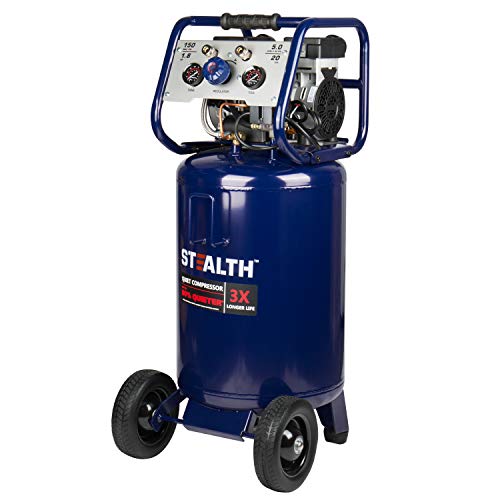
4. Stealth SAQ-12018
- Noise level: 68 dB
- Tank: 20 gallons, vertical
- Airflow: 5.00 CFM at 90 PSI, 5.50 CFM at 40 PSI
- Maximum pressure: 150 PSI
The Stealth SAQ-12018 is a 20-gallon vertical compressor that pairs a large tank with a 68 dB noise rating, making it one of the quietest big-tank options available. Its 1.8 HP oil-free induction motor delivers 5.5 CFM at 40 PSI and 5.0 CFM at 90 PSI, with a maximum pressure of 150 PSI. That airflow is enough for spray guns, sanders, and impact wrenches in intermittent use, which puts it a step ahead of the 8-gallon models for serious workshop work. The vertical tank saves floor space compared with a horizontal 20-gallon unit, and the large rubber wheels help when the unit does need to move.
The Stealth design emphasizes long pump life, with the maker describing an induction motor system built for extended service and a life cycle of more than 1,000 hours. The oil-free pump needs no oil changes, and the 150 PSI maximum gives extra headroom for tools that need higher pressure. At 121.4 pounds, this is a heavy machine, and that weight is its main drawback: it is a partial fit for anyone who needs to move a compressor between locations, and it should be treated as fixed shop equipment. Its 68 dB rating is also a touch louder than the 60 dB California Air Tools models, though still far quieter than a standard shop compressor.
For a workshop that needs real airflow and a large tank but sits in a shared building or a neighborhood where noise matters, the SAQ-12018 is a strong compromise. It delivers the air of a full-size shop compressor while staying quiet enough to hold a conversation beside it.
What to Check Before You Buy
Before ordering, confirm three things on the listing itself. First, check the noise rating and the conditions behind it, since some makers measure at a distance and others measure beside the unit. Second, confirm the airflow at 90 PSI against the tools you own, and add up the requirements if you plan to run two tools at once. Third, check the tank drain valve, the power cord length, and whether the listing includes a hose, fittings, or a filter, since those extras are sometimes sold separately.
Also measure your space and your power supply. A 20-gallon compressor needs a clear corner with room for ventilation around the motor, and all of the models in this guide run on a standard household outlet, but a long extension cord can starve the motor on startup, so keep the cord short and heavy gauge. Finally, plan for maintenance from day one: drain the tank after each use, keep the intake filter clean, and store the compressor in a dry place. Those simple habits matter more for long-term reliability than any single specification on the box.
FAQ
How quiet is a 60 dB air compressor?
A 60 dB compressor sounds about as loud as a normal conversation or a running dishwasher. You can work beside one and talk without raising your voice, and it will not carry through walls the way a standard shop compressor does. Independent testing of the California Air Tools 8010 has measured levels even lower than the rated 60 dB, but treat the maker rating as the honest comparison figure, since test conditions vary.
What size air compressor do I need for a home workshop?
For nailing, stapling, inflation, and cleaning, an 8-gallon compressor with around 2 CFM at 90 PSI is enough. For spray painting, sanding, and impact tools, step up to a 20-gallon tank with 5 CFM or more at 90 PSI. When in doubt, buy the larger tank: extra stored air costs little in noise and saves you from waiting on the pump during a job.
Are oil-free air compressors quieter than oil-lubricated ones?
In most cases, yes. Oil-free quiet compressors use low-speed dual-piston or induction motors that turn far slower than the pumps in traditional oil-lubricated units, and the slower speed is what keeps the noise down. Oil-free pumps also need less maintenance, though they generally have a shorter service life than a well-maintained oil-lubricated pump.
Can a quiet air compressor run an impact wrench?
It depends on the model. A 20-gallon compressor rated at 5 CFM at 90 PSI, such as the Stealth SAQ-12018 or the California Air Tools 20020, can run an impact wrench for intermittent lug work. An 8-gallon model rated at 2.20 CFM at 90 PSI will run the wrench in short bursts but will need frequent pauses while the tank refills, so it is a partial fit for automotive work.
Do quiet air compressors need a break-in period?
Most oil-free quiet compressors need little or no break-in. Check the manual for the specific model, run the unit once with the tank drain open to clear any packing debris, then fill the tank and check for leaks at the fittings. After that, the main routine is draining the tank after use and keeping the intake filter clean.
Bottom Line
The best quiet workshop air compressors prove that you do not have to choose between a peaceful shop and enough air to get work done. For most workshops, the California Air Tools 8010 is the right starting point: 60 dB, an 8-gallon tank, and enough airflow for the finish tools that fill a typical project list. If you move the compressor often, the aluminum-tank 8010A is worth the switch for its lighter weight and corrosion resistance. For bigger jobs, the 20-gallon California Air Tools 20020 and the Stealth SAQ-12018 bring the airflow and tank capacity that spray guns and sanders demand while staying far quieter than a conventional shop compressor. Pick the size that matches your tools, check the airflow at 90 PSI before you order, and your workshop will stay a place you enjoy working in.
Disclosure: As an Amazon Associate, we may earn from qualifying purchases.