Our Short List of 3

- Type: Grow-through grid
- Diameter: 16 inches
- Height: 24 inches
- Legs: 3

- Type: Grow-through grid cage
- Diameter: 16 inches
- Height: 24 inches, with a 30-inch option
- Legs: 4
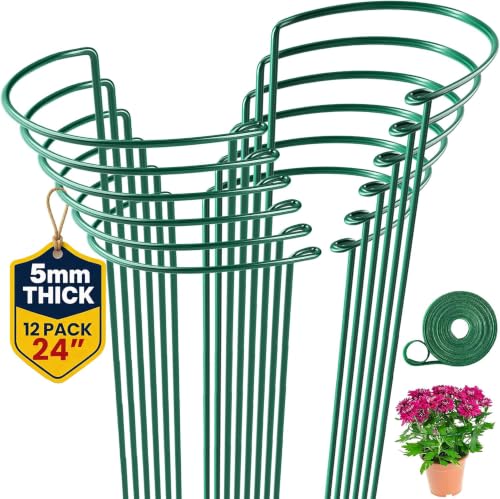
- Type: Half-round support stake
- Size: 10 inches wide by 24 inches high
- Material: Steel core with plastic powder coating
- Colour: Dark green
All 5 Picks at a Glance
| Product | Specs | Action |
|---|---|---|
| MTB Supply Grow Through Plant Support — best overall |
| Check price on Amazon |
| FuBegi Peony Cages and Supports — best tall grow-through grid |
| Check price on Amazon |
| K-Brands Tall Plant Support Stakes — best half-round for tall clumps |
| Check price on Amazon |
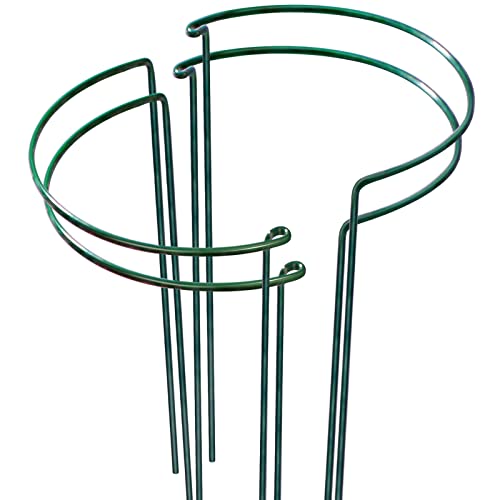 LEOBRO Plant Support Stakes — best interlocking link supports |
| Check price on Amazon |
 NNG Peony Cages and Supports — best compact grow-through for young clumps |
| Check price on Amazon |
Key takeaways
- Find the best plant supports for peonies, from grow-through grids and tall cages to interlocking half-round rings that keep heavy blooms upright in rain.
Peonies carry some of the heaviest flower heads in the perennial border, and those heads sit on stems that were never built to hold them once rain soaks the petals. A clump that looks perfect in bud can splay open overnight after one wet evening, leaving blooms face down in the mulch and stems bent at angles they never recover from. The fix is simple and cheap: a support structure placed around or over the clump early in the season, before the stems need it.
The catch is that peonies need the right kind of support. A single thin stake does almost nothing for a wide, multi-stemmed clump, and a cage sized for tomatoes is usually too tall and too narrow. This guide covers the five support styles that genuinely suit peony growth habits — grow-through grids that stems rise through, full peony rings and cages, half-round supports that prop a clump from one side, and interlocking link stakes that build a ring of exactly the size your planting needs.
As an Amazon Associate, we earn from qualifying purchases.
Quick answer
The MTB Supply Grow Through Plant Support is the top pick for most peony growers: its 16-inch grid on 24-inch legs catches every stem as it grows, so heavy blooms stay upright through rain. Gardeners with taller varieties should look at the FuBegi 30-inch grid, while half-round K-Brands and LEOBRO rings suit borders and rescue work.
How to choose
Peonies grow as clumps, not single stems, so the first decision is shape. Grow-through grids sit over the crown in early spring and let dozens of stems rise through separate openings, which spreads the load across the whole plant and holds each stem near vertical. Full rings and cages surround the clump and corral stems that lean outward. Half-round supports push in from one side, which suits peonies planted along a path or wall where a full ring would crowd the edge. Interlocking halves and link stakes combine into circles, rows or curves, so one pack can serve several clumps of different sizes.
Diameter matters more than most buyers expect. A young peony may spread only a foot across, but a mature herbaceous clump commonly reaches two feet or more, and a grid that is too small forces stems into a tight bunch that looks unnatural and chafes in wind. For most established clumps, a 16-inch grid or a ring built out to roughly 20 inches across gives stems room to arrange themselves while still catching any that lean.
Height is the second measurement. The supporting grid or ring should sit at roughly half to two thirds of the plant’s final stem height, so blooms clear the frame but the frame still holds the stems below the heavy flower heads. For typical garden peonies that finish around 28 to 34 inches tall, a support standing 24 inches above the soil is the sweet spot. Shorter 16-inch supports suit compact varieties and young plants, while tall selections and Itoh hybrids that push past three feet need the 30-inch class.
Material decides how long the support lasts. Steel wire with a PVC, vinyl or powder coating resists rust far longer than bare wire, and the green finish disappears into foliage by flowering time. Thicker wire — around 4 millimetres on the rings in this guide — holds its shape when a rain-loaded bloom leans on it, where thin wire bends and stays bent. Legs should be long enough to anchor firmly; on grids, three legs are adequate on level ground, while four legs sit steadier on slopes and in loose, freshly worked soil.
Timing is the last factor, and it is the one gardeners most often get wrong. Grow-through grids only work when they are placed over the crown while shoots are still short, because mature stems cannot be threaded through a grid without snapping. Half-round and interlocking supports are more forgiving: they can be worked in around a clump that is already leafing out, which makes them the practical choice when spring gets away from you.
MTB Supply Grow Through Plant Support — best overall
- Type: Grow-through grid
- Diameter: 16 inches
- Height: 24 inches
- Legs: 3
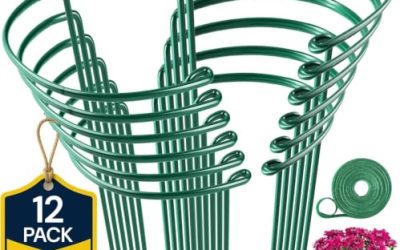
The MTB Supply support is the classic peony grid done properly: a 16-inch round grid held on three legs that stand 24 inches tall, sold in a pack of five. Each grid is divided into openings that separate the stems as they grow, so instead of one mass of foliage leaning in a single direction, every stem gets its own slot and its own share of support. That separation is exactly what heavy-headed varieties need, because the weight of the blooms is distributed across the frame rather than concentrated on the outer stems.
The frame is metal with a green PVC coating, which protects the wire from rust and helps the support vanish into the plant by the time flowers open. In use, you push the legs into the soil over the crown in early spring, while the red shoots are still a few inches high, and then simply let the plant grow up through it. There is nothing to tie and nothing to adjust through the season. The 24-inch height suits the majority of herbaceous peonies, and the pack of five covers a typical border grouping in one purchase.
Its limits are the limits of any fixed grid. Very wide, old clumps can outgrow a 16-inch circle, and tall varieties that finish well above three feet may lean over the top of the frame. On uneven ground, three legs take a little more care to seat level than four. None of that changes the verdict for standard plantings: this is the support to buy first, and the one the other picks in this guide are measured against.
Key specs:
FuBegi Peony Cages and Supports — best tall grow-through grid
- Type: Grow-through grid cage
- Diameter: 16 inches
- Height: 24 inches, with a 30-inch option
- Legs: 4
The FuBegi cage follows the same grow-through principle as the top pick but adds two things taller plantings need: a fourth leg and a taller option. The standard frame stands 24 inches high on a 16-inch grid, and the same listing offers a 30-inch height for varieties that finish too tall for a two-foot frame. Four legs anchor the grid more firmly in loose soil and on beds that are not perfectly level, which matters once a top-heavy clump in full bloom begins to lean on the frame after rain.
Construction is metal with a vinyl coating, again in green so the frame reads as foliage shadow rather than garden hardware. The grid pattern braces stems across the whole clump, and the pack includes six supports, enough for a long border run of the same variety. Because the openings hold stems apart, air moves through the clump more freely than it does in a bunched, tied plant, which helps foliage dry after wet weather.
Choose this grid over the MTB Supply frame if your peonies are tall selections, if your soil is soft or sandy, or if the bed sits on a slope. Keep in mind that, like every grow-through design, it must go on early: once stems are tall and leafy, threading them through the grid risks breakage, and a half-round support becomes the safer tool.
Key specs:
K-Brands Tall Plant Support Stakes — best half-round for tall clumps
- Type: Half-round support stake
- Size: 10 inches wide by 24 inches high
- Material: Steel core with plastic powder coating
- Colour: Dark green
Not every peony can take a grid. Clumps hard against a fence, plants that were missed in spring, and varieties that sprawl sideways rather than up all call for support from the side, and that is the job half-round stakes do best. The K-Brands tall version stands 24 inches high and 10 inches wide, so a pair of them forms a 20-inch ring around a mature clump with enough height to hold stems well below the flower heads. The pack of twelve covers several plants, used singly along borders or paired around specimen clumps.
Each stake is built on a steel core with a plastic powder coating in dark green, described by the maker as rustproof, and the wire is thick enough to push into firm soil without folding. A 10-foot roll of plant tie is included for gathering any stem that escapes the arc. Because the halves are independent, you can add one in front of a clump that only leans toward the path, ring a whole plant with two, or run a line of them along a border as a low retaining edge for flopping foliage.
The honest trade-off is that half-rounds guide stems rather than separate them. A clump held by rings alone can still bunch in the middle, and individual heavy blooms may need the included tie. For tall peonies and for mid-season rescue work, though, nothing else in this guide is as flexible or as easy to place.
Key specs:
LEOBRO Plant Support Stakes — best interlocking link supports
- Type: Interlocking half-round link stake
- Size: 10 inches wide by 15.8 inches high
- Wire thickness: 4 millimetres
- Material: Steel core with plastic powder coating
LEOBRO’s half-round stakes are built around a groove design that lets the halves interlock, so they behave like link stakes: join two for a full circle around one clump, chain several into a row along a border, or overlap them into shapes that follow a curved bed. Each stake is 10 inches wide and 15.8 inches high, formed from 4-millimetre steel-core wire with a dark green plastic powder coating. The set of four is sized for one or two smaller clumps, or for reinforcing the open side of a planting that already has some support.
The shorter height makes these a match for compact and mid-height peonies, young clumps still building size, and the front row of a border where a tall frame would show. The interlocked joints add rigidity that loose half-rounds lack, and the stakes detach and stack flat, so storage takes almost no space in the shed. Gardeners fighting the classic problem — a clump that flops in a different direction every year — can simply add or move a section where the lean appears.
The limits follow from the dimensions. At under 16 inches tall, these stakes cannot hold a full-size, rain-heavy clump on their own; pair them with a grid or use them on smaller varieties. The four-piece pack also runs out quickly in a big border. Within their size class, though, the interlocking design is the most adaptable support in this guide.
Key specs:
NNG Peony Cages and Supports — best compact grow-through for young clumps
- Type: Grow-through ring grid
- Diameter: 12 inches
- Height: 16 inches
- Material: Iron wire with green powder coating
Young peonies and compact varieties do not need a 16-inch grid, and giving them one leaves the frame mostly empty and visible. The NNG cage scales the grow-through idea down: a 12-inch diameter ring grid standing 16 inches high, made from iron wire with a green powder coating. It is the right footprint for first- and second-year plants, compact border varieties, and peonies growing in large containers, where stems need organising while the clump is still small.
The pack includes six supports and a roll of garden twist tie, so a whole group of young plants can be framed at once and any stray stem can be gathered in. As with the larger grids, installation happens in early spring over the emerging shoots, and the plant then grows through the openings and hides the frame. When the clump eventually outgrows the 12-inch circle, the support moves on to the next young plant, so it stays useful for years.
Buyers with established, full-size clumps should skip this size entirely — a mature plant will burst through and over a 16-inch frame by flowering time, and the bigger grids above exist for exactly that job. For the plantings it is sized for, the NNG set is the tidy, economical way to keep small peonies upright from their first season.
Key specs:
Who should skip
Skip this entire category if your peonies are tree peonies. Their woody stems stand on their own, the shrubs grow far larger than any frame here, and what they occasionally need is pruning, not a cage. Gardeners growing peonies purely as cut flowers may also prefer to skip grids and rings: individual stems are usually cut in bud before they grow heavy, and any blooms left in the garden can be held with a few single-stem stakes placed stem by stem.
Also skip the grow-through grids if your plants are already tall and in leaf. Forcing mature stems through a grid snaps them, and no support is worth losing a season of flowers; choose the half-round or interlocking picks instead, and set grids over the crowns next spring. Finally, skip the compact NNG size if your clumps are already mature — undersized supports fail exactly when the blooms get heavy, which is the moment they were bought for.
Frequently Asked Questions
When should peony supports be put in place?
Grow-through grids should go over the crown in early spring, when the shoots are only a few inches tall, so stems can grow up through the openings naturally. Half-round and interlocking supports are more forgiving and can be pushed in around a clump that is already leafing out, as long as care is taken not to spear the crown or snap stems while positioning them.
What size support does a mature peony clump need?
Most mature herbaceous clumps do well with a grid or ring around 16 to 20 inches across and about 24 inches of height above the soil, which places the frame at roughly half to two thirds of the final stem height. Compact varieties and young plants suit the 12-inch class, while tall selections that finish above three feet need a 30-inch grid or 24-inch half-rounds used in pairs.
Is a grow-through grid or a half-round ring better for peonies?
For a clump that can be framed early, the grow-through grid is better, because it separates and holds every stem individually, so the whole plant stays upright with no tying. Half-round rings are better for clumps against walls or paths, for plants missed in spring, and for gardeners who want to add, move or remove support mid-season without disturbing the plant.
Can a support rescue peonies that have already flopped?
Partly. A flopped clump can be lifted gently and gathered into half-round or interlocking supports, and a soft tie can hold the stems against the frame, which saves the remaining blooms and keeps them off the soil. Stems that have already bent sharply at the base rarely straighten fully, so rescued plants look tidier rather than perfect — and the lasting fix is to have a grid in place the following spring.
Final verdict
For most peony growers, the decision is simple: put the MTB Supply grow-through grid over each crown in early spring and let the plants do the rest. Its 16-inch grid on 24-inch legs matches the size and height of the average herbaceous clump, separates stems so heavy blooms share the load, and disappears into the foliage by flowering time. Step up to the FuBegi grid when your varieties run tall or your soil is loose, since its four legs and 30-inch option cover the cases the standard frame cannot. Keep the K-Brands tall half-rounds and the interlocking LEOBRO stakes for borders, awkward spots and mid-season rescues, and give young or compact plants the smaller NNG grids until they earn a full-size frame. Whichever style you choose, the rule that matters most is timing: a modest support placed early outperforms a heavy one placed after the flop.
Product and ASIN Reference
| Product | ASIN |
|---|---|
| MTB Supply Grow Through Plant Support, 16 x 24 Inch, Pack of 5 | B0722NPR7H |
| FuBegi Peony Cages and Supports, 16 x 24 Inch, Pack of 6 | B0G5PLKPNJ |
| K-Brands Tall Plant Support Stakes, 10 Inch Wide x 24 Inch High, Pack of 12 | B0B8P762VQ |
| LEOBRO Plant Support Stakes, 10 Inch Wide x 15.8 Inch High, Pack of 4 | B07X627FVR |
| NNG Peony Cages and Supports, 12 x 16 Inch, Pack of 6 | B0CPPCHMWH |