Key takeaways
- Compare the best metal plant supports, from half round rings and galvanized cages to steel obelisks, by height, coating and plant type to pick yours.
Metal plant supports solve the same problem in several different shapes. A peony that flops after rain needs a ring it can grow through. A tomato needs a cage around it. A clematis needs something tall to climb. Picking the right support is mostly about matching the shape and height of the frame to the way the plant actually grows, then choosing a finish that survives your weather.

This guide lines up five metal supports that cover the main jobs in a garden: two sizes of half round ring, a galvanized conical cage, a tall steel obelisk and a heavy wrought iron trellis. Every one is metal through and through, with a coating or galvanizing layer doing the rust protection. Work through the height and shape questions below and the right frame usually picks itself.
As an Amazon Associate, we earn from qualifying purchases.
Quick Picks
Our Short List of 3
- Best for: Everyday clumps of peonies, hydrangeas and roses in beds and borders
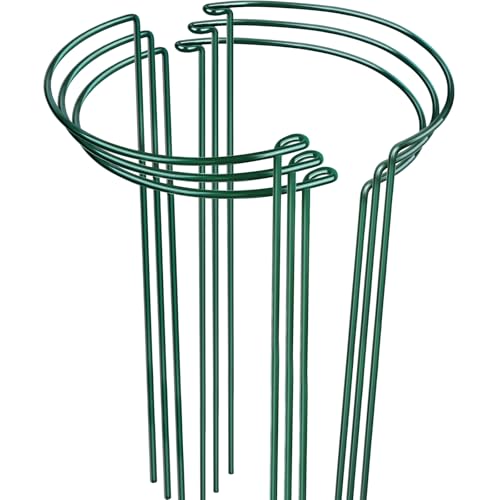
- Pack of 12 half round supports; 10 inches wide x 16 inches high; steel core with plastic powder coating; ring design can be paired or interlinked to form wider circles; for peony, tomato, hydrangea and rose plants, indoors and outdoors
- Best for: Taller stems that outgrow a standard ring, including monstera and tomato plants
- Pack of 6 half round supports; 10 inches wide x 24 inches high; 4 mm thick wire; steel core with plastic powder coating; deep green finish; for indoor and outdoor plants including monstera, tomato and hydrangea

- Best for: Whole rows of small tomatoes, peppers and eggplants
- Pack of 10 conical cages; 33 inches high x 12.1 inches diameter; galvanized steel wire; stackable for storage; model 89723; for small tomatoes, peppers, eggplants and flowering plants
All 4 Picks at a Glance
| Product | Specs | Action |
|---|---|---|
| K-Brands 12 Pack Plant Support Stakes, 10 x 16 in |
| Check price on Amazon |
| LEOBRO 24 Inch Plant Support Stakes, 6 Pack |
| Check price on Amazon |
| Panacea 89723 Tomato and Plant Support Cage, Pack of 10 |
| Check price on Amazon |
 H Potter Lotus Bud Trellis |
| Check price on Amazon |
How to Choose
Match the shape to the growth habit. Half round rings suit bushy plants that lean outward, because two rings pushed together form a full circle around the clump and the foliage hides the frame. Conical cages suit plants that grow up through the middle, like tomatoes and peppers. Obelisks and trellises suit climbers, which need vertical lines to twine around rather than a ring to lean on. Buying the wrong shape is the most common reason a support disappoints: a ring will not train a vine, and a trellis will not hold a flopping peony upright.
Height is measured against the mature plant. A support should reach roughly two thirds of the plant’s final height, and part of its length disappears into the soil. A 16 inch ring gives you about 12 inches of working height above ground, which suits compact peonies and border perennials. Plants heading for three feet or more need the 24 inch rings, a 33 inch cage or a full-height obelisk. Check the ring or cage width as well: a 10 inch ring fits a young clump, while wide, established clumps may need two rings linked together.
Wire thickness decides stiffness. Most coated rings are built on wire around 4 mm thick. That is enough for flowers and light foliage, but a heavy, rain-soaked plant pushes hard, and thin wire flexes. Solid bar and tube frames, like the steel pipe in an obelisk or the solid iron in a wrought iron trellis, hold their shape under loads that would bend a light ring. If your plants are heavy, step up in frame weight rather than adding more light rings.
The coating is the rust plan. Bare steel rusts quickly outdoors. The finishes to look for are plastic or powder coating over a steel core, galvanizing, and stone-look coated finishes. Coatings work until they chip, so check cut ends and joints at the end of the season. Galvanized steel protects differently: the zinc layer covers the whole surface including welds, which is why simple galvanized cages survive years of outdoor use with no maintenance at all.
Think about storage and reuse. Rings and conical cages stack or nest, so a dozen take up little shed space. Obelisks and wrought iron pieces are bulkier but stay out all year in many gardens and double as winter structure. If you rotate annual vegetables, light stackable cages are easier to move between beds each season.
Best Options
K-Brands 12 Pack Plant Support Stakes, 10 x 16 in
- Best for: Everyday clumps of peonies, hydrangeas and roses in beds and borders
- Pack of 12 half round supports; 10 inches wide x 16 inches high; steel core with plastic powder coating; ring design can be paired or interlinked to form wider circles; for peony, tomato, hydrangea and rose plants, indoors and outdoors
Everyday clumps of peonies, hydrangeas and roses in beds and borders
At 16 inches these are mid-height rings, so very tall or top-heavy plants will outgrow them; the coating is the rust protection, so avoid scraping it on stones when you push the legs in
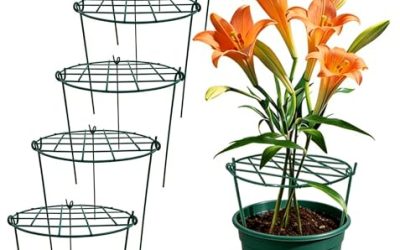
This is the workhorse option: twelve half round rings, each 10 inches wide and 16 inches high, built on a steel core with a plastic powder coating. Push two into the soil facing each other and you have a full ring that a peony, hydrangea or rose clump can grow through, with the green finish disappearing into the foliage. A pack of twelve covers a whole border in one purchase, which matters because supports work best when they go in early, before the plant needs them.
The half round shape is flexible in use. A single ring against a wall or fence props up plants in narrow beds, and rings can be interlinked to widen the circle around a big, established clump. The steel core gives the ring enough spring to stay put once the legs are pushed into firm soil.
Watch out for: At 16 inches these are mid-height rings, so very tall or top-heavy plants will outgrow them; the coating is the rust protection, so avoid scraping it on stones when you push the legs in
LEOBRO 24 Inch Plant Support Stakes, 6 Pack
- Best for: Taller stems that outgrow a standard ring, including monstera and tomato plants
- Pack of 6 half round supports; 10 inches wide x 24 inches high; 4 mm thick wire; steel core with plastic powder coating; deep green finish; for indoor and outdoor plants including monstera, tomato and hydrangea
Taller stems that outgrow a standard ring, including monstera and tomato plants
Six rings cover fewer plants than the bigger value packs, and at 24 inches the legs need firm soil to stay vertical under a heavy plant; in very soft or sandy beds a cage with more legs anchors better
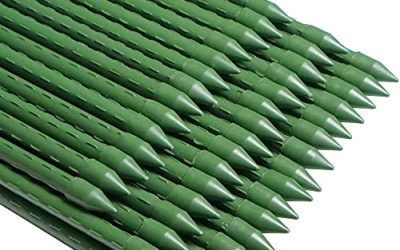
LEOBRO takes the same half round ring design and stretches it to 24 inches tall, which is the size gardeners reach for once standard rings stop being enough. The wire is 4 mm thick with a steel core and a plastic powder coating in deep green, and the pack of six rings at 10 inches wide suits taller perennials, monstera and young tomato plants that need corralling rather than a full cage.
The extra height changes how you use the ring. More of the stem sits inside the frame, so the plant leans less and the support can go in later in the season if growth catches you out. Pairs of rings still combine into a full circle for round clumps, and a single ring works as a prop along paths and edges where plants spill forward.
Watch out for: Six rings cover fewer plants than the bigger value packs, and at 24 inches the legs need firm soil to stay vertical under a heavy plant; in very soft or sandy beds a cage with more legs anchors better
Panacea 89723 Tomato and Plant Support Cage, Pack of 10
- Best for: Whole rows of small tomatoes, peppers and eggplants
- Pack of 10 conical cages; 33 inches high x 12.1 inches diameter; galvanized steel wire; stackable for storage; model 89723; for small tomatoes, peppers, eggplants and flowering plants
Whole rows of small tomatoes, peppers and eggplants
The wire is light for the category, so reserve these for compact plants rather than heavy indeterminate tomatoes; the 33 inch height is the full length, and several inches sit below ground once installed
Panacea’s conical cage is the oldest design in this guide and still one of the most practical. Each cage is 33 inches tall and about 12.1 inches across, made from galvanized steel wire, and the pack of ten is sized for a full row of small tomatoes, peppers or eggplants. The cone shape is wider at the top than the base, so branches rest on the rings as the plant grows up through the middle.
Galvanizing is the point here. There is no paint layer to chip, and the zinc coating covers the welds as well as the wire, so these cages can live outdoors season after season. They also stack inside each other, which makes a pack of ten easy to store in a corner of the shed. Set them over young plants early and the foliage quickly hides the frame.
Watch out for: The wire is light for the category, so reserve these for compact plants rather than heavy indeterminate tomatoes; the 33 inch height is the full length, and several inches sit below ground once installed
Idzo Obelisk Trellis, 72 in
An obelisk answers a different question: not how to hold a plant up, but how to give a climber somewhere to go. The Idzo tower stands 72 inches tall and is built from steel pipe with a hammer stone powder-coated finish in black. The listing rates it for loads up to 20 lb, which covers clematis, climbing roses, jasmine and lighter vegetable vines such as beans and cucumbers, and the spiked legs push into the soil to anchor the frame.
The stone-look coating does two jobs. It protects the steel from rust and fading, and it gives the frame a matte, textured surface that tendrils grip more easily than glossy paint. Because the tower is tall and narrow, it also works in large pots and raised beds where a wide trellis panel will not fit, and it keeps its shape as a garden feature through winter.
Specs
- Obelisk trellis; 72 inches high; steel pipe construction, 1/16 inch thick; hammer stone powder-coated finish in black; supports up to 20 lb as listed; spiked legs for soil installation; for clematis, climbing roses, tomato plants and other vines
Best for: Climbing plants that need real height, from clematis to climbing roses
Watch out for: Assembly is required before first use, and a tall tower catches wind, so it needs firm anchoring in open, exposed beds; heavy vines at full leaf can test the listed load limit, so train the heaviest growth low on the frame
H Potter Lotus Bud Trellis
- Best for: A permanent decorative focal point that also carries vines
- Wrought iron obelisk trellis; approximately 32 inches wide x 69.25 inches high; solid iron construction; charcoal brown powder-coated finish with a hand-rubbed look; assembly required; for climbing rose, mandevilla, honeysuckle, clematis and jasmine
A permanent decorative focal point that also carries vines
It is heavy and sold as a single statement piece, so it is the wrong tool for rows of vegetables or a border full of perennials; confirm the exact variant and dimensions on the listing before ordering, as the range includes several sizes
The H Potter trellis is the permanent, decorative end of the category. It is made from solid wrought iron with a hand-applied charcoal brown powder finish, stands about 69.25 inches high and 32 inches wide, and is shaped with a lotus bud finial that reads as garden sculpture even with nothing growing on it. The listing names rose, mandevilla, honeysuckle, clematis and jasmine as the plants it is built to carry.
Solid iron behaves differently from wire and tube. It does not flex under a mature climbing rose, and the frame is heavy enough to stand as a focal point at the end of a path or in a courtyard bed. This is the support you buy once and site carefully, rather than the one you move around the vegetable beds each spring.
Watch out for: It is heavy and sold as a single statement piece, so it is the wrong tool for rows of vegetables or a border full of perennials; confirm the exact variant and dimensions on the listing before ordering, as the range includes several sizes
Which One Fits
For most flower borders, the decision is between the two ring packs. Choose the K-Brands 12 pack at 16 inches if your plants are compact to mid-height and you need many rings at once. Choose the LEOBRO 24 inch pack when stems regularly pass two feet and standard rings have failed you before. Both disappear into foliage and store flat, so they suit gardeners who tidy supports away each winter.
Vegetable growers working in rows should take the Panacea cages. Ten galvanized cones cover a bed of peppers or compact tomatoes in one pack, and the finish needs no care between seasons.
For climbers, height decides. The Idzo obelisk is the practical pick for clematis, jasmine and beans, including in pots and raised beds. The H Potter trellis is the pick when the support itself is part of the garden design and will stay in place for years. If a plant both flops and climbs, support the base with a ring first and let the obelisk take the upper growth.
Common Mistakes
Installing supports too late. Rings and cages work by letting the plant grow through them. Forcing stems into a frame after the plant has flopped bends and snaps them. Put supports in when the plant is about a third of its final height.
Buying by plant height alone. The part of the support below ground does no supporting. Subtract several inches for the legs before comparing a support’s height with your plant, or tall plants will still lean over the top.
Mixing up support shapes. A ring cannot train a vine and a trellis cannot rescue a flopping clump. Match the frame to the growth habit first, then compare sizes inside the right shape.
Ignoring the coating. Chipped powder coating and scratched plastic are where rust begins. Push legs into soil rather than stony ground, and store coated supports dry so they last more than a season or two.
Under-supporting heavy plants. One light ring around a big, rain-heavy peony just gives it something to bend over. Link two rings, step up to a cage, or choose a heavier frame before the plant reaches full size.
FAQ
Are metal plant supports better than bamboo or plastic?
For longevity, usually yes. Metal frames keep their shape for many seasons, carry heavier plants without snapping, and the coatings or galvanizing handle sun and rain better than untreated cane. Bamboo and plastic still make sense for light, single-season jobs, but a metal ring or cage is the buy-once option for perennials and repeated vegetable beds.
What height of plant support do I need?
Aim for a support that reaches about two thirds of the plant’s mature height after the legs are in the ground. Compact border plants do well with 16 inch rings, taller perennials and young tomatoes with 24 inch rings or a 33 inch cage, and climbers need the full height of an obelisk or trellis at six feet or more.
How do I stop metal supports rusting?
Choose a finish made for outdoor use: plastic or powder coating over steel, a stone-look coated finish, or galvanizing. Rust begins where coating is chipped, so handle the legs carefully during installation, wipe frames down before winter storage, and store them dry. Galvanized cages need the least care of all.
Can I use these supports in pots and containers?
Yes, with the right size. Half round rings at 10 inches wide fit medium and large pots and are a common choice for monstera and other houseplants, and a narrow obelisk can anchor into a large container for a climbing plant. Just confirm the pot is deep enough for the legs to grip, and heavy enough not to tip once the plant is tall.
Final Verdict
Metal supports are a small purchase that decides whether a border looks tended or tired by midsummer. For most gardeners, the K-Brands 12 pack of 16 inch rings is the right foundation: cheap to deploy across a whole bed, strong enough for the classic floppy perennials, and easy to store. Add the LEOBRO 24 inch rings where plants run taller, the Panacea galvanized cages for vegetable rows, and an obelisk or the H Potter iron trellis where climbers need height. Match shape first, height second, and every plant in the bed stands up straight.