Key takeaways
- Compare the best drone landing pads for camera drones, from foldable and weighted pads to large helipads, carry case kits and a simple budget pick.
A camera drone is at its most vulnerable in the first and last few feet of a flight. Rotor wash lifts dust, sand and grit into motors, gimbals and lenses, tall grass can snag a propeller, and a damp or uneven surface gives the aircraft nothing clean to settle on. A landing pad solves that problem: it lays a flat, visible, easy-to-clean surface between your drone and the ground.
This guide compares five pads covering the main ways pilots buy them: a fast-fold pad for travel, a weighted pad that stays put without stakes, a large pad for bigger aircraft, a pad sold as a kit with a carry case, and a simple budget pad. Each listing states its pad diameter, quoted for every pick below, because diameter decides whether your propellers stay inside the circle with room to spare. A pad does not make a location suitable to fly from, so follow local drone rules wherever you fly.
As an Amazon Associate, we earn from qualifying purchases.
Quick answer
For most camera drone pilots, the FPVtosky Nighttime Reflective Drone Landing Pad in the 25 inch size is the top pick. Its fast-fold PU leather surface opens to 25.2 inches, folds down small enough for a drone case, is waterproof and double sided in red and blue, and carries enough listed weight to sit flat on grass, gravel and mud without separate anchors.
FPVtosky Nighttime Reflective Drone Landing Pad, 25 Inch
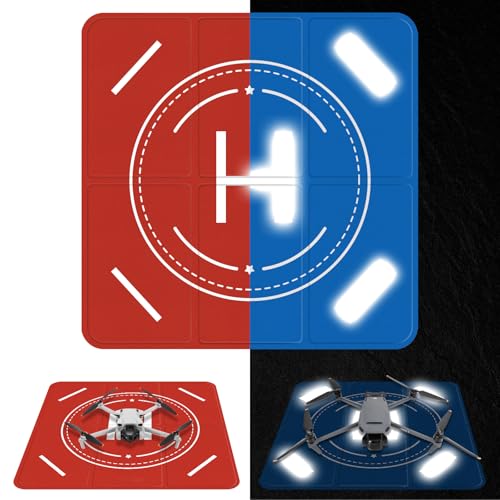
The FPVtosky pad takes the foldable slot and the top spot because its listing balances size, packed size and surface material better than the typical thin nylon circle. Open, it measures 64 by 64 cm, given as 25.2 by 25.2 inches. That is a comfortable target for compact and mid-size camera drones, with margin around the propellers for a drifting final descent. Folded, it drops to 31.7 by 22.2 cm, a flat rectangle that slides into a hard case or backpack.
The surface is double-sided PU leather in red and blue, so you can flip it to whichever color contrasts better with the ground. The listing describes the material as waterproof and dustproof, and says a soiled pad can be rinsed with water and shaken dry. A nighttime reflective treatment is built in, and the listing explains that a drone with a downward light can pick the pad out in low light. At a listed 730 g, the pad has more substance than a featherweight mat, which the maker presents as part of how it stays in place.
Specs
- Pad size: 25.2 by 25.2 inches unfolded (64 by 64 cm)
- Folded size: 12.48 by 8.74 inches, as listed
- Material: PU leather, double sided
- Colors: red and blue
- Weight: 730 g (1.61 lb), as listed
- Model: FP-LD640
- Listed features: fast-fold, waterproof, nighttime reflective
Hoodman 3 Foot Weighted Drone Landing Pad

Weighted pads exist for one reason: wind and rotor wash move light mats, and a pad that shifts during a landing is worse than no pad at all. The Hoodman 3 foot pad answers with a weighted perimeter instead of ground stakes. Its listing describes a zinc-coated cable around the edge, and sources for the same model put that cable at 3.2 pounds, with the pad listed at 2.27 kg in its Amazon technical details. Because the weight is in the rim, the pad hugs the ground and, per the maker, needs no stakes.
At 36 inches across, this is a generous circle for Mavic-class and smaller professional camera drones, and the bright orange 600 denier polyester surface is easy to see from the air. The pad springs into shape when released and collapses to about a third of its deployed size, roughly 13 inches, and Hoodman includes a carry bag for this line. The trade-off is bulk: a weighted rim travels heavier than a folding sheet, so this suits pilots who drive to locations rather than hikers.
Specs
- Pad diameter: 3 feet (36 inches)
- Perimeter: weighted zinc-coated cable, no stakes required, as listed
- Material: 600 denier polyester
- Color: orange
- Item weight: 2.27 kg, as listed in the technical details
- Model: HDLP3, 3 Ft Pad
- Included: carry bag, as described for this pad line
Hoodman 5 Foot Weighted Drone Landing Pad
Bigger drones need a bigger circle, and guessing wrong shows up as propeller tips hanging over the edge. The Hoodman 5 foot pad stretches the landing area to a 60 inch diameter, which its Amazon listing aims squarely at the Inspire 3, Inspire 2 and Inspire 1, aircraft whose footprints overwhelm a travel-size mat. The same ground-hugging approach applies: a weighted perimeter holds the pad down, and the listing states that no stakes are required.
The listing gives the color as orange and the model as HDLP, and notes that the pad collapses to one third of its deployed size and packs into a compact travel bag. Hoodman also advises buyers to choose the pad size that keeps propeller tips within the circle. This is not a pad for a Mini in a backpack; it is for pilots flying larger camera platforms on open ground or fields, where a wide, stable target protects an expensive aircraft.
Specs
- Pad diameter: 5 feet (60 inches)
- Perimeter: weighted, no stakes required, as listed
- Color: orange
- Model: HDLP, 5 Ft Pad
- Transport: compact travel bag, as described in the listing
- Listed fit: DJI Inspire 3, Inspire 2 and Inspire 1
PGYTECH Landing Pad Pro
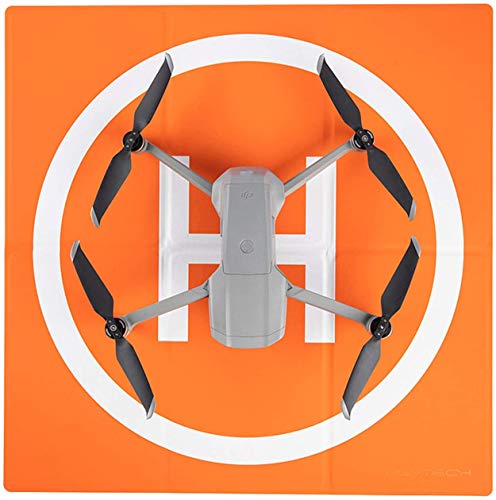
Some pilots would rather buy the pad and its storage as one tidy package, and the PGYTECH Landing Pad Pro is sold that way. Retailer listings describe a square pad of 50 by 50 cm, a sensible footprint for small to mid-size camera drones, with reflective stripes in the box and a carry pouch for transport. The double-sided design pairs an orange face with a blue and white target, giving a clear center mark and a choice of contrast against different ground colors.
The surface is a PU material that listings describe as waterproof, mold and mildew resistant, and printed with UV-resistant, high-precision printing so the target does not fade quickly in sun. At a listed 12.4 ounces, the pad is light, and its easy-fold design folds flat into a rectangle rather than springing into a circle, which many photographers prefer for packing against the side of a camera bag. A light pad still needs care on windy days, but as a complete kit it is the neatest option here.
Specs
- Pad size: 50 by 50 cm (about 20 by 20 inches), as listed by retailers
- Design: double sided, orange and blue with a white target circle
- Material: PU, waterproof, as listed
- Weight: 12.4 oz, as listed
- Included: carry pouch and reflective stripes, as listed
CQT Drone Landing Pad, 55 cm

The CQT pad is the straightforward budget route: a 21.65 inch (55 cm) fast-fold circle in yellow and dark gray, with no premium materials story and no long accessory list. Its Amazon listing gives the special features simply as foldable and waterproof, and the item weight as 14.7 ounces (0.92 pounds). That weight keeps it easy to carry, and the two-tone face gives a small drone a clear target.
A pad this size suits the Mini class and other compact camera drones, and it makes sense as a first pad for a new pilot or a spare in a second vehicle. The limits follow from the brief: at 55 cm it offers the least margin in this guide, so descents need to be accurate, and a light pad on a breezy hilltop will want something holding its edges down. Within its class, though, the listing covers the essentials.
Specs
- Pad diameter: 21.65 inches (55 cm)
- Colors: yellow and dark gray
- Item weight: 14.7 ounces (0.92 lb), as listed
- Material features: foldable and waterproof, as listed
- Brand: CQT
How to choose
Begin with diameter, because it rules out more pads than any other spec. Measure your drone across its widest point with propellers fitted, then choose a pad that leaves a clear margin on every side; Hoodman phrases the same rule as keeping the propeller tips within the circle. Compact drones are well served by 20 to 25 inch pads, mid-size camera drones feel safer on 30 to 36 inches, and large platforms belong on a 5 foot pad.
Next, decide how the pad stays down. Weighted perimeters, like the Hoodman designs above, hold on pavement, rock and hard ground where stakes cannot go in, and they resist rotor wash without setup. Light foldable pads are easier to carry but rely on calm conditions and flat ground, so match the design to your usual launch surfaces.
Then look at the surface. Waterproof PU and coated polyester wipe or rinse clean after mud, sand and wet grass, while plain nylon can hold moisture and grit. Double-sided pads help twice over: you can pick the face that stands out against the ground, and a printed target gives downward sensors and your own eyes a clear center to aim for.
Finally, think about packing. Fast-fold rectangles disappear into a camera bag, spring circles collapse to about a third of their size and prefer their own carry bag, and a kit with a pouch keeps a light pad from unfolding in transit. The best pad is the one whose packed shape fits your bag, because a pad left at home protects nothing.
Who should skip
Skip a landing pad altogether if you always launch from clean pavement, short mown grass or a prepared flying field; there the pad adds setup time without adding protection. Hand launching and catching, where local rules and the drone maker allow it, also removes the need for a ground pad for small drones.
Skip the large 5 foot pad if you fly a compact drone and travel on foot; its circle is far bigger than a small aircraft needs. Skip the budget 55 cm pad in the opposite case: if your drone is mid-size or larger, or you regularly land in wind, the small light circle gives too little margin. Skip weighted pads if you hike long distances, since the perimeter weight that makes them stable is what makes them heavy to carry. And skip every pad here if you expect it to make an unsuitable location acceptable; a pad improves a surface, it does not change the rules about where to fly.
Frequently Asked Questions
What size landing pad does my drone need?
Choose a diameter that covers the drone’s full footprint with propellers fitted, plus margin on all sides for small drifts on descent. Compact drones fit pads of about 20 to 25 inches, mid-size camera drones are safer on 30 to 36 inches, and large aircraft such as the Inspire line call for a pad around 5 feet across.
Do weighted landing pads really stay in place?
A weighted perimeter is designed to hold the pad flat without stakes, using a heavy cable sewn into the rim, as on the Hoodman pads above. That suits pavement and hard ground where stakes cannot be pushed in. Strong gusts can still lift any pad, so check it is flat before every takeoff.
Can a landing pad protect my camera and gimbal?
Yes, that is its main job. Rotor wash throws dust, sand and grit upward, and a pad puts a clean surface under the aircraft so less debris reaches the lens, gimbal and motors. It also keeps propellers out of tall grass and gives the drone a level place to sit on gravel or mud.
How do I clean and store a drone landing pad?
Most pads here use waterproof surfaces that can be rinsed or wiped down and shaken dry after use on mud or sand. Let the pad dry before packing it away, fold it along its intended fold lines, and store it in its carry bag or case.
Final verdict
Buy the FPVtosky 25 inch pad if you want one fast-fold pad that lives in your drone case and covers most camera drones well. Choose the Hoodman 3 foot pad when wind, pavement and repeated field work make a weighted, stake-free surface worth the extra bulk, and step up to the Hoodman 5 foot pad if you fly an Inspire-class aircraft needing a 60 inch circle. Pick the PGYTECH Landing Pad Pro if a complete kit with a carry pouch suits how you pack, and take the CQT 55 cm pad as the simple budget option for a compact drone or a spare.
Product and ASIN Reference
| Product | ASIN |
|---|---|
| FPVtosky Nighttime Reflective Drone Landing Pad, 25 Inch | B0FQTH6394 |
| Hoodman 3 Foot Weighted Drone Landing Pad | B01I0E821G |
| Hoodman 5 Foot Weighted Drone Landing Pad | B01DKL3SEK |
| PGYTECH Landing Pad Pro | B07FCLSXW3 |
| CQT Drone Landing Pad, 55 cm | B0D455738J |