Key takeaways
- Compare phase contrast laboratory microscopes built for microscopy photography, with trinocular ports, matched phase objectives and bundled digital cameras.
As an Amazon Associate, we earn from qualifying purchases made through links on this page.
Phase contrast exists for one reason: most living specimens are nearly transparent. Unstained cells, bacteria in a wet mount, plankton and tissue-culture monolayers absorb so little light that a brightfield microscope renders them as faint ghosts, yet the moment you stain them for visibility they stop being alive. A phase contrast laboratory microscope solves this by converting invisible phase shifts in the light passing through the specimen into visible differences in brightness, so living, unstained material can be observed and photographed in something close to its natural state.
For microscopy photography, though, phase optics are only half of the purchase. The other half is the imaging path: a trinocular photo port or a bundled C-mount camera, a sensor with enough resolution for the detail the objectives resolve, and software that can capture, measure and save images without fighting you. A microscope can have an excellent phase kit and still be a poor photography instrument if the camera port is an afterthought.
Every microscope in this roundup meets two non-negotiable conditions. First, it has genuine phase contrast hardware from the manufacturer: phase-ring objectives matched to a phase condenser, turret disk or annulus plates, not a brightfield scope with a marketing label. Second, it is built for a camera, with either a trinocular port or a digital camera in the box. The three models below cover the realistic buying paths: a high-resolution camera bundle, a camera-free trinocular frame for people who already own an imaging system, and an established halogen platform that adds darkfield to the phase kit.
What to look for
A complete, matched phase kit. Phase contrast only works when the annulus in the condenser aligns with the phase ring inside the objective. Look for phase objectives (marked PH) covering the magnifications you actually shoot, ideally 10X, 20X, 40X and 100X, plus a condenser system that carries the matching annuli. Turret and disk condensers switch annuli as you rotate them, which is fast and repeatable. Separate annulus plates work just as well optically but must be swapped and re-centered by hand. Either way, a centering telescope should be included, because an off-center annulus quietly destroys contrast.
Plan correction on the phase objectives. A photograph records the whole field, including the edges that your eye forgives when viewing live. Plan (flat-field) phase objectives keep the frame sharp from center to corner, which matters far more for photography than for casual observation. Achromatic phase objectives cost less and are fine at the center of the field, but expect soft edges in your images.
The photo port and light split. A trinocular head sends light to a dedicated vertical port. Some heads split the light so you can view and photograph simultaneously; others use a sliding rod that diverts the full beam to the camera. For photography, simultaneous viewing is more comfortable for framing and focusing, while a diverting port gives the camera maximum light. Check whether the port is a standard C-mount thread, because that decides which cameras fit without adapters.
Camera resolution versus frame rate. High-megapixel USB cameras deliver detailed stills for documentation and publication, but full-resolution live video is slow on most of them; vendors quote much faster rates at reduced resolutions. If your photography is mostly stills of cultures and slides, prioritize sensor size and pixel count. If you record moving organisms, prioritize the frame rate at 1080p-class resolutions and consider an HDMI camera for a lag-free monitor feed.
Illumination that survives long sessions. LED illumination runs cool, holds a consistent color temperature and lasts for years, which suits time-lapse work on living specimens. Halogen is brighter at the top end and renders color in a way some photographers prefer, but it heats the stage area, drifts in color as you dim it, and consumes bulbs. Koehler-style alignment controls, or at least a centerable condenser, pay off in evenly lit photographs with no bright hotspot in the frame.
A stage and focus system built for finding the shot again. A mechanical stage with vernier scales lets you record coordinates and return to the same cell cluster after changing objectives or annuli. Coaxial coarse and fine focus with tension adjustment prevents drift during long exposures and focus stacking. These are unglamorous specifications, but they decide how much of your session is photography and how much is hunting.
The best phase contrast laboratory microscopes for microscopy photography
1. OMAX M837ZL-PHB1-C180U3 — 18MP USB 3.0 camera bundle with plan phase objectives

ASIN: B01CESY1OQ — View on Amazon
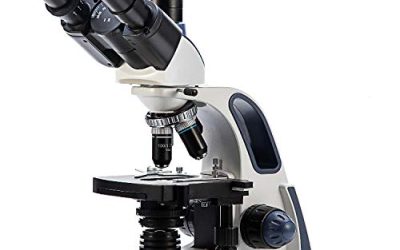
This is the most photography-forward package in the roundup because the imaging system is not an accessory decision left for later: an 18MP USB 3.0 camera with a 0.5X reduction lens and a calibration slide ships in the box, mounted over a trinocular head that allows simultaneous viewing through the eyepieces and the port. The phase kit is equally complete. Four plan phase-contrast objectives (PH10X, PH20X, PH40X and the oil PH100X) pair with a turret phase disk whose annuli can each be centered individually, so phase photography is available at every working magnification rather than just the two most common ones.
- Magnification: 40X–2500X brightfield; 100X–2500X phase contrast
- Eyepieces: WF10X/18 and WF25X widefield pairs
- Brightfield objectives: achromatic DIN 4X, 10X, 40X (spring), 100X (spring, oil)
- Phase kit: plan PH10X, PH20X, PH40X (S), PH100X (S, oil) objectives; turret phase disk with individually centerable annuli; centering telescope included
- Camera: 18MP USB 3.0, 4912 x 3684 stills, 0.5X reduction lens, 0.01mm calibration slide, capture and measurement software for Windows, Mac and Linux
- Head: trinocular, 45-degree inclined, 360-degree swiveling
- Illumination and condenser: variable-intensity LED; Abbe NA1.25 condenser with iris diaphragm
- Extras: hard aluminum carrying case
Who it is for: photographers who want one purchase to cover live-cell phase work and high-resolution documentation, especially culture monitoring where the 20X phase objective is the everyday lens and stills need enough pixels for cropping.
Limitations: the camera needs a USB 3.0 host to reach its rated transfer speeds, and like most high-resolution microscope cameras it is a stills-first device, with smooth live video available at reduced resolutions rather than at full sensor size. The headline 2500X figure comes from the 25X eyepieces and exceeds what an NA1.25 optical system can resolve, so plan your photography around the 10X eyepiece range.
2. OMAX M837ZL-PHD — trinocular phase contrast frame for your own camera

ASIN: B00SGCFM98 — View on Amazon
Not everyone needs a bundled camera. If you already own a C-mount microscope camera, or you intend to choose one deliberately rather than accept a kit sensor, this version of the OMAX M837 platform sells the microscope and the phase kit on their own. The trinocular head carries the same adjustable photo port as its camera-bundle siblings, and the phase system is built around three separate condenser annulus plates matched to PH10X, PH40X and PH100X objectives, each plate centerable on its own with the included centering telescope.
- Magnification: 40X–2500X brightfield; 100X–2500X phase contrast
- Eyepieces: WF10X/18 and WF25X widefield pairs
- Brightfield objectives: achromatic DIN 4X, 10X, 40X (spring), 100X (spring, oil)
- Phase kit: achromatic PH10X, PH40X (S), PH100X (S, oil) objectives; NA1.25 condenser with three separate annulus plates (10X, 40X, 100X), each individually centerable; centering telescope included
- Camera: none included; trinocular photo port accepts a camera of your choice
- Head: trinocular, 45-degree inclined, 360-degree swiveling
- Illumination and condenser: replaceable 3W LED with variable intensity; Abbe NA1.25 condenser with iris diaphragm, rack-and-pinion adjustment
Who it is for: labs and serious hobbyists who already have an imaging camera they trust, and photographers who would rather put the whole budget into the optical bench than split it with a bundled sensor.
Limitations: there is no camera in the box, so the photography setup is incomplete until you add one, along with any adapter your camera needs. The phase set skips a 20X objective, which leaves a gap at the magnification many people use most for cell colonies, and swapping separate annulus plates is slower than rotating a turret disk when you change objectives often.
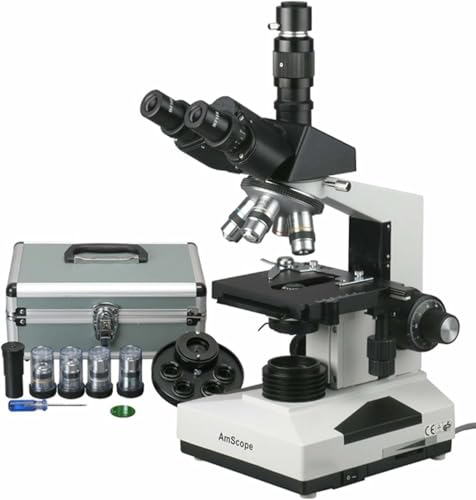
3. AmScope T490A-PCT — phase turret platform with darkfield and a C-mount port
ASIN: B005LVVCSW — View on Amazon
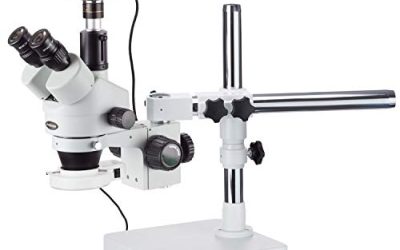
The T490A-PCT is built on one of the longest-running trinocular frames in this class, and its party trick is the condenser. The NA1.25 turret condenser carries brightfield, darkfield and four phase positions on a single dial, so the same microscope that photographs unstained cells in phase contrast can swing to darkfield for specimens that suit it, without swapping condensers. Four plan phase objectives (10X, 20X, 40X, 100X) deliver phase contrast at eight magnification settings across the two eyepiece pairs, and the vertical trinocular port accepts a 23mm eyepiece-tube camera or a C-mount camera with an adapter.
- Magnification: 40X–1600X across brightfield, darkfield and phase contrast
- Eyepieces: WF10X and WF16X widefield pairs
- Brightfield objectives: DIN achromatic 4X, 10X, 40XS (spring), 100XS (spring, oil)
- Phase kit: plan PH10X, PH20X, PH40X, PH100X (oil) objectives; NA1.25 turret phase-contrast condenser with brightfield, darkfield and four phase positions; centering eyepiece included
- Camera: none included; trinocular port fits 23mm or C-mount cameras (adapter dependent)
- Head: trinocular Siedentopf-style, 30-degree incline, 360-degree rotation, 55–75mm interpupillary range
- Illumination: 6V/20W halogen with rheostat control
- Stage: double-layer mechanical stage, 140 x 140mm, with 1mm divisions and a stage stop
Who it is for: photographers who want phase and darkfield in one instrument, prefer halogen illumination, or already own an AmScope-compatible camera and want the frame with the deepest accessory ecosystem of the three.
Limitations: as with the OMAX frame above, the camera is a separate purchase. Halogen light brings consumable bulbs and noticeable heat near the stage during long sessions, which living specimens do not appreciate, and the finite DIN optical system is an older design than the infinity-corrected platforms used in research-grade instruments.
Comparison table
| Model | Phase objectives | Phase condenser | Camera | Illumination | Magnification |
|---|---|---|---|---|---|
| OMAX M837ZL-PHB1-C180U3 (B01CESY1OQ) | Plan PH10X, PH20X, PH40X, PH100X oil | Turret phase disk, centerable annuli | 18MP USB 3.0 included | LED, variable | 40X–2500X |
| OMAX M837ZL-PHD (B00SGCFM98) | PH10X, PH40X, PH100X oil | Three separate annulus plates | None; trinocular port | 3W LED, variable | 40X–2500X |
| AmScope T490A-PCT (B005LVVCSW) | Plan PH10X, PH20X, PH40X, PH100X oil | Turret with brightfield, darkfield and phase positions | None; 23mm / C-mount port | 20W halogen, rheostat | 40X–1600X |
FAQ
Do I need a trinocular microscope for phase contrast photography?
For anything beyond occasional snapshots, yes. A trinocular head gives the camera its own optical path, so you can frame, focus and expose through the software while keeping both eyepieces free. Eyepiece-tube cameras on binocular heads work, but they replace one eyepiece, change the balance of the head and make simultaneous viewing impossible.
Why does the phase kit need a centering telescope?
Each phase objective contains a fixed phase ring, and the condenser must project its annulus exactly onto that ring. The centering telescope replaces an eyepiece temporarily so you can see both rings and adjust the annulus until they overlap. Skip this step and contrast collapses, no matter how good the optics are, so a kit that includes the telescope and centerable annuli is worth prioritizing.
Is a bundled camera or a separate camera better?
A bundled camera guarantees compatibility with the port and software on day one, and bundles such as the 18MP OMAX above are the fastest route to publishable stills. A separate camera makes sense when you have specific requirements, such as HDMI output for a monitor, higher frame rates for moving organisms, or a larger sensor. Both routes are legitimate; the mistake is buying a trinocular frame and assuming any camera will fit without checking the mount and reduction lens.
Can phase contrast microscopes photograph stained slides too?
Yes. Every model here is also a full brightfield microscope: rotate the phase condenser to its brightfield position (or fit the standard Abbe condenser setting), use the regular objectives, and the instrument behaves like a conventional laboratory microscope for stained histology and smears. The AmScope adds a darkfield condenser position as a third option.
What magnification do I actually need for cell photography?
Most cell culture and microbiology photography happens between 100X and 400X total magnification, which is why the 10X and 20X phase objectives matter so much. The 40X phase objective serves smaller bacteria and fine detail, and the 100X oil objective is for maximum-resolution work on tiny specimens. Figures beyond 1000X add size without adding resolved detail on NA1.25 optics.
Conclusion
For microscopy photography, the phase kit and the camera path have to be chosen together. If you want the complete system in one box, the OMAX M837ZL-PHB1-C180U3 pairs a full set of plan phase objectives and a centerable turret disk with an 18MP USB 3.0 camera, and it is the easiest recommendation here. If you already own a camera you trust, the OMAX M837ZL-PHD delivers the same bench and a three-objective phase kit without charging you for a second sensor. And if darkfield work sits alongside phase contrast in your photography, the AmScope T490A-PCT remains a proven halogen platform with both modes on one turret condenser. Whichever route you take, confirm the phase objectives are genuinely phase-ring models, keep the centering telescope somewhere safe, and your unstained specimens will finally photograph the way they look alive.