Key takeaways
- Compare five digital laboratory microscopes with built-in cameras for microscopy photography, from high-resolution compound models to stereo zoom scopes.
Choosing a digital laboratory microscope for microscopy photography means balancing two instruments at once: the optics that show the specimen and the camera that records it. A scope with a weak camera produces soft, noisy images no matter how good the glass is, while a high-resolution camera cannot rescue poor illumination or a stage that drifts during long exposures. Buyers also face a real fork in the road between stereo zoom scopes, which suit larger three-dimensional specimens and inspection work, and compound scopes, which reach the high magnifications needed for slides and cells.
This guide is written for lab workers, teachers, researchers, and photographers who need to capture what they see through a microscope rather than only look at it. Every microscope below was chosen from names and specifications listed on its Amazon product page, with attention to camera resolution, magnification range, illumination, and the type of work each design handles best.
Quick Picks
As an Amazon Associate we earn from qualifying purchases
| Product | Best for | Key spec |
|---|---|---|
| AmScope SM-3TZZ-54S-5M | Large specimens on a boom stand | 5MP camera, 3.5X to 180X zoom |
| AmScope SM-1TZ-FRL-GT-9M | High-resolution stills on a pillar stand | 9MP camera, 3.5X to 90X zoom |
| AmScope SM-6TZ-FRL-5M | Bench work with a clamp-on arm | 5MP camera, 3.5X to 90X zoom |
| AmScope T690C-PL-10M | Slide work at very high magnification | 10MP camera, 40X to 2500X range |
| OMAX M83EZ-C03S | Teaching labs on a smaller outlay | 0.3MP USB camera, 40X to 2500X range |
How to Choose
Match the Microscope Type to the Specimen
Stereo and compound microscopes serve different subjects, so the specimen should decide the design before anything else. Stereo zoom scopes give a three-dimensional view with a long working distance, which suits circuit boards, insects, coins, plant material, and anything that must be handled while it is under the lens. Compound microscopes use transmitted light through thin slides and reach far higher magnification, which suits cells, bacteria, tissue sections, and prepared slides. A buyer who photographs pond water or blood smears needs a compound scope, while someone documenting solder joints or gemstones needs a stereo scope. Picking the wrong type first makes every later specification irrelevant.
Weigh Camera Resolution Against Frame Rate
Camera resolution decides how much detail a still image holds, yet the frame rate decides how smooth the live view feels while focusing. A 9MP or 10MP camera captures fine stills for publication and documentation, but it may refresh slowly at full resolution, which makes live focusing feel laggy. Lower resolutions refresh faster and suit teaching demonstrations and live inspection, where smooth movement matters more than pixel count. Check the capture resolution and maximum frame rate together on the product page rather than trusting the headline megapixel figure alone. For microscopy photography, a camera that holds focus comfortably during a session often beats a higher-resolution sensor that stutters.
Check Illumination and the Stand
Even lighting separates a usable microscopy photograph from a muddy one, and the stand decides which specimens fit underneath the lens. Ring lights spread light evenly across opaque subjects on stereo scopes, while transmitted LED or halogen illumination shines through slides on compound scopes. Fluorescent ring lights run cool and give soft, even coverage for long sessions. Boom stands and articulating arms leave room for bulky objects and let the head swing over a workbench, while pillar stands hold the scope steady in a fixed footprint for repeated slide work. Confirm the light type, whether its brightness adjusts, and whether the stand suits the size of specimen being photographed.
Confirm Software and Computer Compatibility
A digital microscope is only as useful as the software that captures its images, so operating system support deserves a check before ordering. Most bundled cameras ship with Windows software for still capture, video recording, measurement, and image stitching, while Mac and Linux support varies by model and sometimes needs a different application. Confirm the supported operating system versions, whether the software handles measurement and annotation, and whether stills save in a standard image format. Also check the connection type, since USB cameras need a nearby computer while HDMI models can feed a monitor directly. A scope that cannot talk to the computer on the bench becomes an expensive optical microscope.
The 5 Best Options
AmScope SM-3TZZ-54S-5M Digital Stereo Microscope

This AmScope stereo zoom microscope pairs a wide 3.5X to 180X magnification range with a 5MP USB camera, making it a flexible choice for photographing larger specimens that need room to move. Its single-arm boom stand leaves the bench clear for circuit boards, mineral samples, and other bulky objects, while the 54-LED ring light with a dimmer gives even illumination that can be tuned to the subject. The trinocular head swivels a full circle, so sharing the view with a colleague or repositioning the camera takes seconds. Software for Windows, Mac, and Linux covers capture, measurement, and editing.
Specs
- Magnification range: 3.5X to 180X
- Camera: 5MP USB 2.0 color camera, 2592 by 1944 pixels
- Sensor: Aptina MT9P001 CMOS
- Light source: 54-LED ring light with dimmer
- Head: 45 degree inclined trinocular, 360 degree swiveling
- Eyepieces: 10X and 20X super widefield high-eyepoint
- Zoom objective: 0.7X to 4.5X with 0.5X and 2X Barlow lenses
- Stand: single-arm boom stand
- Reduction lens: 0.5X included
Best for: Photographing large or bulky specimens with room to handle them under the lens.
Watch out for: The boom stand needs a sturdy bench edge and clear space behind it, so measure the workspace first.
ASIN: B007RFJU48
AmScope SM-1TZ-FRL-GT-9M Digital Stereo Microscope

For buyers who want the sharpest still images in this roundup, this AmScope model pairs a 9MP camera with a steady pillar stand and fluorescent lighting. Its 3.5X to 90X zoom range covers most inspection and documentation tasks, from coins and stamps to small mechanical parts, and the extra-large pillar base keeps the scope planted during long shooting sessions. Fluorescent illumination runs cool and spreads light smoothly across the subject, which helps when photographing reflective surfaces. The trinocular head rotates fully, and the included software supports image processing, measurement, and stitching on Windows, Mac, and Linux.
Specs
- Magnification range: 3.5X to 90X
- Camera: 9MP USB 2.0 color camera, 3488 by 2616 pixels
- Sensor: CMOS, pixel size 1.67 micrometres
- Light source: fluorescent ring light
- Head: trinocular, 45 degree incline, 360 degree rotatable
- Optical system: Greenough stereoscopic
- Barlow lenses: 0.5X and 2X included
- Stand: pillar stand with extra-large base
- Frame rates: 1.9 frames per second at 3488 by 2616, 8 at 1744 by 1308, 27 at 872 by 654
Best for: High-resolution still photography of small solid objects on a fixed lab bench.
Watch out for: Full-resolution live view refreshes slowly, so focus at a lower resolution before capturing the final still.
ASIN: B005MT2W1Y
AmScope SM-6TZ-FRL-5M Digital Stereo Microscope

Where bench space is tight, this AmScope stereo microscope clamps its articulating arm to the edge of a desk and swings out of the way when the work is done. The 5MP camera records stills and video through USB, and the 8W fluorescent ring light gives smooth, cool illumination for extended inspection sessions. Its 3.5X to 90X zoom range, 100mm working distance, and widefield eyepieces suit electronics repair, engraving, and quality-control photography. The trinocular head inclines at 45 degrees and rotates a full circle, which keeps viewing comfortable during long sessions at the bench.
Specs
- Magnification range: 3.5X to 90X
- Camera: 5MP USB 2.0 color camera, 2592 by 1944 pixels
- Light source: 8W fluorescent ring light
- Head: trinocular, 45 degree incline, 360 degree rotatable
- Optical system: Greenough stereoscopic
- Interpupillary adjustment: 54 to 76mm
- Eyepieces: 10X super widefield high-eyepoint
- Zoom objective: 0.7X to 4.5X
- Working distance: 100mm
- Stand: clamping articulating arm
- Frame rates: 5 frames per second at 2592 by 1944, 18 at 1280 by 960, 60 at 640 by 480
Best for: Shared or crowded benches where a clamp-on arm beats a fixed base.
Watch out for: The clamp needs a bench edge thick enough to grip firmly, so check the edge before ordering.
ASIN: B005MKYDSI
AmScope T690C-PL-10M Digital Compound Microscope

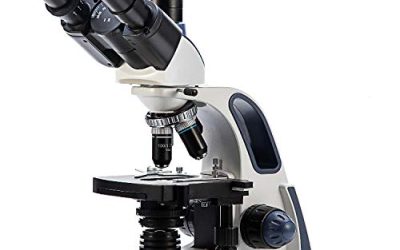
This AmScope compound microscope is the strongest pick here for slide photography at high magnification, with a 10MP camera and a 40X to 2500X range built around infinity plan achromatic objectives. The Kohler condenser and brightfield halogen illumination give even light across the field, which matters when photographing cells and tissue sections for records or teaching. Its double-layer mechanical stage moves slides precisely, and the trinocular head carries a vertical camera mount so the camera stays aligned with the optics. Super-widefield eyepieces in 10X and 25X give a broad view before the camera takes over.
Specs
- Magnification range: 40X to 2500X
- Camera: 10MP USB 2.0 color camera, 3584 by 2748 pixels
- Sensor: 1/2.3 inch Aptina MT9J001 CMOS
- Objectives: infinity plan achromatic, four positions
- Eyepieces: WH10x and WH25x super-widefield
- Condenser: Kohler condenser
- Illumination: brightfield halogen
- Stage: double-layer mechanical stage
- Reduction lens: included with camera
- Head: trinocular with vertical camera mount, 360 degree rotation
Best for: High-magnification slide photography for research, teaching, and lab documentation.
Watch out for: Halogen illumination runs warm during long sessions, so allow cooling time between extended slide runs.
ASIN: B00ALA16F2
OMAX M83EZ-C03S Digital Compound Microscope
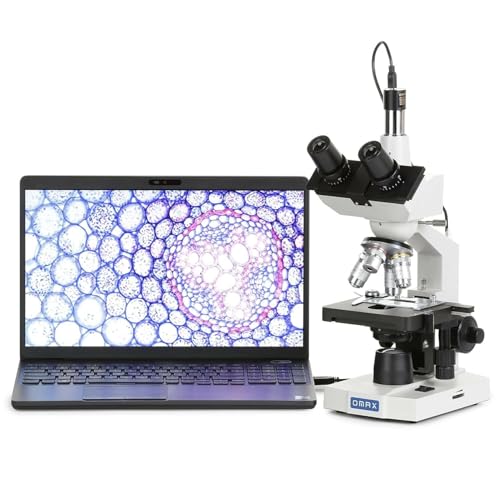
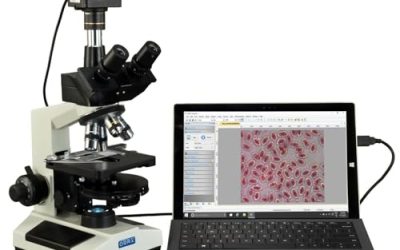
Teachers and small labs that need digital capture without a large outlay will find this OMAX compound microscope a practical entry point. Its 40X to 2500X range covers the standard slide work of a teaching lab, and the built-in USB camera streams a live view to a Windows computer for classroom projection or shared viewing. Four achromatic objectives, a double-layer mechanical stage, and an Abbe condenser with a 1.25 numerical aperture give solid optical foundations, while LED transmitted illumination stays cool and steady. The trinocular head swivels a full circle for easy sharing between viewers.
Specs
- Magnification range: 40X to 2500X
- Camera: 0.3MP USB digital camera, 640 by 480 pixels
- Frame speed: 30 frames per second at 640 by 480
- Head: 45 degree inclined trinocular, 360 degree swiveling
- Objectives: four achromatic objectives
- Eyepieces: two pairs of widefield eyepieces
- Condenser: NA 1.25 Abbe condenser
- Stage: stain-resistant double-layer mechanical stage with scales
- Illumination: variable intensity LED transmitted illumination
- Focusing: coarse and fine focusing
- Compatibility: Windows
Best for: Classroom demonstrations and basic slide imaging where live projection matters most.
Watch out for: The 640 by 480 camera suits live viewing and basic records, so do not expect publication-grade stills from it.
ASIN: B01BPJJ1IQ
Which One Fits Your Situation
Photographing Circuit Boards and Small Parts
Inspection and repair work calls for a stereo scope with a long working distance and a camera that keeps up with hand movements. The AmScope SM-6TZ-FRL-5M fits here because its clamp-on articulating arm swings over a workbench, its fluorescent ring light stays cool, and its 5MP camera refreshes quickly at lower resolutions. The AmScope SM-3TZZ-54S-5M is the alternative when larger boards need the open space of a boom stand.
Documenting Slides for Teaching or Research
Slide photography needs high magnification, even transmitted light, and a camera with enough pixels for detailed stills. The AmScope T690C-PL-10M leads this situation with its 10MP camera, plan objectives, and Kohler condenser, which together produce clean, evenly lit slide images. When the goal is live projection to a class rather than fine stills, the OMAX M83EZ-C03S covers the same magnification range with a simpler camera at a smaller outlay.
Building a Fixed Photography Station
A permanent bench station rewards stability and the highest still resolution available. The AmScope SM-1TZ-FRL-GT-9M suits this setup because its 9MP camera captures detailed stills and its heavy pillar base holds position through repeated sessions. Pair it with a fixed monitor and consistent lighting, and the station produces comparable images from one specimen to the next without constant readjustment.
Working in a Shared or Crowded Lab
Shared benches need equipment that adapts to different users and packs away cleanly. The AmScope SM-6TZ-FRL-5M works well here since its clamp-on arm frees the bench surface and its rotating trinocular head lets each viewer find a comfortable angle. For shared slide work, the OMAX M83EZ-C03S offers a straightforward USB camera and Windows software that new users can learn quickly.
Common Mistakes
- Buying a stereo scope for slide work, or a compound scope for bulky three-dimensional objects, instead of matching the design to the specimen first.
- Judging a camera by megapixels alone while ignoring frame rate, sensor size, and whether the software supports measurement and annotation.
- Overlooking illumination, so uneven or harsh light ruins images that the optics and camera could otherwise capture cleanly.
- Forgetting to check operating system support, then discovering the bundled capture software does not run on the computer at the bench.
- Treating the headline magnification figure as image quality, when optical resolution, condenser quality, and focus stability matter far more.
Frequently Asked Questions
What magnification do I need for microscopy photography?
Most photography work falls into two bands: stereo scopes from 3.5X to 180X suit solid objects, inspection, and larger specimens, while compound scopes from 40X to 2500X suit slides, cells, and tissue sections. Choose the band that matches the subject, since no single scope covers both well. Higher magnification without matching optical resolution only enlarges a blurry image.
Is a built-in camera better than adding one later?
A bundled camera is matched to the trinocular port, includes a reduction lens, and ships with capture software, which removes guesswork about mounts and compatibility. Adding a camera later offers more choice of sensor, but it requires checking the port size, mount type, and software support. For most buyers, a bundled digital model is the simpler and safer route.
Do I need a trinocular head for microscopy photography?
Yes, a trinocular head is the practical choice because its third port holds the camera while both eyepieces stay free for viewing. Binocular models force a choice between looking and photographing, or need an eyepiece adapter that narrows the field. A switched or simul-focal trinocular port lets the camera and eyepieces work at the same time.
Can these microscopes record video as well as stills?
All five models in this guide capture both still images and video through their USB cameras, using the bundled software on a connected computer. Still resolution is higher than video resolution on most models, and frame rates rise as the capture resolution falls. For smooth live viewing, select a lower resolution, then switch to full resolution for the final still.