Our Short List of 3

- 14mm prime, f/1.8 to f/16, Sony E mount, full frame, 460 g, 83 x 99.8 mm, 114-degree angle of view, 0.25 m minimum focus distance, rear gel filter holder.

- 17-28mm zoom, constant f/2.8 aperture, Sony E mount, full frame, 420 g, 99 mm long, 67 mm filter thread, RXD stepping motor autofocus.

- 15mm prime, f/2 to f/22, Sony E mount, full frame, manual focus, 500 g, 82 mm long, 72 mm filter thread, 110-degree angle of view, 0.15 m minimum focus distance.
All 4 Picks at a Glance
| Product | Specs | Action |
|---|---|---|
| Sony FE 14mm f/1.8 GM |
| Check price on Amazon |
| Tamron 17-28mm f/2.8 Di III RXD |
| Check price on Amazon |
| Venus Optics Laowa 15mm f/2 FE Zero-D |
| Check price on Amazon |
 Sony FE 24mm f/1.4 GM |
| Check price on Amazon |
Key takeaways
- The best lenses for astrophotography: five fast wide-angle lenses for Milky Way and night sky shots, from a budget manual prime to pro glass.
Astrophotography asks more of a lens than almost any other kind of photography. The subject is faint, the light is scarce, and the exposure is long, so a lens that is merely good in daylight can fall apart under a dark sky. The Milky Way core, a meteor shower, or a faint nebula rising over a ridge all reward the same combination: a wide field of view, a fast maximum aperture, and clean rendering in the corners of the frame, where point light sources either stay round or smear into little wings.
The five lenses below were picked for exactly that job. Every one of them is wide, fast, and suited to long exposures of the night sky, but they differ in meaningful ways: one is a featherweight flagship prime, one is the only zoom on the list, one is a manual focus classic that costs a fraction of the others, one is a distortion-free manual prime, and one trades a little width for a brighter aperture and a tighter frame.
As an Amazon Associate, we earn from qualifying purchases.
Quick answer
The Sony FE 14mm f/1.8 GM is the best lens for astrophotography for most Sony shooters, combining a fast aperture with a compact body and strong corner sharpness. If you want zoom flexibility, take the Tamron 17-28mm f/2.8 instead, and if your budget is tight, the manual focus Rokinon 14mm f/2.8 delivers the classic wide astro view for far less money.
Sony FE 14mm f/1.8 GM
- 14mm prime, f/1.8 to f/16, Sony E mount, full frame, 460 g, 83 x 99.8 mm, 114-degree angle of view, 0.25 m minimum focus distance, rear gel filter holder.
The Sony FE 14mm f/1.8 GM is the lens most night sky photographers would pick if they could only own one astro prime. At 14mm it takes in a huge sweep of sky, so the Milky Way core fits comfortably in the frame with room for a foreground subject below it. At f/1.8 it gathers far more light than a typical kit zoom, which means shorter exposures and cleaner files. And at 460 grams it is remarkably light for a lens of this speed.
What sets this lens apart is its corner performance. Astrophotography is unforgiving about coma, the aberration that stretches point light sources into little comet shapes near the edges of the frame, and this lens controls it better than most in its class. The lens takes rear gel filters rather than a front filter thread, which is a limitation if you like screw-on light pollution filters.
Tamron 17-28mm f/2.8 Di III RXD
- 17-28mm zoom, constant f/2.8 aperture, Sony E mount, full frame, 420 g, 99 mm long, 67 mm filter thread, RXD stepping motor autofocus.
A zoom lens is not the obvious choice for astrophotography, where every fraction of an aperture stop counts, but the Tamron 17-28mm f/2.8 Di III RXD earns its place by being the most flexible lens on this list. At 17mm it is wide enough for a broad Milky Way panorama, and at 28mm it frames tighter compositions such as a single constellation or a mountain peak under the galactic core. That range means one lens can cover a whole night of shooting without a lens change in the dark.
The constant f/2.8 aperture is the key number here. It is a stop slower than the f/1.8 primes on this list, which means longer exposures or higher sensitivity settings for the same brightness, but it is still fast enough for clean Milky Way images, especially on a modern full frame body. Coma is controlled well for a zoom, and the center is sharp at full aperture, though the corners are a little softer than the best primes. The 67 mm front filter thread is a real advantage over primes that take only rear gels, because a screw-on light pollution filter can make a visible difference under skies that are not fully dark.
Rokinon 14mm f/2.8 IF ED UMC
The Rokinon 14mm f/2.8 IF ED UMC is the lens that introduced a generation of photographers to astrophotography, and it remains the best value on this list by a wide margin. It is a fully manual lens with a built-in AE chip for Nikon F mount cameras, so the camera meters normally while you focus by hand.
Specs
- 14mm prime, f/2.8 aperture, Nikon F mount, full frame, manual focus with built-in AE chip, 114.2-degree angle of view, about 550 g.
The appeal starts with the field of view. At 14mm on a full frame body, this lens takes in the whole Milky Way arch with room to spare, and its 114.2-degree angle of view makes it easy to compose a scene with a strong foreground and a big sky above it. The f/2.8 aperture is a stop slower than the fastest primes here, but it is fast enough for the classic Milky Way exposure, and the lens is sharp in the center at full aperture. The honest weaknesses are in the corners, where coma and softness are more visible than on the Sony GM primes. For a photographer learning the night sky, that is a fair trade: the money saved buys a tripod, a remote release, or a dark sky trip.
Venus Optics Laowa 15mm f/2 FE Zero-D
- 15mm prime, f/2 to f/22, Sony E mount, full frame, manual focus, 500 g, 82 mm long, 72 mm filter thread, 110-degree angle of view, 0.15 m minimum focus distance.
The Venus Optics Laowa 15mm f/2 FE Zero-D is the most specialized lens on this list, and the one that rewards a photographer who likes to work deliberately. It is a fully manual prime for Sony E mount full frame cameras, with an f/2 aperture and a design that keeps straight lines straight, which is what the Zero-D name promises. For astro work, the low distortion matters less than it does for architecture, but the fast aperture matters a great deal.
At 15mm and f/2, this lens sits in a sweet spot for night sky shooting. The field of view is a touch narrower than the 14mm lenses, which can be an advantage when you want the Milky Way core to fill more of the frame, and f/2 gathers noticeably more light than f/2.8. Its 12-element design renders point light sources cleanly across most of the frame. The 72 mm front filter thread is a genuine advantage, because it accepts a standard screw-on light pollution filter, something the bulbous front elements of other wide primes cannot do. At f/2 the corners darken noticeably, and corner softness improves only as you stop down.
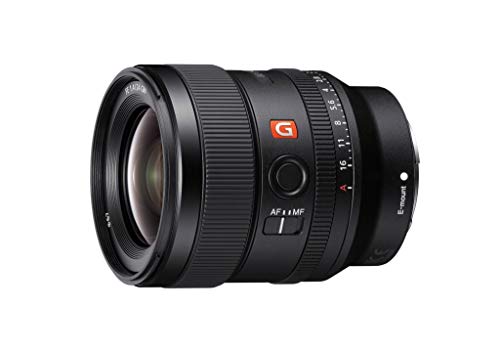
Sony FE 24mm f/1.4 GM
- 24mm prime, f/1.4 to f/16, Sony E mount, full frame, 445 g, 75 mm diameter, 67 mm filter thread, 0.24 m minimum focus distance, 11-blade aperture.
The Sony FE 24mm f/1.4 GM is the longest and fastest lens on this list, and it fills a role the wider lenses cannot. At 24mm it frames a tighter slice of sky, which makes it the right choice for a single constellation, a detailed Milky Way core, or a landscape where the sky is part of the composition rather than the whole of it. At f/1.4 it is the brightest aperture here, gathering more light than any other lens in this roundup.
Two extreme aspherical elements and three extra-low dispersion elements keep coma under control, and the result is point light sources that stay round across the frame at full aperture. The f/1.4 aperture changes how you shoot: compared with an f/2.8 lens, it gathers four times as much light, which means you can cut exposure time dramatically or lower the sensitivity setting for cleaner files. The limitation is the field of view: at 24mm, the Milky Way arch will not fit in a single frame, and you will need to stitch a panorama to capture the whole sweep of the galactic core.
How to choose
Start with your camera mount, because it narrows the field immediately. Sony E mount shooters have the widest choice on this list, with three lenses made for their system, while Nikon F mount shooters have the Rokinon as the clear value pick. Buying a lens for a mount you do not own is the one mistake that cannot be fixed in post-processing, so confirm the mount in the Specs line before anything else. Next, decide how wide you need to go. A 14mm or 15mm lens takes in the whole Milky Way arch, which suits landscape astrophotography, while a 24mm lens frames a tighter view of the galactic core. If you are not sure, start wider: you can always crop a wide frame. Aperture is the third decision: a faster aperture means shorter exposures and cleaner files, which matters most without a tracking mount. Then consider manual focus against autofocus: astro work is almost always done by hand, using magnified live view and a bright point of light, so a manual focus lens is not a handicap here. Finally, a front filter thread lets you use a screw-on light pollution filter, which helps under skies that are not fully dark.
Who should skip
Skip this roundup if you shoot deep-sky targets through a telescope, because these wide-angle lenses are built for broad nightscapes, not for small, faint objects that need long focal lengths and tracking mounts. A 14mm lens will show the Andromeda galaxy as a small smudge, and no amount of aperture will change that. Skip the fastest primes if your camera is an APS-C body and you are buying your first astro lens: on a crop sensor, a 14mm lens behaves like a 21mm lens, and a dedicated APS-C wide prime may serve you better for less money. Skip the manual focus lenses if you want one lens that does everything, including daytime portraits and family photography, since manual focus is slow for moving subjects in daylight.
Frequently Asked Questions
What aperture should I use for Milky Way photography?
Most night sky photographers shoot at or near the widest aperture of their lens, because the night sky is faint and every bit of light helps. An f/1.8 or f/1.4 lens can be used wide open with good results, while an f/2.8 lens is also commonly used at its maximum aperture. Stopping down can sharpen the corners, but it costs light.
Do I need autofocus for astrophotography?
No, autofocus is not needed for night sky photography. The standard method is to switch to manual focus, point at a bright point of light in the sky, and use magnified live view to adjust focus until that point is as small and sharp as possible. All five lenses on this list focus this way.
What focal length is best for photographing the Milky Way?
A focal length between 14mm and 24mm on a full frame camera covers most Milky Way photography. A 14mm or 15mm lens captures the whole galactic arch in one frame, which suits landscape astrophotography. A 24mm lens frames a tighter view of the galactic core with more detail.
Can I use these lenses on an APS-C camera?
Yes, all five lenses will mount and work on APS-C cameras of the same mount, but the field of view becomes narrower because of the crop factor. A 14mm lens behaves like a 21mm lens on a Sony APS-C body, and a 24mm lens behaves like a 36mm lens. The lenses still perform well, but APS-C shooters may prefer a dedicated wide prime made for their sensor size.
Final verdict
The Sony FE 14mm f/1.8 GM is the best lens for astrophotography on this list, and it is the one to buy if you shoot Sony full frame. The Tamron 17-28mm f/2.8 is the best choice if you want one lens that covers the night sky and daylight landscapes alike, and the Sony FE 24mm f/1.4 GM is the best second lens for tighter, brighter compositions. The Rokinon 14mm f/2.8 remains the smartest starting point for Nikon shooters and for anyone on a tight budget, while the Laowa 15mm f/2 suits Sony shooters who want a manual prime with a filter thread. Whichever you choose, a sturdy tripod, a dark sky, and patience with manual focus matter as much as the lens.
Product and ASIN Reference
| Product | ASIN |
|---|---|
| Sony FE 14mm f/1.8 GM | B09316YPCH |
| Tamron 17-28mm f/2.8 Di III RXD | B07TP4YM1F |
| Rokinon 14mm f/2.8 IF ED UMC | B004NNUN02 |
| Venus Optics Laowa 15mm f/2 FE Zero-D | B075ZTC8X7 |
| Sony FE 24mm f/1.4 GM | B07HJXVHSS |