Our Short List of 3
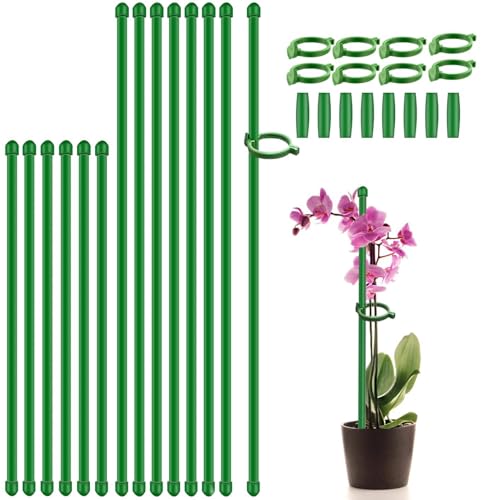
- Best for: Mixed indoor and outdoor pots where stems range from short to tall and the holding height needs adjusting.
- 16 fiberglass stakes: 8 at 17 inches and 8 at 11 inches
- Stake diameter of 0.25 inch
- 16 movable leaf-shaped ring buckles
- 8 connectors in two sizes for joining stakes to increase length

- Best for: Indoor climbers that need a tall, extendable coir surface to climb over several seasons.
- 4 coco coir poles, each 16 inches long and 1.8 inches wide
- Stackable to 48 inches
- Reinforced PVC core with a pointed soil stake
- Includes 16 feet of jute rope and 6.6 feet of hook-and-loop tape

- Best for: Bushy potted flowers and vegetables that flop outward and need a cage around the outer stems.
- 6 half-round stakes, each 10 inches wide by 24 inches high
- 4 mm powder-coated iron wire
- Dark green finish
- Two pieces can be joined together to support a plant
All 4 Picks at a Glance
| Product | Specs | Action |
|---|---|---|
| SupKing Adjustable Length Plant Support Stakes, 16-Piece |
| Check price on Amazon |
| The Blooming Jungle Moss Pole, 4-Pack 16-Inch |
| Check price on Amazon |
| HiGift Half Round Plant Support Stakes, 6-Pack 24-Inch |
| Check price on Amazon |
 Lunhans Plant Support Stakes with Clips, 12-Pack 16-Inch |
| Check price on Amazon |
Key takeaways
- Compare the best plant supports for pots, from adjustable fiberglass stakes to stackable moss poles and half-round cages, matched to pot size and plant height.
A potted plant that leans, flops, or outgrows its first stake needs a support that fits the container as well as the plant. The real decision is not simply tall versus short. A slender stake suits a single upright stem, a coir pole gives a climber something to grip, and a half-round cage contains a bushy plant that spreads sideways. Choosing the wrong shape leaves the stem unsupported at the point where it bends, or crowds a small pot with a frame that is wider than the soil surface.
This guide is for indoor growers with a shelf of potted flowers, owners of climbing monstera and pothos, and gardeners keeping peonies, hydrangeas, roses, and lilies upright in pots. The four supports below were chosen from their Amazon listing names and specifications, covering adjustable fiberglass stakes, a stackable coir pole, a half-round metal cage, and a clip-and-stake set for single stems.
Quick Picks
As an Amazon Associate we earn from qualifying purchases.
| Product | Best for | Key spec from title |
|---|---|---|
| SupKing Adjustable Length Plant Support Stakes, 16-Piece | Mixed pots with stems of different heights | 16 pieces in 17-inch and 11-inch lengths |
| The Blooming Jungle Moss Pole, 4-Pack 16-Inch | Climbing plants that need more height over time | 4-pack of 16-inch poles, stackable up to 48 inches |
| HiGift Half Round Plant Support Stakes, 6-Pack 24-Inch | Bushy potted plants that flop outward | 10 inches wide by 24 inches high, half-round metal |
| Lunhans Plant Support Stakes with Clips, 12-Pack 16-Inch | Single tall stems in several pots | 12 stakes with 24 clips, 16-inch length |
How to Choose
Match the support shape to the plant
A plant support works only when its shape matches how the plant grows. A single-stem flower such as a rose, lily, or amaryllis needs one upright stake with a loop or clip near the stem to keep it vertical. A climber such as monstera, pothos, or philodendron needs a vertical surface it can grip, which is why a coir pole fits better than a bare rod. A bushy plant such as a peony, hydrangea, or tomato spreads in every direction, so a half-round cage against the pot edge contains the outer stems. Before ordering, look at the plant from the side and note where it bends and whether one stem or many need holding.
Size the support to the pot, not just the plant
Height on a listing can mislead when the pot is shallow or narrow. A 24-inch cage sounds generous, but if only a few inches of leg sit in the soil, a top-heavy plant can pull it over after watering. Measure the pot opening, then check the support width against it, and allow for the part of the stake that must sit below the soil. A support slightly shorter than the mature plant is often more stable than a very tall one in a small pot, because the buried section and the pot weight work together. For a plant that will keep growing, a stackable or joinable design lets height increase without replacing the support or disturbing roots.
Choose a material for indoor or outdoor use
Fiberglass, coated steel, and coir behave differently in damp soil and sunlight. Fiberglass stakes resist rust and rot, which makes them practical for pots that stay moist indoors and for outdoor containers exposed to rain. Powder-coated iron wire is sturdy for heavier bushy plants, but once the coating chips, the exposed metal underneath is the weak point, so check the finish where the wire meets the soil. Coir poles suit indoor climbers because aerial roots can grip the fibre, yet the base can stay wet in a frequently watered pot, so the pole needs a firm, well-drained mix. Match the material to where the pot lives and how much weight it must carry.
Check how stems are held and whether height can grow
A support that only stands beside a plant does little unless the stem is attached at the right points. Ring buckles that slide up and down let the holding point move as the plant grows, while separate clips fasten a stem without wrapping a tie tightly around it. Ties and jute rope work well for climbers that need guiding along a pole, but they should hold the stem close without cutting into soft growth. Also check whether the set can be extended. Connectors that join two stakes, or pole sections that stack, mean one purchase can follow a plant from a cutting to a mature specimen, instead of forcing a replacement support halfway through the season.
The 4 Best Options
SupKing Adjustable Length Plant Support Stakes, 16-Piece
- Best for: Mixed indoor and outdoor pots where stems range from short to tall and the holding height needs adjusting.
- 16 fiberglass stakes: 8 at 17 inches and 8 at 11 inches
- Stake diameter of 0.25 inch
- 16 movable leaf-shaped ring buckles
- 8 connectors in two sizes for joining stakes to increase length
Mixed indoor and outdoor pots where stems range from short to tall and the holding height needs adjusting.
Check the joined length before building a tall support, because a stake extended with connectors needs a deep enough pot and firm soil to stay upright.
This set fits a household with many potted plants at different stages, because the two stake lengths and the joining pieces cover short seedlings and taller stems from one box. The movable ring buckles are the most useful feature for orchids, amaryllis, lilies, and potted vegetables, since each ring can be slid to the exact height where a stem starts to lean. Fiberglass keeps the stakes light in small pots, and the included ties give a second way to secure growth that does not sit neatly inside a ring.
Watch out for: Check the joined length before building a tall support, because a stake extended with connectors needs a deep enough pot and firm soil to stay upright.
The Blooming Jungle Moss Pole, 4-Pack 16-Inch
- Best for: Indoor climbers that need a tall, extendable coir surface to climb over several seasons.
- 4 coco coir poles, each 16 inches long and 1.8 inches wide
- Stackable to 48 inches
- Reinforced PVC core with a pointed soil stake
- Includes 16 feet of jute rope and 6.6 feet of hook-and-loop tape
Indoor climbers that need a tall, extendable coir surface to climb over several seasons.
Handle the pointed end with care when pushing the pole into soil, and leave enough buried length so a tall stack does not wobble in a light pot.
This coir pole fits a climbing houseplant that is still growing, because the sections stack instead of forcing a single fixed height. A monstera, pothos, or philodendron can be guided up one 16-inch section at first, then given another section as new leaves appear, so the support grows with the plant rather than being replaced. The coir surface gives aerial roots something to grip, which a smooth rod does not, and the included rope and hook-and-loop tape provide two ways to hold stems against the pole while they establish.
Watch out for: Handle the pointed end with care when pushing the pole into soil, and leave enough buried length so a tall stack does not wobble in a light pot.
HiGift Half Round Plant Support Stakes, 6-Pack 24-Inch
- Best for: Bushy potted flowers and vegetables that flop outward and need a cage around the outer stems.
- 6 half-round stakes, each 10 inches wide by 24 inches high
- 4 mm powder-coated iron wire
- Dark green finish
- Two pieces can be joined together to support a plant
Bushy potted flowers and vegetables that flop outward and need a cage around the outer stems.
Measure the pot opening against the 10-inch width before ordering, and confirm that the legs can sit deep enough in the soil for a heavy, rain-soaked plant.
This half-round set fits bushy potted plants that splay outward rather than growing as a single stem. Peonies, hydrangeas, coneflowers, and potted tomatoes push stems sideways as buds get heavy, and a cage that hugs the plant from one side holds those outer stems without hiding the flowers. The six-piece pack covers several pots at once, and two pieces can be joined to form a full ring around a larger plant. The dark green finish blends into foliage, so the frame reads as part of the planting instead of standing out against it.
Watch out for: Measure the pot opening against the 10-inch width before ordering, and confirm that the legs can sit deep enough in the soil for a heavy, rain-soaked plant.
Lunhans Plant Support Stakes with Clips, 12-Pack 16-Inch
- Best for: Several potted single-stem flowers that each need one upright stake and a clip to stay vertical.
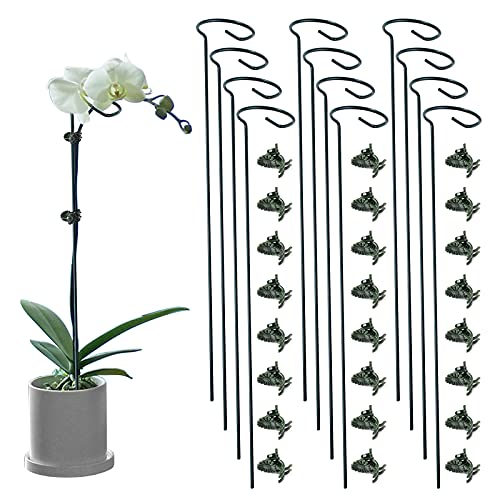
- 12 stakes plus 24 plant clips
- Nominal 16-inch length, item length 15.7 inches
- Top loop inner diameter of about 2.5 inches, wire diameter of 0.15 inch
- Alloy steel with green plastic coating
Several potted single-stem flowers that each need one upright stake and a clip to stay vertical.
Confirm the listed length and the loop size against the stem thickness before ordering, because a thick or woody stem may not sit comfortably inside a 2.5-inch loop.
This set fits a grower who needs the same simple support in many pots, because twelve stakes and twenty-four clips cover a whole shelf of single-stem plants. Each stake has a top loop that a stem passes through, so a rose, orchid, lily, peony, or tomato stem is held upright at one clear point instead of being tied along its whole length. The steel core with a green plastic coating suits indoor and outdoor pots, and the open slot in the loop makes it easier to slip a stem into place without bending it sideways.
Watch out for: Confirm the listed length and the loop size against the stem thickness before ordering, because a thick or woody stem may not sit comfortably inside a 2.5-inch loop.
Which One Fits Your Situation
A mixed shelf of small potted flowers
Choose the SupKing Adjustable Length Plant Support Stakes, because the 17-inch and 11-inch pieces cover different pot heights from one set, and the sliding ring buckles let each stem be held at its own leaning point. The connectors also help when one plant outgrows its first stake, since two pieces can be joined instead of buying a taller set.
A climbing monstera or pothos that keeps growing
Choose The Blooming Jungle Moss Pole, because the four 16-inch coir sections stack to 48 inches and the coir surface gives aerial roots a place to grip. The jute rope and hook-and-loop tape included in the kit make it easier to guide new growth upward and keep the vine tidy as the plant adds height.
A bushy peony or hydrangea that flops outward
Choose the HiGift Half Round Plant Support Stakes, because the half-round cage sits against the pot edge and holds the outer stems that a single stake would miss. The 24-inch height and 10-inch width suit taller bushy plants, and two pieces can be joined into a full ring for a larger specimen.
Single tall stems such as roses, lilies, or amaryllis
Choose the Lunhans Plant Support Stakes with Clips, because each stake supports one stem through its top loop and the 24 included clips hold stems without wrapping ties around the whole plant. The twelve-piece pack is practical when several pots need the same straightforward support at the same time, with clips ready for each stem.
Common Mistakes
- Buying by plant height alone and ignoring the pot opening, so a wide cage does not fit or a tall stake has too little buried length to stay upright.
- Pushing a stake in after the plant is fully grown and damaging roots, instead of placing the support early and guiding new growth onto it.
- Tying a stem tightly against a stake, which can cut into soft growth as the stem thickens during the season.
- Choosing a smooth rod for a climber that needs a surface to grip, when a coir pole would give aerial roots something to hold.
- Leaving a support in wet soil without checking the base, so a coated metal frame rusts at a chip or a coir pole base stays waterlogged.
Frequently Asked Questions
How tall should a plant support be for a pot?
Match the support to the mature height of the plant and the depth of the pot together. Allow several inches of stake below the soil surface for anchoring, then choose a visible height that reaches near the point where the stem bends. A stackable or joinable support is useful when the plant is still growing, because height can be added without disturbing the roots or replacing the whole piece.
Do climbing plants need a moss pole or will a stake work?
A plain stake can hold a climber upright, but it gives aerial roots little to grip, so the plant may keep leaning away from the rod. A coir pole provides a textured surface that roots can attach to, which helps monstera, pothos, and philodendron grow upward in a straighter line. Use ties or hook-and-loop tape at first, then let the roots take over as the plant establishes.
Can two half-round supports be used together?
Yes, the HiGift half-round stakes in this guide are listed as joinable, so two pieces can be attached to form a full ring around a plant. That is useful for a larger bushy specimen in a wide pot, where a single half-round piece would only cover one side. Check the width of the joined ring against the pot opening before fitting it around an established plant.
When should a support be added to a potted plant?
Add the support while the plant is still young or at the start of the growing season, when the stem is flexible and the roots have not yet filled the pot. Pushing a stake into a mature, root-bound pot risks damaging roots. Early placement also lets new growth be guided onto the support gradually, instead of forcing a bent stem back into position later.