Our Short List of 3

- Best for: Couples traveling together who both monitor, and anyone reporting readings to a doctor.
- Model: BP4350
- Cuff fit: wrists 5.3 to 8.5 inches
- Memory: 200 readings total, 2 users (100 each)
- Connectivity: Bluetooth to OMRON Connect app

- Best for: Solo frequent travelers who want positioning guidance and automatic averaging.
- Model: BP6350
- Cuff fit: wrists 5.3 to 8.5 inches
- Memory: 90 readings, 1 user
- Connectivity: Bluetooth to OMRON Connect app
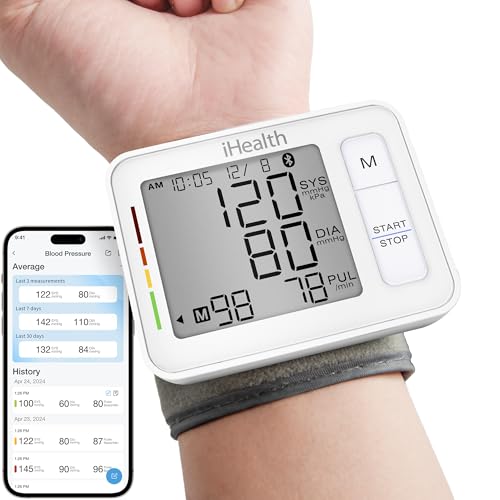
- Best for: Travelers with smaller wrists who want a hard case and simple app logging.
- Model: KD-723
- Cuff fit: wrists 5.5 to 7.75 inches
- Memory: 99 readings on device, unlimited in the app
- Connectivity: Bluetooth, app-enabled for iOS and Android
All 3 Picks at a Glance
| Product | Specs | Action |
|---|---|---|
| OMRON Gold Wireless Wrist Blood Pressure Monitor (BP4350) |
| Check price on Amazon |
| OMRON 7 Series Wireless Wrist Blood Pressure Monitor (BP6350) |
| Check price on Amazon |
| iHealth Push Wrist Blood Pressure Monitor (KD-723) |
| Check price on Amazon |
Key takeaways
- Compare the best travel wrist blood pressure monitors: compact validated picks with storage cases, app sync and cuff ranges checked first before you pack.
A wrist monitor only earns its place in a carry-on if it still gives a trustworthy reading in a hotel room, where the chair is the wrong height and there is no armrest to hold your wrist steady at heart level. The real decision is not wrist versus upper arm — it is whether the model you pack helps you hold the correct position, survives being knocked around inside a bag, and stores enough readings to cover the whole trip without needing attention every night.
This shortlist is for frequent flyers, business travelers, couples who share one device, and anyone whose doctor has asked for readings away from home. Every pick is a wrist monitor sold on Amazon US, chosen from the model names and specifications on its product page: cuff range, memory size, the included case, battery type and positioning aids are the details that separate a travel-ready monitor from one that merely happens to be small.
Quick Picks
As an Amazon Associate we earn from qualifying purchases
| Product | Best for | Key spec from title |
|---|---|---|
| OMRON Gold Wireless Wrist Blood Pressure Monitor (BP4350) | Couples who both track readings on the road | Stores up to 200 readings for two users |
| OMRON 7 Series Wireless Wrist Blood Pressure Monitor (BP6350) | Solo travelers who want guided positioning | Wireless with OMRON Connect app sync |
| iHealth Push Wrist Blood Pressure Monitor (KD-723) | Small wrists and the tightest packing space | Travel case included, cuff fits 5.5 to 7.75 inches |
How to Choose
Measure your wrist before you compare anything
Wrist cuffs are far less forgiving than upper-arm cuffs, and the ranges differ between brands. The two Omron models here fit wrists from 5.3 to 8.5 inches, while the iHealth Push stops at 7.75 inches, so a tape measure matters more than any feature list. Wrap it snugly around your bare wrist just below the hand, exactly where the cuff will sit. If you land near either end of a stated range, expect error messages and inconsistent numbers; a cuff that sits loose can under-read, and one forced too tight can distort the result. Buyers with larger wrists should treat the upper limit as a hard filter, not a rough guideline.
Positioning help matters more away from home
A wrist reading is only meaningful with the cuff held at heart level, and that is hardest to judge on unfamiliar furniture — a low hotel sofa, a deep armchair, a rental-car seat. Models with Heart Zone Guidance, like both Omron picks below, coach your wrist toward the right height before measuring, which removes the biggest source of error on the road. The iHealth Push takes a different approach: its hard carrying case doubles as a support to rest your arm on. If a monitor offers neither guidance nor a support trick, your posture discipline has to do all the work, every single reading.
Memory and app sync for trips longer than a weekend
On-device memory decides how often you must think about your data while traveling. The three picks store 90, 99 and 200 readings respectively, which covers anything from a long weekend to a month of twice-daily checks. Bluetooth sync changes the picture further: the Omron models send readings to the OMRON Connect app and the iHealth to its own app, giving unlimited history, trend graphs and an easy way to show or send a report to your doctor after the trip. If you never open health apps, prioritize raw on-device slots instead — a big memory you actually use beats an account you never create.
Case, batteries and packed size
Every monitor here runs on two AAA batteries and weighs only a few ounces, so power and weight rarely separate them; the case does. A hard or fitted storage case keeps the cuff from being crushed under a laptop and keeps the unit from switching on inside your bag. All three picks include one, which should be a minimum requirement for travel. AAA cells are the right choice for international trips because replacements are sold almost everywhere, unlike proprietary rechargeable packs that leave you stranded with a flat monitor and the wrong cable in a foreign hotel room.
The 3 Best Options
OMRON Gold Wireless Wrist Blood Pressure Monitor (BP4350)
- Best for: Couples traveling together who both monitor, and anyone reporting readings to a doctor.
- Model: BP4350
- Cuff fit: wrists 5.3 to 8.5 inches
- Memory: 200 readings total, 2 users (100 each)
- Connectivity: Bluetooth to OMRON Connect app
Couples traveling together who both monitor, and anyone reporting readings to a doctor.
The display is not backlit, so check readability if you usually measure in dim rooms.
The Gold is the pick for travelers who want the fewest compromises. It is the only model here with two-user memory, holding 100 readings each, and its Heart Zone Guidance helps you find heart level on unfamiliar furniture before the cuff inflates. Bluetooth syncs everything to the OMRON Connect app for unlimited storage and shareable reports, which suits people who send readings to a doctor after a trip. At just over three ounces with a storage case in the box, it disappears into a wash bag. Measure your wrist first, because the cuff tops out at 8.5 inches.
OMRON 7 Series Wireless Wrist Blood Pressure Monitor (BP6350)
- Best for: Solo frequent travelers who want positioning guidance and automatic averaging.
- Model: BP6350
- Cuff fit: wrists 5.3 to 8.5 inches
- Memory: 90 readings, 1 user
- Connectivity: Bluetooth to OMRON Connect app
Solo frequent travelers who want positioning guidance and automatic averaging.
Memory is single-user only, so a partner’s readings would overwrite the same history.
Choose the 7 Series if you travel alone and want guided readings without paying for two-user memory you will never use. It keeps 90 readings on the device, averages up to three readings taken within ten minutes, and uses the same Heart Zone Guidance as the Gold to coach your wrist to heart level — genuinely useful in airport lounges, trains and rental apartments. Bluetooth sync to the OMRON Connect app covers longer trips where 90 slots run out. It runs on two AAA batteries and ships with a storage case, so it is ready for a carry-on the day it arrives.
iHealth Push Wrist Blood Pressure Monitor (KD-723)
- Best for: Travelers with smaller wrists who want a hard case and simple app logging.
- Model: KD-723
- Cuff fit: wrists 5.5 to 7.75 inches
- Memory: 99 readings on device, unlimited in the app
- Connectivity: Bluetooth, app-enabled for iOS and Android
Travelers with smaller wrists who want a hard case and simple app logging.
The 7.75-inch cuff ceiling is the tightest here — measure before ordering.
The Push is built around the trip itself. Its listing leads with the included carrying case, and that hard case doubles as a support to rest your arm on while you measure, which helps with heart-level positioning when the hotel desk is the wrong height. It stores 99 readings on the device, syncs over Bluetooth to the iHealth app for unlimited history, and its large display stays easy to read in dim rooms early in the morning. The trade-off is the cuff, which fits a narrower range than the Omron models, so this one suits small to average wrists best.
Which One Fits Your Situation
You fly every week for work
Pick the OMRON 7 Series BP6350. Ninety on-device readings cover a full week of morning and evening checks without opening an app, Heart Zone Guidance compensates for whatever chair the hotel gives you, and the included case stands up to living in a carry-on. Sync over Bluetooth when you get home if you want the long-term trend in OMRON Connect.
You and a partner both monitor
The OMRON Gold BP4350 is the only sensible choice here, because it keeps two separate memories of 100 readings each on one device. One monitor in one case serves both of you for the whole trip, and neither person’s history overwrites the other’s. That single feature is worth more on a shared trip than any display or inflation upgrade.
Your wrist is on the smaller side
Go with the iHealth Push. Its cuff starts at 5.5 inches and wraps smaller wrists without the excess material that can bunch up and skew a reading on the wider-range Omron cuffs. The hard case doubling as an arm support also helps if you are slight enough that standard hotel armrests sit too low for heart-level positioning.
Your doctor wants a report after each trip
Either Omron model works, because OMRON Connect turns synced readings into trend views you can share at an appointment. Choose the Gold if a partner’s readings travel with you, the 7 Series if they do not. The iHealth app also stores unlimited history, so it remains a fine option if you prefer its smaller cuff and case.
Common Mistakes
- Measuring with your wrist resting in your lap, well below heart level, which inflates the reading.
- Ordering by brand name without measuring your wrist, then discovering the cuff range excludes you.
- Taking one reading straight after a flight or a walk instead of sitting quietly for a few minutes first.
- Packing the monitor loose in a suitcase without its case, so the cuff gets crushed or the unit switches on.
- Comparing travel readings taken at random times with home readings taken on a strict morning routine.
Frequently Asked Questions
Are wrist monitors accurate enough to rely on while traveling?
They can be, provided the model is clinically validated and you hold your wrist at heart level for every reading. The Omron models above appear on validated-device listings, and their positioning guidance exists precisely because wrist height is the weak point. Technique matters more than the badge, so build a consistent seated routine and repeat it in every location.
Can I take a wrist blood pressure monitor in my carry-on?
Yes. A wrist monitor is a small battery-powered medical device, and all three picks run on removable AAA batteries, which keeps things simple at security. Keep it in its case in your cabin bag rather than checked luggage, so baggage handling cannot crush the cuff and your routine is not interrupted if a checked bag goes missing.
How do I get a reliable reading in a hotel room?
Sit on a firm chair with your back supported and feet flat, rest quietly for a few minutes, then raise the cuffed wrist to heart level — resting your elbow on the iHealth case or a folded towel helps. Take two or three readings a minute apart and note the average, at the same times of day you measure at home.
Should I pack my upper-arm monitor instead?
If your doctor has specified upper-arm readings, or your wrist falls outside every cuff range here, pack the upper-arm unit and accept the bulk. For most travelers whose wrists fit, a validated wrist monitor that actually gets carried and used daily produces a far more useful record than a more precise device left at home in a drawer.