Key takeaways
- Compare trinocular compound microscopes built for microscopy photography, with C-mount camera ports, capable optics and LED or halogen illumination.
Photographing through a compound microscope is a different purchase from simply looking through one. The moment a camera enters the setup, the third port on the head becomes the deciding feature: it has to hold focus at the same point as the eyepieces, accept a standard mount, and pass enough well-controlled light for a sensor that is far less forgiving than your eye. A scope that looks sharp visually can still produce soft, vignetted, unevenly lit photographs.
The models below suit home labs, classrooms, clinics and serious hobby benches where stills and video matter as much as viewing. Each pick was chosen from its Amazon listing name and stated specifications: trinocular head design, camera port and mount type, whether a camera is included, objective set, illumination source and condenser control. Two ship with USB cameras in the box, three leave the camera choice open.
Quick Picks
As an Amazon Associate we earn from qualifying purchases
| Product | Best for | Key spec from title |
|---|---|---|
| Swift SW380T | Adding your own camera later | 40X-2500X magnification, camera-compatible |
| AmScope T120B-5M | Shooting straight out of the box | 5MP camera with reduction lens included |
| OMAX M83EZ-C50U | The widest magnification span with a camera | 40X-2500X with 5 MP digital camera |
| AmScope T490 | A classic halogen brightfield setup | 40X-1000X, 23mm or C-Mount trinocular port |
| AmScope T490B-DK | Darkfield photography of live specimens | Brightfield/Darkfield halogen illumination |
How to Choose
Start With the Camera Port and Mount
The trinocular port is the whole reason this category exists, so check its mount before anything else. Most ports here accept either a 23mm tube fitting or a C-mount adapter, and C-mount is the standard thread that dedicated microscope cameras use. Confirm whether a camera is included or sold separately, because that single detail changes the total setup more than any other line in the specification table. Also note the port style: a fixed vertical photo tube behaves differently from an adjustable parfocal port when you swap cameras.
Judge the Optics by Photograph Standards
A camera sensor crops the image circle and magnifies every flaw, so objective quality matters more for photography than for casual viewing. Achromatic DIN objectives are the baseline across this list; spring-loaded 40X and 100X elements protect slides during the close focusing that photo work demands. The 100X oil-immersion objective delivers the finest detail for bacteria and blood work, but only with immersion oil applied correctly. Widefield eyepieces shape your viewing comfort, while the camera’s field is set by its sensor and any reduction lens.
Treat Illumination as a Photographic Tool
Exposure begins at the lamp. LED illumination runs cool and holds a steady colour, which suits long photo sessions and live specimens that suffer under heat. Halogen lamps, paired with a rheostat, give a bright, concentrated path of light that many photographers prefer for stained slides. Either way, an Abbe condenser with an iris diaphragm is close to non-negotiable: stopping the iris down trades a little brightness for the contrast and depth that make a photograph look crisp instead of washed out.
Match Magnification Range to Your Subjects
Total magnification comes from the eyepiece and objective pairing, and the ranges here run from 40X up to 2500X depending on which eyepiece set is fitted. Pond life, plant sections and insect parts live comfortably between 40X and 400X, while bacteria push you toward 1000X with oil. Higher headline numbers achieved through stronger eyepieces add size without adding resolved detail, so weigh the objective set more heavily than the maximum figure. For photography, also check the camera’s frame rate at full resolution if you plan to record moving organisms.
The 5 Best Options
Swift SW380T

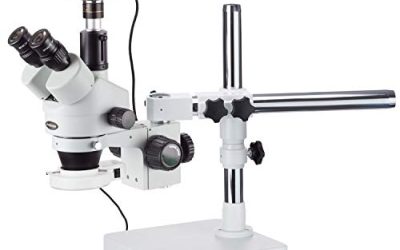
The Swift SW380T is the natural starting point for photographers who would rather choose their own camera than accept a bundled one. Its dedicated camera port sits on a Siedentopf trinocular head, so the interpupillary distance adjusts without disturbing focus, and the listing pairs that head with ultra-precise focusing for holding a photographic focal plane. Two eyepiece pairs, 10X and 25X wide-field, combine with four achromatic objectives for six magnification levels. LED illumination keeps the stage cool during long sessions of framing and shooting living subjects.
Specs
- Magnification: 40X-2500X across six levels
- Head: trinocular Siedentopf, 30-degree tilt, fully rotatable
- Eyepieces: wide-field 10X and 25X pairs included
- Objectives: 4 DIN achromatic — 4X, 10X, 40X (spring), 100X (spring, oil)
- Camera: dedicated port, camera-compatible; camera sold separately
- Illumination: LED light source
- Stage: mechanical stage with slide holder
- Item weight: 9.46 pounds
Best for: photographers who already own a microscope camera or want freedom to upgrade one later.
Watch out for: the camera and any adapter are separate purchases, so the port alone does not get you shooting on day one.
ASIN: B07N7TPSP7
AmScope T120B-5M

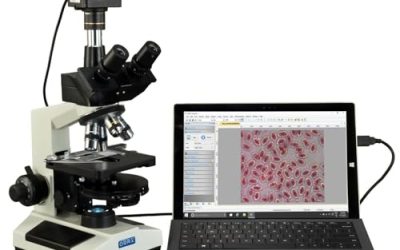
The AmScope T120B-5M removes the guesswork from a first photomicroscopy rig by putting a 5MP USB camera in the box, complete with a 0.5X reduction lens that widens the captured field toward what the eyepieces show. The Siedentopf trinocular head swivels a full circle for shared viewing, and two eyepiece pairs yield eight magnification settings up to 2000X. LED brightfield illumination and an Abbe condenser with iris diaphragm give you the contrast control that stained-slide photography depends on, while the double-layer mechanical stage keeps framing movements smooth and repeatable.
Specs
- Magnification: 40X-2000X across eight settings
- Head: Siedentopf trinocular, 30-degree inclined, 360-degree swiveling
- Eyepieces: WF10X and WF20X pairs included
- Objectives: achromatic DIN 4X, 10X, 40X (spring), 100X (spring, oil)
- Camera: 5MP CMOS (2592 x 1944) with 0.5X reduction lens, C-mount, USB 2.0
- Camera frame rates: 5fps at full resolution, 18fps at 1280×960, 60fps at 640×480
- Illumination: LED brightfield
- Condenser: Abbe condenser with iris diaphragm
- Stage: double-layer mechanical stage
- Power: 100-240VAC
Best for: buyers who want a complete, working camera setup without researching adapters and sensors separately.
Watch out for: the bundled camera records its highest frame rates only at reduced resolutions, so fast-moving subjects mean smaller frames.
ASIN: B009VUP9OW
OMAX M83EZ-C50U

The OMAX M83EZ-C50U stretches the magnification range furthest on this list while still including its own imaging hardware. A 5MP digital camera with a 0.5X reduction lens mounts to the trinocular port through a C-mount connection, and the included software captures stills and video, edits images and takes measurements against the bundled 0.01mm calibration slide. Two widefield eyepiece pairs and four achromatic objectives produce six magnification levels reaching 2500X. Adjustable-intensity LED transmitted illumination and an NA1.25 Abbe condenser round out a package aimed squarely at documented, measurable photo work.
Specs
- Magnification: 40X-2500X across six levels
- Head: trinocular, 45-degree inclined, 360-degree swiveling, interpupillary distance 55-75mm
- Eyepieces: wide-field WF10X and WF25X pairs included
- Objectives: achromatic DIN 4X, 10X, 40X (spring), 100X (spring, oil)
- Camera: 5MP colour (2592 x 1944) with 0.5X reduction lens, C-mount, USB 2.0
- Camera frame rates: 5fps at full resolution, 18fps at 1280×960, 60fps at 640×480
- Condenser: NA1.25 Abbe condenser with iris diaphragm
- Illumination: transmitted LED, intensity adjustable
- Stage: double-layer mechanical, 115 x 125mm, X-Y stroke 70 x 30mm
- Extras: 0.01mm calibration slide included
Best for: photographers who want the broadest magnification span plus measurement-ready software in one purchase.
Watch out for: the software’s stated operating-system support skews older, so confirm compatibility with a current computer before relying on it.
ASIN: B00ZAS8LH6
AmScope T490

The AmScope T490 is the traditionalist’s pick: a halogen-lit brightfield instrument whose vertical trinocular port accepts a camera through either a 23mm fitting or a C-mount adapter, leaving the imaging chain entirely in your hands. Its magnification tops out at 1000X, which is the honest working ceiling for most slide photography, and the four DIN achromatic objectives include spring-loaded 40X and oil-immersion 100X elements. A rheostat dims the 6V/20W halogen lamp for exposure control, and the rack-and-pinion Abbe condenser adjusts light distance as well as aperture.
Specs
- Magnification: 40X-1000X
- Head: compound trinocular, 30-degree incline, 360-degree rotation, interpupillary range 55-75mm
- Trinocular port: accepts 23mm or C-Mount camera adapter; camera sold separately
- Eyepieces: WF10X pair
- Objectives: DIN achromatic 4X, 10X, 40XS (spring), 100XS (spring, oil)
- Illumination: halogen 6V/20W with rheostat, brightfield
- Condenser: 1.25 NA Abbe with iris diaphragm, rack-and-pinion adjustment
- Stage: double-layer mechanical, 140 x 140mm, travel range 75 x 45mm
- Focus: coaxial coarse and fine, fine divisions of 0.002mm
Best for: photographers who prefer halogen light and want to pair the scope with a camera they select themselves.
Watch out for: halogen bulbs generate heat and need occasional replacement, and a spare bulb is included for exactly that reason.
ASIN: B00E3IQRGQ
AmScope T490B-DK

The AmScope T490B-DK adds a second photographic language to the T490 formula: a dry darkfield condenser alongside the standard brightfield Abbe unit. Darkfield turns transparent, unstained subjects — pond organisms, fibres, live cells — into bright images against a black background, a look brightfield simply cannot produce. The trinocular head carries a vertical camera mount accepting 23mm or C-mount adapters, and its adjustable port is designed to keep the camera image parfocal with the eyepieces. Interchangeable 10X and 20X eyepiece pairs extend the range to 2000X for framing flexibility.
Specs
- Magnification: 40X-2000X across eight settings
- Head: trinocular with vertical camera mount, 30-degree incline, 360-degree rotation, interpupillary range 55-75mm
- Trinocular port: accepts 23mm or C-Mount camera adapter; camera sold separately
- Eyepieces: WF10X and WF20X pairs included
- Objectives: DIN achromatic 4X, 10X, 40XS (spring), 100XS (spring, oil)
- Illumination: brightfield and darkfield halogen with rheostat
- Condensers: 1.25 NA Abbe with iris diaphragm, plus dry darkfield condenser (0.7-0.8 NA)
- Stage: double-layer mechanical stage with stage stop
Best for: photographers drawn to live, unstained specimens who want darkfield images without a separate condenser purchase later.
Watch out for: darkfield alignment takes practice, and the technique works with transmitted light only, so opaque subjects still need a different instrument.
ASIN: B004TP7KDM
Which One Fits Your Situation
You Want to Shoot the Day the Box Arrives
Choose one of the two camera bundles. The AmScope T120B-5M and OMAX M83EZ-C50U both include a 5MP USB camera, a 0.5X reduction lens and capture software, so the trinocular port is working within the first session. Between them, the OMAX reaches higher magnifications and adds a calibration slide for measurements, while the AmScope keeps the same imaging formula in a slightly simpler package.
You Already Own a Camera You Like
A port-only model protects that investment. The Swift SW380T, AmScope T490 and AmScope T490B-DK all leave the camera bay empty for a C-mount or 23mm camera you already trust. Check your camera’s mount against the port specification before ordering, and remember that a reduction lens may still be needed to match the camera’s field of view to the eyepieces.
You Photograph Live, Unstained Specimens
The AmScope T490B-DK is the standout here because its dry darkfield condenser renders transparent organisms bright against black, the classic look for pond-life photography. Its halogen rheostat also helps manage exposure on moving subjects. If your live work is mostly time-lapse or video, an LED model such as the Swift SW380T keeps heat off the slide during long sessions, which living specimens appreciate.
You Teach, Present or Share the View
A swivelling trinocular head earns its keep when a second person needs the eyepieces or a screen takes over. The camera bundles feed a computer or projector directly, turning one slide into a room-wide image. The T120B-5M’s 360-degree swivelling Siedentopf head and the OMAX’s measurement software both suit demonstration benches where the audience asks questions about what they are seeing.
Common Mistakes
- Buying a trinocular scope and forgetting the camera, adapter or reduction lens, then discovering the port alone captures nothing.
- Judging a microscope by its maximum magnification figure, which usually comes from stronger eyepieces rather than better objectives.
- Leaving the condenser iris wide open for every shot, which flattens contrast and makes photographs look hazy.
- Skipping the calibration slide when publishing measurements, so scale bars and size claims cannot be verified.
- Using the 100X objective without immersion oil, which guarantees a soft image no matter how good the camera is.
Frequently Asked Questions
Does a trinocular microscope always include a camera?
No. Trinocular describes the head: two eyepiece tubes plus a third port for a camera. Some models, like the T120B-5M and M83EZ-C50U here, bundle a USB camera, while others provide the port only and leave the camera as a separate purchase. Always check the listing’s contents before assuming a complete imaging kit is in the box.
What adapter does a dedicated microscope camera need?
Most microscope cameras use a C-mount thread, and the ports on these scopes accept either a C-mount adapter or a 23mm tube fitting. A reduction lens, commonly 0.5X, often sits between camera and port to widen the captured field. Match the adapter to your camera’s mount and sensor size rather than buying on thread size alone.
Why do my photos show a narrower view than the eyepieces?
The camera sensor is usually smaller than the full image circle the eyepieces present, so it records only the central portion. A 0.5X reduction lens shrinks the projected image so more of it lands on the sensor, bringing the photographed field closer to the visual one. Both camera bundles here include that lens for exactly this reason.
Is darkfield worth it for microscopy photography?
For stained slides, brightfield remains the default and darkfield adds little. For transparent, unstained subjects — living pond organisms, fibres, thin tissue — darkfield produces bright subjects on a black background with striking contrast that brightfield cannot match. If that subject matter is your focus, a model with a darkfield condenser, like the T490B-DK, saves a later upgrade.