Key takeaways
- Cold weather batteries for the Pontiac Bonneville compared by group size, CCA, and terminal fit: Group 78, 34/78, and Group 75 AGM picks for reliable winter starts.
As an Amazon Associate we earn from qualifying purchases.
Affiliate Disclosure: This article contains affiliate links. If you buy through a link on this page, we may earn a commission at no extra cost to you. Product specifications below come from the manufacturers’ and sellers’ product pages; we have not personally tested these batteries.


Why Cold Weather Is Hard on a Bonneville
The Pontiac Bonneville was built from an era when big GM sedans were expected to start on the coldest morning of the year without drama. The 3.8-litre V6 fitted to most Bonnevilles, and the supercharged version of that engine, ask a lot of a battery at cranking time. Engine oil thickens as temperatures fall, the starter motor needs more current to turn a cold engine over, and the battery itself delivers less of its rated power exactly when the car needs more of it. A battery that feels fine all summer can expose its weakness on the first hard frost.
That is why cold cranking amps, usually shortened to CCA, matter more for this car than almost any other number on the label. CCA is measured at 0 degrees Fahrenheit, and it describes how much current a battery can deliver for 30 seconds at that temperature while holding a usable voltage. For a Bonneville that lives outside through winter, choosing a battery with strong CCA for its group size is the single most useful decision you can make. Reserve capacity matters too, because it describes how long the battery can keep essential loads running if the charging system is struggling in bad weather.
Fitment comes before power, though. The Bonneville does not take one single battery across its whole production run. Depending on model year, fitment catalogues list Group 78 for most later cars, Group 75 for many earlier cars, and Group 79 for a small number of years around the turn of the century. Most of these cars use GM-style side terminals rather than top posts, so a battery with the wrong terminal layout will not connect to the factory cables no matter how strong it is. Before ordering anything on this page, confirm your model year, your current battery’s group size, and whether your cables are side-terminal or top-post. The picks below cover the Group 78 and Group 75 fitments with high CCA for their size. If your car is one of the Group 79 years, none of these is a direct substitute, and you should shop for that group size specifically.
Our Picks at a Glance
- Best overall for most Bonnevilles: OPTIMA RedTop 34/78 starting battery, 800 CCA, dual SAE and GM side terminals.
- Best for accessory-heavy cars: OPTIMA YellowTop D34/78 dual-purpose battery, 750 CCA, built to tolerate deeper discharge.
- Best for Group 75 years: OPTIMA YellowTop D75/25 dual-purpose battery, 620 CCA, dual terminal layout for earlier cars.
1. OPTIMA RedTop 34/78 Starting Battery
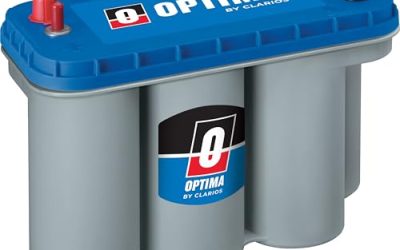
The RedTop 34/78 is the natural first pick for a cold-climate Bonneville because it attacks the winter problem directly: cranking power. The listing rates it at 800 CCA, which is strong for this case size and comfortably above what most Bonneville model years left the factory with. Its dual-terminal design is the other reason it belongs here. The case carries both SAE top posts and GM-style side terminals, so it can connect to the side-terminal cables fitted to most Bonnevilles while still working in a car that has been converted to top-post cables.
OPTIMA builds this battery around its SpiralCell absorbed glass mat design. The electrolyte is held in the mat rather than sitting as free liquid, which makes the battery sealed and maintenance-free, resistant to spilling, and far more tolerant of vibration than a conventional flooded battery. The manufacturer describes the design as delivering high cranking power even in harsh weather, with faster recharging and a longer service life than standard flooded batteries. For a car that may sit outside between drives in winter, that combination of strong cranking and low fuss is exactly the point.
The listed dimensions are about 10 inches long, 6-7/8 inches wide, and 7-13/16 inches tall, and the listed weight is 38.8 pounds. Those figures matter because the 34/78 case is a dual-fit case rather than a pure Group 78 case. On most Bonneville trays it sits correctly, but you should measure your tray and hold-down arrangement before ordering, and confirm the side terminals line up with your cable reach. A battery that is a few millimetres too tall for the hold-down or a cable that cannot reach a terminal is a bad day in a cold driveway.
Choose this battery if your Bonneville is a Group 78 car, or a dual-fit application, and your priority is the strongest, most reliable first turn of the key on a freezing morning. It is a starting battery first and foremost, so it is not the right choice if you routinely run heavy electrical loads with the engine off. For normal starting duty in a cold climate, it is the pick we would fit first.
2. OPTIMA YellowTop D34/78 Dual Purpose Battery
The YellowTop D34/78 trades a little peak cranking power for a very different strength: it is a genuine dual-purpose battery. The listing rates it at 750 CCA, which is still strong cold-weather cranking for a Bonneville, and the same dual-terminal 34/78 case gives you both SAE posts and GM side terminals. Where it differs from the RedTop is in what happens after the engine starts. The YellowTop is designed for vehicles whose electrical loads are higher than average, and for discharge cycles that go beyond simple engine starting.
That profile suits a certain kind of Bonneville very well. These cars often carry power seats, heated mirrors, rear demisters, strong cabin heaters, and aftermarket audio, and winter driving stacks those loads together on short trips where the alternator has little time to replace what the battery gave up. A dual-purpose AGM battery tolerates that deeper, more frequent cycling better than a pure starting battery. If your Bonneville does short winter journeys with everything switched on, or runs accessories with the engine off, this is the more forgiving battery.
The YellowTop uses the same sealed SpiralCell AGM construction, so it is maintenance-free, non-spillable, and can be mounted in more positions than a flooded battery. Its listed size is the same 10 by 6-7/8 by 7-13/16 inch footprint as the RedTop above, which means the same tray and terminal checks apply. Confirm that your car takes the 34/78 dual-fit case and that the side terminals suit your cables before you commit.
Choose this battery if your Bonneville’s problem is not just cold starts but cold starts combined with heavy electrical use and short trips. You give up a small amount of headline CCA compared with the RedTop, and in return you get a battery that copes better with the way a well-equipped sedan is actually used through a winter.
3. OPTIMA YellowTop D75/25 Dual Purpose Battery
Not every Bonneville takes a Group 78 battery. Many earlier cars, covering a long stretch of production through the late 1980s and into the mid 1990s, are listed with Group 75. Fitting a 78-sized case into a car built for a 75 can mean tray, hold-down, and cable problems, so Group 75 owners need a pick of their own. The YellowTop D75/25 is that pick: a dual-purpose AGM battery in the 75/25 dual-fit format, with dual terminals that include the GM side-terminal layout these cars use.
Its listed rating is 620 CCA. That is lower than the two picks above, and it is worth being honest about why it still earns its place. CCA comparisons only make sense inside the correct fitment. A smaller Group 75 case holds less active material than a Group 78 case, so its ceiling is lower, and 620 CCA is a solid figure for this size. For the earlier, lighter Bonneville models that specify Group 75, it meets the job the car actually asks for, and its dual-purpose design adds tolerance for accessory loads and repeated short trips in cold weather.
Like the other YellowTop, this battery is sealed, maintenance-free AGM with spiral-wound cells, so there is no water to check and no acid to spill if the car sits at an angle on a sloped winter driveway. The dual terminals also help if a previous owner changed the cable ends at some point in the car’s long life, which is common on vehicles of this age.
Choose this battery only if your Bonneville’s fitment is Group 75. Do not choose it for a Group 78 or Group 79 car as a way to save effort, because a battery that is the wrong group size can sit loose, strain the cables, or fail to clamp down safely. Correct fit first, then CCA, is the rule for this whole page.
How to Choose a Cold Weather Battery for a Bonneville
Start with the group size your model year specifies. Fitment sources for the Bonneville list Group 78 for most 1995 to 1999 and 2004 to 2005 cars, Group 75 or 78 for several early 1990s years, Group 75 for 1991, and Group 79 for 2000 to 2001, with some overlap years listing more than one option. Because the ranges overlap, the most reliable check is the battery already in the car: read its group size label, note the terminal type, and measure the tray if you are unsure.
Next, compare CCA within that group size. For a car that sleeps outside in a cold region, favour the higher-CCA options, since a battery’s available cranking power falls as the temperature drops while the engine’s demand rises. Reserve capacity is your second number. A higher reserve rating gives you more margin if a short-trip pattern or a weak charging system leaves the battery doing extra work.
Then think about how the car is used. A pure starting battery such as the RedTop suits a car whose battery only starts the engine and is then promptly recharged. A dual-purpose battery such as the YellowTop suits a car with heavy accessory loads, an uprated stereo, or a pattern of short journeys. Finally, consider construction. Sealed AGM batteries need no water checks, resist vibration, and generally recharge faster than flooded batteries, which makes them a sensible winter default for a car of this age, provided the charging system is healthy and set for normal automotive voltages.
Fitting and Winter Care Tips
Side-terminal cables deserve a careful look before the new battery goes in. Corrosion hides under the insulating boots on GM side terminals, and a corroded connection can make a brand-new, fully charged battery behave like a flat one on a cold morning. Clean the contact faces, replace any bolt that is rounded or heavily corroded, and tighten to a snug fit without over-torquing the terminal insert.
Keep the battery charged through winter. Short trips, heated screens, and blower fans can slowly pull a battery down over a week of commuting, and a partially charged battery is both weaker at cranking and more vulnerable to damage in hard frost. If the car is used rarely, a maintenance charger suited to AGM batteries is a sensible companion. If cold starts still sound slow with a new battery fitted, have the starter draw and charging voltage checked rather than blaming the battery, because an ageing starter or alternator produces the same symptoms.
Frequently Asked Questions
What group size battery does a Pontiac Bonneville take?
It depends on the model year. Most later cars take Group 78, many earlier cars take Group 75, and a small number of years around 2000 to 2001 take Group 79. Check the label on your existing battery or your model year’s fitment listing before ordering.
How many CCA does a Bonneville need for winter?
The car needs at least the CCA its original specification calls for, and for cold climates more is better within the correct group size. The picks above range from 620 CCA in the smaller Group 75 case to 800 CCA in the 34/78 case, and the higher figure is the safer choice where it fits.
Can I fit a Group 78 battery in a Group 75 Bonneville?
Not reliably. The cases differ in size and the hold-down and cable reach may not suit. Fit the group size your car specifies, or a manufacturer-listed dual-fit case that explicitly covers your application, and verify the tray and terminals first.
Is an AGM battery worth it for an older Bonneville?
For winter use, usually yes. AGM batteries are sealed, need no water maintenance, tolerate vibration well, and the picks here deliver strong CCA for their size. They still need a healthy charging system, so confirm the alternator output if the car has a history of flat batteries.
Why does my Bonneville still crank slowly with a new battery?
The common causes are corroded side-terminal connections, a worn starter motor drawing excess current, or an alternator that is not fully recharging the battery between trips. Clean the terminals first, then have the starting and charging system tested.