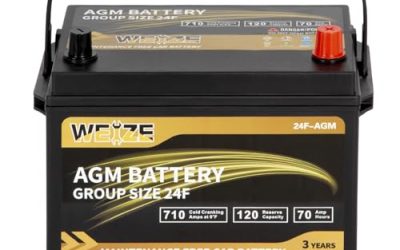
Our Short List of 3


All 3 Picks at a Glance
| Product | Specs | Action |
|---|---|---|
| 1. OPTIMA D31M BLUETOP Dual Purpose Marine Battery — ASIN: B00099DW6G | Check price on Amazon | |
| 2. LiTime 12V 100Ah Group 24 Dual-Purpose Marine Battery — ASIN: B0DNP3G4L1 | Check price on Amazon | |
 3. Interstate Batteries 24M-AGM Marine/RV Battery — ASIN: B0BHTWRDNQ | Check price on Amazon |
Key takeaways
- Find the best marine cranking battery for starting a 100 hp Mercury outboard, with MCA and CCA requirements, group sizes, and three marine-only picks compared.
As an Amazon Associate we earn from qualifying purchases.
Affiliate Disclosure: This article contains affiliate links. If you buy through a link on this page, we may earn a commission at no extra cost to you.
A 100 hp Mercury that cranks slowly, drops voltage on the electronics, or refuses to restart after a drift is usually not suffering from a starter problem. It is suffering from a battery problem — most often a battery that was never a proper marine cranking battery in the first place, or one whose cranking rating falls short of what Mercury specifies for this engine family. This guide explains exactly what Mercury asks for, why a car battery is the wrong answer even when it seems to fit, and which marine starting and dual-purpose batteries meet the requirement on paper.
The short version is simple: buy a 12-volt marine cranking or marine dual-purpose battery, in the group size your tray holds, with a marine cranking amp rating that clears Mercury’s minimum for your exact 100 hp model and for the temperatures you actually boat in. Everything below expands on that sentence so you can check a listing yourself before you order.
What Mercury Actually Requires for a 100 HP Engine
Mercury does not publish one single number for every engine that has ever worn a 100 hp badge, because the 100 hp rating covers different generations and technologies. A carbureted or EFI two-stroke in the 75 to 125 hp family, a 2.1-litre FourStroke in the 75 to 115 hp family, and an OptiMax direct-injected engine place different demands on the battery, even though the horsepower on the cowling looks similar.
Published Mercury guidance for the conventional two-stroke 75 to 125 hp range calls for a minimum of 525 marine cranking amps (MCA) or 450 cold cranking amps (CCA). For FourStroke models, Mercury guidance lists 465 MCA or 350 CCA as the minimum in operation above freezing, rising to 1,000 MCA or 750 CCA for operation below 0 degrees Celsius. OptiMax engines are the strictest case in the Mercury line: Mercury manuals for OptiMax state that the engine must use a marine starting battery with 1,000 MCA, 800 CCA, or a 180 amp-hour rating, and they warn explicitly not to use a deep-cycle battery as the starting battery for DTS and OptiMax applications.
That spread matters for how you shop. If your 100 hp Mercury is a FourStroke used in mild weather, several good Group 24 marine batteries clear the bar comfortably. If it is an OptiMax, or if you launch on cold mornings early and late in the season, you should shop to the higher figure — 1,000 MCA — and treat anything below it as unsuitable, no matter how attractive the rest of the specification looks. When in doubt, open the owner’s manual for your serial number range and use the figure printed there. The manual for your exact engine always outranks a general guide, including this one.
There is also a capacity side to the requirement. Cranking amps describe the burst; amp-hours and reserve capacity describe how long the battery can support the engine’s electronics, a bilge pump, lights, and a fish finder between starts. Mercury’s FourStroke guidance pairs its cranking minimums with a capacity range in the region of 70 to 100 amp-hours for this engine class in some published tables, which is another reason a small automotive battery is a poor substitute even when its headline CCA number looks adequate.
Why MCA Matters More Than the CCA Number on the Box
Boaters often compare batteries by CCA alone because that is the number printed largest. For a Mercury outboard, MCA is the more relevant rating. CCA is measured at 0 degrees Fahrenheit, while MCA is measured at 32 degrees Fahrenheit, the temperature reference Mercury uses in its marine specifications. A battery rated at 1,000 MCA will typically carry a CCA rating somewhere around 800, because the same battery delivers less current when it is colder.
When you compare two listings, compare like with like. Do not reject a battery because its CCA looks lower than a rival’s MCA, and do not accept one because a seller has printed a large hot cranking amp figure measured at a warm temperature. Line up the MCA column first, then check CCA, then look at capacity and reserve capacity. The picks in this guide were chosen because their published MCA or CCA figures, taken together, clear Mercury’s requirements for a 100 hp engine, with the intended use for each pick stated plainly.
Voltage sag is the hidden reason behind Mercury’s generous minimums. A modern Mercury does not draw anywhere near 1,000 amps while cranking; the starter draw is far lower. What the engine’s electronics need is a battery stiff enough that voltage does not collapse during that brief draw. A battery with a high cranking rating holds its voltage up under load, so the ECU, fuel system, and ignition see clean power through the whole start. An undersized or tired battery can turn the engine over and still cause hard starting, alarms, or fault behaviour because the voltage dipped too far while it did so.
Why You Should Not Use a Regular Car Battery
It is tempting to fit an automotive starting battery. The posts look the same, the voltage is the same, and a Group 24 car battery may even drop into the tray. Resist it, for four practical reasons.
First, construction. Marine batteries are built to survive vibration, pounding, and repeated slamming in a hull in a way that a battery designed for a smooth road vehicle is not. Internal plate support and case design differ, and a battery that fails internally on the water leaves you without propulsion, not just without transport.
Second, terminals and hardware. Marine batteries typically provide threaded stud terminals alongside or instead of automotive posts, so wing nuts or nuts can secure ring terminals for the engine leads and accessories properly in a damp environment.
Third, rating and capacity balance. Automotive batteries are optimised almost entirely for a short starting burst in a vehicle whose alternator immediately takes over and whose accessory loads are handled while the engine runs. A boat asks its starting battery to also tolerate fish finders, livewell pumps, navigation lights, and anchor lights, sometimes with the engine off. Marine dual-purpose batteries are designed with that second job in mind.
Fourth, Mercury’s own wording. The manuals specify a marine starting battery. Fitting a non-marine battery is a deviation from the manufacturer’s instruction for the engine, which is a weak position to be in if you ever need to discuss a starting or charging problem with a dealer.
For the same reason, do not solve the problem in the opposite direction by fitting a pure deep-cycle or trolling-motor battery as your only starting battery unless its manufacturer explicitly rates it for engine starting and its cranking figures clear Mercury’s minimum. Some modern lithium dual-purpose batteries do meet that test and are included below. Many deep-cycle batteries do not publish a meaningful cranking rating at all, and Mercury specifically warns against deep-cycle batteries for OptiMax starting.
Group Size, Terminals, and Fit
Most 100 hp Mercury installations use a Group 24, Group 27, or Group 31 battery, depending on the boat. Group size describes the case footprint and height, not the power. Measure your tray or battery box, check the hold-down, and confirm the terminal positions before ordering, because a battery that is electrically perfect and physically loose is a hazard in a seaway.
Check three fit details on every listing. One, the exact length, width, and height, including the terminals. Two, the terminal type: your Mercury battery cables end in ring terminals that need a stud or a post with the correct adapter, tightened securely and protected against corrosion. Three, weight. A large AGM Group 31 can weigh well over twice as much as a Group 24 lithium battery, which affects handling, mounting, and where the weight sits in a small boat.
Keep the battery secured, the terminals clean and tight, and the connections in the order and configuration your engine manual describes. Never run the engine with the battery disconnected, and follow the manual’s precautions for charging, jump-starting, and winter storage. Those warnings exist because outboard charging systems and electronics can be damaged by loose or interrupted battery connections.
The Picks
The three batteries below are all marine batteries sold for starting or for combined starting and accessory use. They are not car batteries, and none of them is a pure house battery with no cranking rating. They differ in chemistry, size, and in which Mercury requirement they suit best, so read the note under each one rather than treating the order as a universal ranking.
1. OPTIMA D31M BLUETOP Dual Purpose Marine Battery — ASIN: B00099DW6G
The OPTIMA D31M BLUETOP is a sealed AGM battery in the Group 31 class, listed at 900 CCA, and positioned by OPTIMA as a dual-purpose battery for both starting and deep-cycle use in boats and RVs. Its dual terminals suit marine installations, it is maintenance-free, and the sealed AGM construction tolerates mounting positions and vibration that would trouble a conventional flooded battery.
For a 100 hp Mercury, the appeal is headroom. A 900 CCA rating sits above the OptiMax CCA figure quoted in Mercury manuals and comfortably above the FourStroke and two-stroke minimums, so this is the pick to look at first if your engine is an OptiMax, if you boat in cold weather, or if one battery must start the engine and also run a meaningful accessory load. The trade-offs are size and weight: a Group 31 case needs a tray that fits it, and an AGM battery of this capacity is heavy to lift in and out. Confirm the dimensions against your compartment before choosing it over a Group 24 option.
2. LiTime 12V 100Ah Group 24 Dual-Purpose Marine Battery — ASIN: B0DNP3G4L1
The LiTime Group 24 battery is a 12-volt, 100Ah LiFePO4 battery listed for dual-purpose marine use, combining engine starting with deep-cycle power for onboard equipment. Its published cranking figures are 900 CCA at 14 degrees Fahrenheit, 1,000 MCA at 32 degrees Fahrenheit, and 1,200 HCA at 77 degrees Fahrenheit. It is listed in a Group 24 format at about 22.71 pounds, with an IP67 waterproof rating, self-heating, Bluetooth monitoring on the current version, and a battery management system that reserves a portion of charge for restarting.
On paper, the 1,000 MCA figure is exactly the level Mercury specifies for OptiMax starting and for cold-weather FourStroke use, and LiTime describes the battery as designed for compatible outboards including Mercury models. The weight saving over a lead-acid Group 24 is substantial, which matters in small centre-consoles and bass boats. Two cautions apply to any lithium starting battery, and they are more important than the headline numbers. First, confirm that your exact Mercury model and its charging system are compatible with a lithium starting battery before you switch chemistry; Mercury has approved specific lithium starting batteries for specific engine families, and approval is model-specific, not universal. Second, respect the battery management system’s cranking limits and low-temperature charging cutoffs described by LiTime. If your dealer or manual does not support a lithium starter for your serial number, choose one of the AGM picks instead.
3. Interstate Batteries 24M-AGM Marine/RV Battery — ASIN: B0BHTWRDNQ
The Interstate 24M-AGM is a 12-volt, 70Ah, Group 24M dual-purpose AGM battery listed at 750 CCA, built as a pure-lead AGM for marine and RV starting and accessory use. It is the conventional, widely understood option in this list: sealed, maintenance-free, and sized for the Group 24 trays fitted to a large share of boats powered by engines in this class.
Match it to the right Mercury. Its 750 CCA rating clears the published minimums for a 100 hp FourStroke in normal operation and for the conventional two-stroke range with room to spare, and it reaches the cold-weather CCA figure in Mercury’s FourStroke guidance. It does not, by itself, demonstrate the full 1,000 MCA / 800 CCA combination that Mercury manuals demand for OptiMax engines, so OptiMax owners should choose the OPTIMA or the LiTime above, subject to the lithium compatibility check, rather than stretching this battery beyond the specification it publishes. For a FourStroke or two-stroke 100 hp boat that also runs a fish finder, lights, and a livewell from the same battery, it is a well-matched dual-purpose choice.
How to Choose Between Them
Start with your engine, not with the battery catalogue. Identify whether your 100 hp Mercury is a FourStroke, a conventional two-stroke, or an OptiMax, and find the cranking minimum in its manual. Then buy to that number in MCA first, using CCA as the cross-check.
Next, decide whether the starting battery works alone. A dedicated starting battery on a simple boat can be a starting-focused AGM. A single-battery boat that runs electronics at anchor needs a dual-purpose battery with enough amp-hours and reserve capacity, which pushes you toward the Group 31 OPTIMA or the 100Ah LiTime. A boat with a separate house or trolling bank should keep the starting battery’s job simple and protect it from accessory drain.
Then confirm the physical facts: group size, dimensions, terminal type and position, and weight. Finally, consider chemistry honestly. AGM is the default for a reason — broad charger and alternator compatibility, predictable behaviour, and no management-system cranking limits. Lithium saves a great deal of weight and offers more usable capacity, but only belongs on the engine if the battery is explicitly built and approved for starting your engine family and your charging system suits it.
Charging and Care That Protect Your Starting Battery
Most starting problems that get blamed on a battery begin with charging habits. Keep the battery fully charged between trips with a charger that has the correct profile for its chemistry — AGM and LiFePO4 do not share identical requirements — and do not leave a lead-acid battery sitting partly discharged for weeks, which shortens its life quickly.
Before the season, and whenever starting feels lazy, have the battery load-tested and check the cable ends at both the battery and the engine. A corroded or loose connection can imitate a failed battery. Keep terminals tight and protected, keep the battery secured so it cannot shift, and follow Mercury’s storage instructions over winter, including the state of charge and disconnection guidance for your model.
If you replace the battery and the engine still cranks slowly or the electronics still reset on starting, stop replacing batteries and have the starting and charging system diagnosed. A failing starter, a high-resistance cable, or a charging fault will defeat a new battery as reliably as it defeated the old one.
Frequently Asked Questions
Can I use a deep-cycle battery to start my 100 hp Mercury?
Only if that specific battery is also rated by its manufacturer for engine starting and its MCA or CCA clears Mercury’s minimum for your engine. Mercury warns against using deep-cycle batteries for OptiMax and DTS starting. A dual-purpose battery is the safer category when one battery must do both jobs.
Is 750 CCA enough for a 100 hp Mercury?
For many FourStroke and conventional two-stroke 100 hp models, yes, based on Mercury’s published minimums, and it matches the cold-weather CCA figure in the FourStroke guidance. For an OptiMax, Mercury’s manual figure is 1,000 MCA or 800 CCA, so choose a battery that meets that specification instead.
What group size do I need?
Whichever group size your boat’s tray or box was built for — commonly Group 24, 27, or 31 in this engine class. Group size is about fit, not power. Measure the compartment and check terminal layout before ordering.
Should I switch to a lithium starting battery?
Consider it for the weight saving and usable capacity only if the battery is a purpose-built marine starting or dual-purpose model, its cranking rating meets your engine’s requirement, and your engine family and charging system are confirmed compatible. Otherwise, a marine AGM remains the lower-risk choice.
Bottom Line
For a 100 hp Mercury, the best starting battery is a marine battery that meets Mercury’s number for your exact engine: the OPTIMA D31M BLUETOP for maximum AGM cranking headroom in a Group 31 case, the LiTime Group 24 dual-purpose battery for a lightweight 1,000 MCA lithium option where compatibility is confirmed, and the Interstate 24M-AGM for a conventional Group 24 dual-purpose fit on FourStroke and two-stroke models. Skip the car battery, skip the unrated deep-cycle battery, check the tray before you order, and your Mercury should start cleanly every time you turn the key.