Our Short List of 3

- Best for: 2019–2023 Forester owners replacing front pads with an OE-spec ceramic set.
- Friction material: Ceramic
- Position: Front
- Listed fitment: Subaru Forester 2019–2023
- Part number: CFC2045

- Best for: Newer Forester owners who want low-dust front pads with corrosion-resistant hardware included.
- Friction material: Carbon-infused ceramic
- Position: Front
- Listed fitment: Subaru Forester 2019–2023; Impreza 2017–2023
- Hardware: Stainless-steel mounting hardware included

- Best for: 2009–2018 Forester owners replacing rear pads who want hardware included in the box.
- Friction material: Ceramic
- Position: Rear
- Listed fitment: Subaru Forester 2009–2018
- Part number: SBC1114
All 4 Picks at a Glance
| Product | Specs | Action |
|---|---|---|
| Bendix Priority1 CFC2045 Ceramic Front Brake Pads |
| Check price on Amazon |
| Max Advanced Brakes SelectMAX Front Brake Pads |
| Check price on Amazon |
| Bendix Premium SBC1114 Ceramic Rear Brake Pads |
| Check price on Amazon |
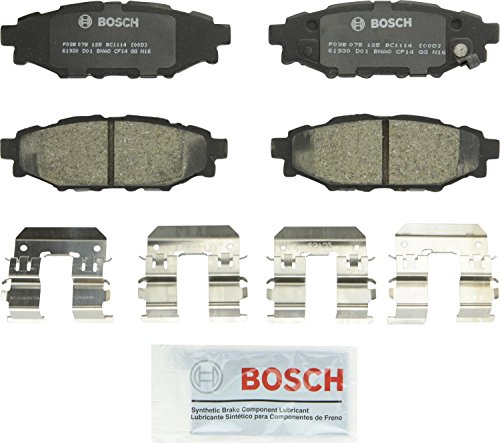 Bosch BC1114 QuietCast Premium Ceramic Disc Brake Pad Set |
| Check price on Amazon |
Key takeaways
- Compare four brake pad sets that list Subaru Forester fitment, with ceramic front and rear options, hardware notes and the year ranges each listing names.
A worn set of Forester pads rarely fails all at once, so the real decision is narrower than most listings make it look: which axle is worn, which model years the pad shape actually covers, and whether the box includes the hardware your calipers need. Guessing on any of those three points means a second order and a car sitting on stands.
This guide is for Forester owners replacing pads at home or handing a set to a shop, across the 2009–2023 model years that the listings below cover. Every pick comes from an Amazon listing that names the Forester in its fitment, and the specs are taken from those listings alone, including the year ranges, the hardware each box does or does not promise, and the compound each pad uses.
Quick Picks
As an Amazon Associate we earn from qualifying purchases.
| Product | Best for | Key spec from title |
|---|---|---|
| Bendix Priority1 CFC2045 | Front pads for 2019–2023 Foresters | Ceramic front set built to OE specifications |
| Max Advanced Brakes SelectMAX Front Pads | Low-dust front pads for newer Foresters | Carbon-infused ceramic with stainless hardware |
| Bendix Premium SBC1114 | Rear pads for 2009–2018 Foresters | Ceramic rear set with installation hardware |
| Bosch BC1114 QuietCast | Quiet rear pads for select Foresters | Ceramic rear set with rubber core shims |
How to Choose
Start With the Axle That Is Actually Worn
Front and rear pads on a Forester are different shapes, different part numbers, and sold as separate axle sets, so a listing that says “front” will never cover the rear wheels. Front pads usually wear faster because braking shifts weight forward, but the only reliable check is pad thickness at each corner. Measure before you order, note which axle is thin, and buy for that axle first. The four sets in this guide split evenly: two front sets for 2019–2023 cars and two rear sets, so matching the worn axle to the listing is the first filter.
Match the Pad Shape to Your Model Years
Forester pad shapes changed across generations, and the listings draw the lines clearly. The front sets here name 2019–2023 Foresters, while the rear sets cover earlier spans, with one listing naming 2009–2018. A pad built for a 2015 car will not seat in a 2021 caliper bracket even though both are Foresters. Read the year range in the listing title, then confirm with the fitment checker on the page using your exact year and trim. If your car falls between two ranges, neither set is a safe guess.
Read the Hardware Line Before You Order
Some sets in this guide include installation hardware in the box, and one listing does not state hardware either way. Abutment clips and shims wear, corrode, and lose tension, and reusing tired clips is a common cause of squeaks and uneven pad wear after a careful install. If the set you pick includes hardware, plan to fit it. If the listing is silent on hardware, budget for a separate hardware kit for your axle so the job does not stall halfway with the caliper already off the bracket.
Ceramic Compounds Suit How Foresters Are Driven
Every set here uses a ceramic or carbon-infused ceramic compound, which matches the Forester’s daily work: commuting, school runs, wet roads, and light loads. Ceramic pads are known for quiet stops and low dust output, and the listings lean on exactly those points, from rubber core shims to low-dust formulas. Drivers who tow or descend long grades regularly ask more of their brakes; for them, the front set described as holding stopping power under high temperatures and heavy loads is the relevant starting point in this group.
The 4 Best Options
Bendix Priority1 CFC2045 Ceramic Front Brake Pads
- Best for: 2019–2023 Forester owners replacing front pads with an OE-spec ceramic set.
- Friction material: Ceramic
- Position: Front
- Listed fitment: Subaru Forester 2019–2023
- Part number: CFC2045
2019–2023 Forester owners replacing front pads with an OE-spec ceramic set.
The listing does not state whether installation hardware is included, so check the box contents or plan on a separate hardware kit.
Owners of a 2019–2023 Forester who need front pads get the most direct fitment statement here: the listing names the Forester for exactly those years, alongside Crosstrek, Impreza, Legacy, and Outback applications. Bendix describes the set as engineered to OE specifications, with friction material intended to keep stopping power under high temperatures and heavy loads, which suits Foresters that carry passengers and cargo on hilly routes. It is a front-axle set only, so rear pads are a separate purchase when that axle wears down.
Max Advanced Brakes SelectMAX Front Brake Pads
- Best for: Newer Forester owners who want low-dust front pads with corrosion-resistant hardware included.
- Friction material: Carbon-infused ceramic
- Position: Front
- Listed fitment: Subaru Forester 2019–2023; Impreza 2017–2023
- Hardware: Stainless-steel mounting hardware included
Newer Forester owners who want low-dust front pads with corrosion-resistant hardware included.
Fitment is vehicle-specific to the listed Subaru models, so confirm your year in the listing checker before ordering.
This front set covers the same newer generation, naming the Forester from 2019 through 2023 and the Impreza from 2017 through 2023. Its compound is carbon-infused ceramic, and the listing points to low-speed noise suppression and a low-dust formulation, which will appeal to owners tired of dark dust building up on the front wheels. Stainless-steel mounting hardware comes in the kit, a practical detail for cars driven on salted winter roads where plain clips corrode and start to rattle against the bracket.
Bendix Premium SBC1114 Ceramic Rear Brake Pads
- Best for: 2009–2018 Forester owners replacing rear pads who want hardware included in the box.
- Friction material: Ceramic
- Position: Rear
- Listed fitment: Subaru Forester 2009–2018
- Part number: SBC1114
2009–2018 Forester owners replacing rear pads who want hardware included in the box.
The same part number also lists many other Subaru models and years, so verify the Forester year range in the fitment checker rather than relying on the part number alone.
Rear pads for the earlier generations are covered by this Bendix Premium set, whose listing names the Forester from 2009 through 2018 among a wide group of Subaru applications. It is a ceramic rear set, and unlike the front Bendix above, the box contents are stated plainly: one ceramic brake pad set with installation hardware. For owners of a 2009–2018 Forester doing a rear-axle refresh in the driveway, that removes one unknown from the parts list and keeps the job to a single order.
Bosch BC1114 QuietCast Premium Ceramic Disc Brake Pad Set
- Best for: Forester owners whose rear brakes squeal and who want a shim-focused ceramic set.
- Friction material: Ceramic, copper free
- Position: Rear
- Listed fitment: Select Subaru models including Forester, per the listing title
- Part number: BC1114
Forester owners whose rear brakes squeal and who want a shim-focused ceramic set.
The listing names several Subaru models without one Forester year range in the title, so the fitment checker matters more here than for the other sets.
Bosch builds this rear set around noise control: the listing highlights a pre-attached multilayer rubber core shim, part of its Molded Shim Technology, bonded to the pad to cut vibration before it becomes a squeal. The ceramic formula is copper free and described as compliant with 2025 copper free legislation, using an aluminum-based alloy borrowed from aerospace practice. The set covers one axle, and the listing says it ships with a hardware kit where available plus synthetic lubricant for the sliding contact points.
Which One Fits Your Situation
Your 2019–2023 Forester Needs Front Pads
Start with the Bendix Priority1 CFC2045 if you want the set whose listing pairs the exact years with an OE-spec description and a heavy-load friction claim. Choose the Max SelectMAX instead if dust on the front wheels and winter corrosion are your bigger complaints, since its listing leads with a low-dust compound and stainless hardware. Either way, the rear axle takes a different part number, so leave it for its own inspection.
Your 2009–2018 Forester Needs Rear Pads
The Bendix Premium SBC1114 is the straightforward pick: its listing states the 2009–2018 Forester range directly and includes installation hardware in the box. The Bosch BC1114 is the alternative when noise is the complaint, thanks to its rubber core shim, but its title does not pin down Forester years, so run the fitment checker carefully before choosing it over the Bendix.
You Are Replacing Pads on Both Axles This Season
No single set in this guide covers all four wheels, so plan two purchases matched by generation: a front set and a rear set that both name your model year. Newer cars pair either front option here with a rear set from the same listings family after a fitment check, while 2009–2018 cars start from the SBC1114 at the rear and need a front set matched to that earlier shape.
A Shop Is Doing the Work, Not You
Bring the listing fitment printout for your exact year and hand over a set that includes hardware, like the SBC1114 or the SelectMAX, so the technician is not reusing corroded clips. If you choose the CFC2045, ask the shop beforehand whether they supply abutment hardware, because its listing does not say. Confirming this in advance avoids a mid-job parts run and a second labor charge for the same axle.
Common Mistakes
- Ordering by model name alone: Forester pad shapes changed across generations, and a set listed for 2019–2023 will not fit a 2015 car even though both carry the same badge.
- Assuming one set covers the whole car: front and rear pads are separate part numbers sold per axle, so a four-wheel job always needs two matched sets.
- Reusing old clips and shims when the new set includes hardware, which invites squeaks and uneven wear that get blamed on the pads themselves.
- Skipping the fitment checker: several listings here cover many Subaru models and wide year spans, and trim or engine notes can change which set applies to your car.
- Fitting new pads against scored or thin rotors without measuring them, which shortens pad life and can leave pedal feel worse than before the job.
Frequently Asked Questions
How do I know whether my Forester needs front or rear pads first?
Check pad thickness at each corner through the caliper or with the wheel removed. Front pads usually wear sooner because braking loads the front axle, but wear is not always even. Buy for the axle that measures thin, and treat the other axle as its own separate job with its own part number.
Will one of these sets fit every Forester generation?
No. The listings split by generation: the front sets here name 2019–2023 Foresters, and the rear sets cover earlier years, one of them stating 2009–2018. Pad shapes changed between generations, so match your exact model year to the range printed in the listing and confirm it in the fitment checker before ordering.
Should pads be replaced on both sides of an axle together?
Yes. Every set in this guide is sold as an axle set covering both wheels on that axle, and fitting a new pad on one side only leaves uneven friction and uneven wear across the axle. Replace the pair together, fit the included hardware on both sides, and bed the new pads in as one set.
Do I need to replace the rotors at the same time as the pads?
Not automatically. Rotors need attention when they measure below their minimum thickness, show deep scoring, or cause a pulsing pedal. If the rotor faces are smooth and within specification, new pads can go on after a proper clean. When in doubt, have the rotors measured during the pad job rather than guessing.