Key takeaways
- Compare LED bulbs built for reflector headlights, with 1:1 filament placement, thin chip boards, and fan or fanless cooling in 9005, H11, and combo sizes.
A reflector housing was shaped around a halogen filament in one exact spot, so the real decision is not how bright an LED bulb claims to be, but whether its chips sit where the filament sat. Move the light source a few millimeters and the reflector throws the beam upward into traffic instead of down the road. Shoppers who start with chip placement, board thickness, and rotation adjustment end up with a clean cutoff; shoppers who start with the largest lumen figure usually end up with glare.

This roundup is for drivers of cars, trucks, and SUVs whose headlamps use reflector housings with 9005 or H11 sockets, including owners replacing one position at a time and owners converting high and low beams together. Every pick below is an LED replacement bulb rather than a full housing, and each one was chosen from its Amazon listing details: bulb size, chip layout, board thickness, cooling method, and the beam language the maker itself uses.
Quick Picks
As an Amazon Associate we earn from qualifying purchases.
| Product | Best for | Key spec from title |
|---|---|---|
| FAHREN Upgraded 9005/HB3 | High-beam reflector housings taking a 9005 bulb | 50,000 lumens per set, 6500K |
| Termitor Upgraded H11/H9 | Low-beam reflector housings with an H11 socket | 70,000 lumens, 1:1 halogen size |
| AUTOONE Fanless Combo | Sealed housings with no room for a fan | Fanless body, 6000K |
| OXILAM Combo | Drivers converting high and low beams together | 0.03-inch chip spacing, 70,000 lumens |
| AUXITO M3S Combo | Combo fitment with a thin chip board | 0.039-inch baseboard, 50,000-hour life |
How to Choose
Put Filament Position Ahead of Output Claims
A reflector is a shaped mirror, and it only forms the intended beam when light leaves from the focal point the housing was built around. Halogen filaments sit at a fixed depth inside the bulb, so a replacement LED has to park its chips at that same depth and height. Listings that describe a 1:1 halogen size, chips arranged along the filament line, or a thin board between the two chip faces are speaking to this point. When a listing leads with a huge lumen figure and says nothing about placement, treat the beam as unproven for a reflector.
Match Each Socket Size to Its Position
Cars rarely use one bulb size everywhere. A typical reflector setup pairs a 9005 high beam with an H11 low beam, and other cars run a single dual-filament H4 for both beams. The sizes look alike on a shelf yet lock into different sockets and sit at different depths, so a bulb bought for the wrong position can seat crooked and wreck the pattern. Read the size stamped on the bulb you remove, check the manual for each position, and treat combo packs as two separate purchases that happen to share a box.
Decide Between a Cooling Fan and a Fanless Body
Heat decides how long an LED bulb holds its output, and the two cooling routes suit different housings. A small fan behind the chips moves air actively, which helps high-output bulbs, but the fan and its housing need clear space and the dust cap must still close. A fanless bulb leans on an aluminum body and copper board, runs silent, and fits shallow housings, though it usually gives up some output headroom. Measure the depth behind your socket before choosing, because a bulb that stops the cap from sealing invites moisture into the reflector.
Check Board Thickness and Rotation Adjustment
The board between the two chip faces decides how close the pair can mimic a single filament. Thick boards push each chip face away from the focal point, widening the beam and softening the cutoff; thin boards, down near three hundredths of an inch on some listings, keep both faces close to the centerline. Rotation matters just as much. The chips should face sideways, toward the reflector walls, once the bulb locks in. Models with an adjustable collar let you correct the angle after seating, which is often the difference between a sharp cutoff and scattered light.
The 5 Best Options
FAHREN Upgraded 9005/HB3 LED Headlight Bulbs
Drivers whose reflector housings take a 9005 high-beam bulb get a straightforward single-position swap here. The FAHREN listing describes a real 1:1 halogen size, which is the detail that matters in a reflector, because the chips land where the filament sat instead of floating ahead of the focal point. A built-in cooling fan handles the heat from the high claimed output, and the maker’s CANbus-ready driver aims to keep dashboard warnings away on cars that monitor bulb draw. It suits owners converting one position at a time rather than reworking both beams in one afternoon.
Specs
- Bulb size: 9005 / HB3
- Listed output: 50,000 lumens per set
- Color temperature: 6500K cool white
- Cooling: built-in fan
- Driver: CANbus-ready, plug and play
- Sealing: IP68 waterproof
- Pack contents: 2 bulbs
- Part number: FA05F7B1025
Best for: 9005 high-beam reflector housings
Watch out for: The fan needs clear depth behind the socket, so confirm the dust cap still closes before ordering.
Termitor Upgraded H11/H9 LED Headlight Bulbs
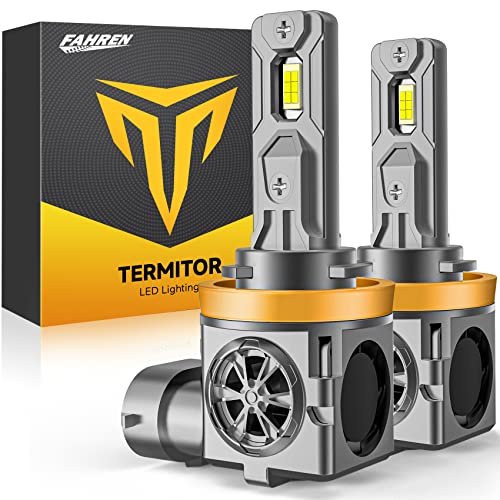
For H11 low-beam reflectors, this Termitor pair keeps the same 1:1 thinking in a two-bulb box. The listing pairs a 70,000-lumen output claim with a 1:1 halogen size and a 12-volt spec, and it adds an 85,000-hour service life figure that frequent night drivers will care about more than raw brightness. Termitor builds the bulbs under its own name with a Canbus-ready driver, so cars that watch bulb resistance should accept them without extra parts in most cases. The box even includes gloves, a small touch that keeps skin oil off the new bulbs.
Specs
- Bulb size: H11 / H9, also listed for H8
- Listed output: 70,000 lumens
- Color temperature: 6500K cool white
- Voltage: DC 12V
- Listed service life: 85,000+ hours
- Driver: Canbus ready, plug and play
- Pack contents: 2 bulbs, gloves, manual
- Part number: TE11Z10791215
Best for: H11 low-beam reflector housings
Watch out for: H11 also appears in fog light sockets on many cars, so confirm your H11 position is a headlight socket before ordering.
AUTOONE H11 and 9005 Fanless LED Bulb Combo
Sealed reflector housings with a tight dust cap are where fanless bulbs earn their place, and this AUTOONE combo covers the common 9005 high-beam and H11 low-beam pairing in one four-bulb box. With no fan at the back, the body stays close to halogen depth, and the double-sided CSP chips throw light in a full circle so the reflector can shape it. The 6000K color runs a touch less blue than the 6500K sets around it. A built-in driver handles the electrical side, keeping the swap free of separate decoder boxes behind the housing.
Specs
- Bulb sizes: H11 / H9 / H8 and 9005 / HB3
- Color temperature: 6000K white
- Cooling: fanless, no external driver
- Chips: double-sided CSP, 360-degree illumination
- Compatibility: built-in Canbus driver
- Pack contents: 4 bulbs
- Part number: AUTOONE-US-10SFH11+9005-WX4
Best for: Shallow or sealed reflector housings with no fan clearance
Watch out for: Fanless bulbs shed heat through the body alone, so long idling with the lights on is harder on them than steady driving airflow.
OXILAM H11 and 9005 LED Bulb Combo
OXILAM builds its combo around the thinnest chip spacing in this group, listing a 0.03-inch gap between chip faces so both sides sit close to the reflector’s focal line. Sixteen CSP chips per bulb feed a 70,000-lumen set claim, and the wireless body carries no external driver to tuck behind the housing. The set covers H11 low beams and 9005 high beams in one purchase, which suits owners converting a whole reflector front end at once. An IP68 sealing claim adds peace of mind for housings that see road spray.
Specs
- Bulb sizes: H11 / H9 / H8 and 9005 / HB3
- Listed output: 70,000 lumens per set
- Color temperature: 6500K cool white
- Chips: 16 CSP chips, 0.03-inch spacing, 360-degree lighting
- Design: 1:1 size, wireless, no external driver
- Sealing: IP68 waterproof
- Pack contents: 4 bulbs
- Part number: OLA36QH11005W410
Best for: Converting high and low reflector beams together
Watch out for: Four bulbs only help if your car actually uses both sizes, so verify the second position before choosing the combo over a pair.
AUXITO M3S 9005 and H11 LED Bulb Combo
The AUXITO M3S set takes a similar combo route with its own twist: a 0.039-inch baseboard between customized CSP chip faces, wider than the OXILAM board yet still far slimmer than the thick boards that push chips off the focal point. AUXITO lists the set for 50,000 hours of service and builds in an intelligent IC driver for cars that flicker or flag warnings with plain LED swaps. Because the body is all-in-one with no separate driver brick, the bulbs drop into reflector housings that leave little room behind the socket.
Specs
- Bulb sizes: 9005 / HB3 and H11 / H8 / H9
- Color temperature: 6500K cool white
- Chips: double-sided customized CSP, 0.039-inch baseboard
- Lighting: 360-degree illumination
- Listed lifespan: 50,000 hours
- Driver: built-in intelligent IC driver
- Pack contents: 4 bulbs
- Part number: AUXITO-USM3S9005H11WX4
Best for: Combo conversions in housings with little rear clearance
Watch out for: Judge this set on board design and fit rather than a headline output figure, since the listing leads with placement details instead.
Which One Fits Your Situation
Your High Beams Light the Trees Instead of the Road
That pattern usually means the chips sit too far forward or face the wrong way in the reflector. A 1:1 size bulb such as the FAHREN 9005 pair puts the light source back at the halogen depth, and seating it so the chips face sideways gives the reflector its intended shape back. Finish with a wall check at night and adjust the housing aim before blaming the bulb.
Your Dust Caps Barely Clear the Factory Bulbs
Shallow housings rule out tall fan bodies, so a fanless design is the safer route. The AUTOONE combo keeps a halogen-like depth with no fan at the rear, letting the cap close and seal as it did before. The AUXITO M3S set is the other low-profile route here, since its all-in-one body carries no separate driver to find room for.
You Want Both Beam Positions Done in One Weekend
Combo boxes exist for exactly this job. The OXILAM set covers H11 low beams and 9005 high beams with the thinnest chip spacing in this roundup, while the AUTOONE combo covers the same pairing in a fanless body for tighter housings. Confirm both sizes in the manual first, because a combo only saves effort when every bulb in the box has a socket waiting for it.
Your Dashboard Complains After an LED Swap
Many cars watch headlight draw and read the lower LED load as a failed bulb. Every set in this roundup carries a built-in driver described as Canbus-ready, and the Termitor H11 pair is a sensible first try for a single low-beam position because the swap stays small. If warnings persist on a sensitive model, a dedicated decoder harness is the next step rather than a different bulb.
Common Mistakes
- Judging bulbs by the largest lumen claim instead of chip placement, even though a reflector can only shape light that starts at its focal point.
- Ordering one bulb size for every position, when high beams, low beams, and fog positions often take different sizes on the same car.
- Locking the bulb in with the chips facing up and down, which turns the reflector pattern sideways and scatters light.
- Forcing a fan-cooled bulb into a housing where the dust cap no longer seals, letting moisture fog the reflector from inside.
- Skipping the wall check after installation, so a crooked seat or shifted aim goes unnoticed until other drivers start flashing back.
Frequently Asked Questions
Can an LED bulb form a proper beam in a reflector housing?
Yes, when the chips sit at the same depth and height as the halogen filament they replace. A reflector has no lens to correct a misplaced light source, so placement does the work. Bulbs built at a 1:1 halogen size with thin chip boards give the housing the geometry it expects, and a wall check after fitting confirms the cutoff.
Why do some LED swaps scatter light in reflectors?
Scatter usually traces back to geometry. A thick board holds the two chip faces apart, so each face sits off the focal point and the reflector sends that light wide. Chips facing the wrong direction after installation cause the same problem. Thin boards, correct sideways orientation, and an adjustable collar where fitted are the three fixes listings give you to work with.
Do reflector LED bulbs need a decoder?
Only some cars ask for one. Vehicles that monitor bulb draw can flicker or show a warning because LEDs sip far less current than halogens. The sets here carry built-in drivers described as Canbus-ready, which settles most cars. If yours still complains after a correct install, an inline decoder harness made for your socket size is the usual next step.
Should I replace both reflector bulbs at the same time?
Replacing the pair keeps both sides matched in color and output, which matters because a reflector beam is judged as a pattern, not as two separate lights. It also means both bulbs age on the same schedule. If one side of an older LED set fails, swapping the pair again is usually simpler than hunting for the same model years later.