Our Short List of 3

- Highest magnification in this guide for maximum reach
- Huge 100 mm objectives for bright low-light viewing
- Multi-coated optics with BaK-4 Porro prisms
- Tripod adapter and carrying case included

- Strong 20x magnification with bright 80 mm objectives
- 4 mm exit pupil suits daylight and twilight viewing
- Integrated tripod adapter and deluxe carrying case included
- More manageable in size than the 25×100
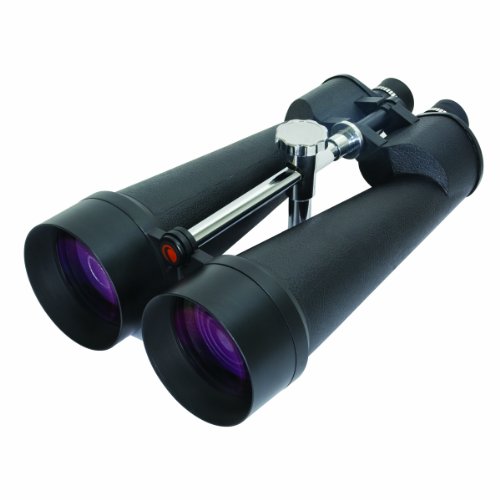
- Enormous 25-125x zoom range for scanning and identifying
- 80 mm objectives for good light gathering
- One instrument covers many observation distances
- Porro-prism design with a natural, deep image
All 4 Picks at a Glance
| Product | Specs | Action |
|---|---|---|
| Celestron SkyMaster 25×100 |
| Check price on Amazon |
| Celestron SkyMaster 20×80 |
| Check price on Amazon |
| Celestron SkyMaster 25-125×80 Zoom |
| Check price on Amazon |
 Nikon ACULON A211 10-22×50 Zoom |
| Check price on Amazon |
Key takeaways
- The best binoculars for surveillance bring distant details into sharp focus, with high magnification, large objectives and tripod-ready stability in low light.
Introduction
Watching a distant fence line, a trailhead, a stretch of shoreline, or wildlife moving across open ground all demand the same thing from optics: the ability to pull far-away detail close enough to identify. The best binoculars for surveillance are built for exactly that job. They pair high magnification with large objective lenses, so the image stays bright and detailed at distances where ordinary binoculars turn everything into a blur. They are also designed to be mounted on a tripod, because at twenty times magnification and beyond, even a small tremor in your hands becomes a large shake in the image.
This guide covers four high-magnification binoculars suited to long-range observation, from fixed-power giants to zoom models that let you scan wide and then tighten in on a single subject. Every pick below is a full-size Porro-prism binocular with tripod support, chosen for reach, light gathering, and steady, comfortable viewing over long sessions. Availability details here come from Amazon search-index listings and independent sources; live stock status could not be checked directly, so confirm availability before ordering. Used responsibly and within local privacy laws, these optics are practical tools for property observation, wildlife monitoring, and keeping an eye on large areas of open land.
At a Glance
| Product | Best for | Key spec |
|---|---|---|
| Celestron SkyMaster 25×100 | Maximum reach and brightness | 25x magnification, 100 mm objectives |
| Celestron SkyMaster 20×80 | Balanced power for long sessions | 20x magnification, 80 mm objectives |
| Celestron SkyMaster 25-125×80 Zoom | Scanning wide, then zooming in | 25-125x zoom, 80 mm objectives |
| Nikon ACULON A211 10-22×50 Zoom | Portable zoom in a lighter body | 10-22x zoom, 50 mm objectives |
How to Choose Binoculars for Surveillance
Magnification matters most. Surveillance is about identification at distance, so magnification in the 15x to 25x range is the practical starting point. Fixed-power models in this range give a bright, stable image, while zoom models trade a little brightness for the flexibility to find a subject at low power and then magnify it. Anything above 25x becomes very hard to hold steady without a tripod, so treat a tripod as part of the purchase, not an optional extra.
Objective lens size controls brightness. The second number in a binocular specification is the diameter of the front lenses in millimetres. Larger objectives gather more light, which keeps the image usable at dawn, dusk, and in overcast conditions — exactly when observation often matters most. A 100 mm objective gathers far more light than a 50 mm one, but it also adds considerable size and weight. Match the objective size to how long you plan to observe and whether the binoculars will live on a tripod or travel in a pack.
Exit pupil and eye relief shape comfort. Exit pupil is the objective diameter divided by the magnification, and it describes how wide the beam of light reaching your eye is. A 4 mm exit pupil, as found on a 20×80 binocular, suits daylight and twilight viewing well. Eye relief matters if you wear glasses; longer eye relief lets you see the full field of view without pressing the eyecups against your lenses. Turn-and-slide eyecups, found on the Nikon model below, make this adjustment simple.
Prism type and coatings affect image quality. All four picks here use Porro prisms, the classic design that delivers strong depth perception and a wide, natural image. Multi-coated lenses reduce glare and internal reflections, which keeps contrast high when you are looking toward a bright sky or across sunlit water. BaK-4 prism glass, used in the Celestron models, is the standard for a bright, sharp image edge to edge.
Tripod mounting is essential, not optional. At high magnification, hand shake is magnified just as much as the subject. Every binocular in this guide is tripod adaptable, and the larger Celestron models include a tripod adapter in the box. A sturdy tripod with a smooth pan head turns a shaky, tiring session into a stable, comfortable one, and it lets you keep watch on one spot for long periods without fatigue.
Weight and size decide where you can use them. Giant-aperture binoculars are observation instruments, not hiking companions. A 25×100 binocular is a substantial piece of equipment that belongs on a tripod at a fixed observation point, while a 10-22×50 zoom is light enough to carry and use handheld for shorter scans. Think about where you will actually be standing before choosing between maximum power and portability.
Celestron SkyMaster 25×100
- Highest magnification in this guide for maximum reach
- Huge 100 mm objectives for bright low-light viewing
- Multi-coated optics with BaK-4 Porro prisms
- Tripod adapter and carrying case included
The Celestron SkyMaster 25×100 is the most powerful fixed-magnification binocular in this guide, and the natural first choice when maximum reach is the priority. Its 25x magnification brings distant subjects dramatically closer, while the enormous 100 mm objective lenses gather enough light to keep the image bright in low-light conditions where smaller binoculars fade out. That combination makes it well suited to watching large areas of land, scanning a shoreline, or observing distant structures and wildlife at dawn and dusk.
The optics use multi-coated lenses and BaK-4 Porro prisms, a pairing that delivers bright, high-contrast views with good depth perception. The binoculars ship with a tripod adapter and a carrying case, which is important because this is not a handheld instrument for extended use. Mounted on a solid tripod, the 25×100 holds a steady image that lets you study fine detail — the shape of a distant vehicle, the markings on an animal, or movement along a tree line — for as long as you need to watch.
The trade-offs are size and weight. This is a large, heavy binocular that belongs at a fixed observation point rather than in a day pack, and its narrow field of view means finding a fast-moving subject takes practice. It is also best used with a tripod at all times; handheld use at 25x magnification produces a shaky image that defeats the purpose of the extra power. For a dedicated observation post, though, few binoculars at this level offer more reach for the money.
Pros
Cons
Celestron SkyMaster 20×80
- Strong 20x magnification with bright 80 mm objectives
- 4 mm exit pupil suits daylight and twilight viewing
- Integrated tripod adapter and deluxe carrying case included
- More manageable in size than the 25×100
The Celestron SkyMaster 20×80 strikes a useful balance between power and practicality. Its 20x magnification is strong enough for serious long-range observation, while the 80 mm objectives keep the image bright through the low-light hours at the start and end of the day. With a 4 mm exit pupil, the view stays comfortable in daylight and twilight, and the multi-coated BaK-4 Porro prism optics deliver the sharp, high-contrast image the SkyMaster line is known for.
This model is the most versatile of the large Celestron binoculars. It is still a full-size instrument that benefits greatly from a tripod — an integrated tripod adapter rod is built in, and a deluxe padded carrying case is included — but it is noticeably easier to handle and position than the 25×100. That makes it a strong choice for observers who move between a few watching positions, such as a porch, a vehicle window mount, or a hide at the edge of a field, rather than staying at a single fixed post.
The 20×80 also works well as a general long-distance viewing instrument beyond surveillance, including astronomy and shoreline scanning, which adds value if the binoculars will serve more than one purpose. Its limitations are the same as any high-power Porro binocular: handheld use produces visible shake, and the field of view is narrower than a standard 10x pair, so scanning a wide area takes a systematic sweep rather than a single glance.
Pros
Cons
Celestron SkyMaster 25-125×80 Zoom
- Enormous 25-125x zoom range for scanning and identifying
- 80 mm objectives for good light gathering
- One instrument covers many observation distances
- Porro-prism design with a natural, deep image
The Celestron SkyMaster 25-125×80 Zoom is the most flexible surveillance optic in this guide. Its zoom range runs from 25x all the way to 125x, which means you can scan a wide area at the low end, locate a subject, and then zoom in for a close look without changing instruments or losing your place. The 80 mm objectives keep the image as bright as the zoom range allows, and the Porro-prism design preserves the depth and natural feel of the view.
This flexibility comes with a clear condition: at the upper end of the zoom range, a tripod is absolutely required, and even a light breeze or a touch on the focus knob can disturb the image. At 125x, the field of view is very narrow, so the practical working range for most observation is the lower half of the zoom, with the top end reserved for brief, careful looks at a stationary subject. Used that way, the zoom is a genuine advantage, letting one instrument do the work of several fixed-power pairs.
The binoculars are large, with product dimensions of 12 x 8 x 18 inches, so they belong on a sturdy tripod at an observation point. For watchers who need to cover a wide area and then identify specific details — a vehicle type, a distant structure, an animal at the edge of a field — the ability to zoom in place is hard to match with a fixed-power binocular.
Pros
Cons
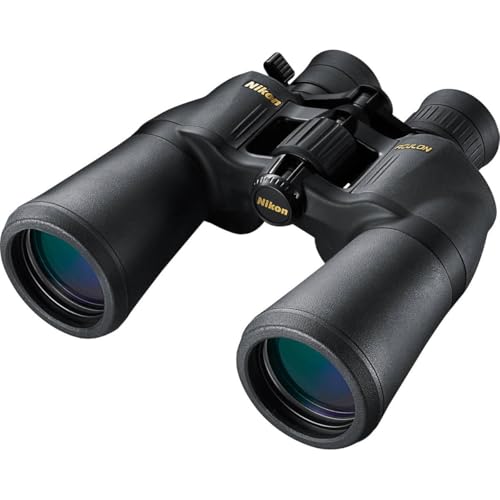
Nikon ACULON A211 10-22×50 Zoom
- Light and portable at 960 g, usable handheld
- 10-22x zoom covers scanning and identification
- Multilayer-coated Eco-Glass lenses with BaK-4 Porro prisms
- Turn-and-slide eyecups and supplied tripod adapter
The Nikon ACULON A211 10-22×50 Zoom is the portable option in this guide, and the best choice when surveillance means moving around rather than sitting at a fixed post. Its zoom runs from 10x for wide scanning to 22x for closer identification, and the 50 mm objectives keep the body light enough to carry and use handheld for short sessions. At 960 g, it is far lighter than the giant Celestron models, which matters on a long day of observation on foot.
The optics are built around Nikon’s lead- and arsenic-free Eco-Glass lenses with multilayer coatings, and BaK-4 Porro prisms that deliver a bright image from dawn to dusk. Turn-and-slide rubber eyecups make it comfortable to use with or without glasses, and the smooth central focus knob allows quick adjustment when a subject appears. A tripod adapter, model TRA-2, is supplied as an accessory for this model, so it can be mounted for steady long sessions as well as used handheld for quick scans.
The compromise is reach and brightness. At 22x maximum magnification and 50 mm objectives, it cannot match the giant Celestron models for distant detail in poor light. But for property checks, trail watching, and general observation where portability matters as much as power, it is the most practical pick here — a zoom binocular that goes anywhere and still reaches far enough to identify what you are looking at.
Pros
Cons
Which One Fits You
Choose the Celestron SkyMaster 25×100 if your observation point is fixed and maximum reach matters above all else. It gathers the most light and magnifies the most, which is exactly what a dedicated watch post needs. Choose the SkyMaster 20×80 if you want nearly the same capability in a more manageable instrument that moves between a few positions. Choose the SkyMaster 25-125×80 Zoom if you need to scan wide areas and then zoom in on specific subjects without switching optics, and you are willing to use a sturdy tripod at all times. Choose the Nikon ACULON A211 10-22×50 Zoom if you observe on foot, need something light enough to carry, and value the freedom to scan handheld before mounting up for a closer look. In every case, budget for a solid tripod — it is the accessory that turns high magnification from a shaky novelty into a genuinely useful observation tool.
Frequently Asked Questions
What magnification is best for surveillance binoculars?
For most long-range observation, 15x to 25x is the practical range. Lower magnification is easier to hold steady but may not resolve enough detail, while magnification above 25x demands a tripod and very still conditions. Zoom models let you work across that whole range with one instrument.
Do I need a tripod for surveillance binoculars?
Yes, for any sustained observation at 15x magnification or above. Hand shake is magnified along with the subject, so a tripod is what makes high-power binoculars usable for more than a few seconds at a time. All four binoculars in this guide are tripod adaptable.
Are zoom binoculars good for surveillance?
Zoom binoculars are useful when you need to find a subject at low power and then magnify it for identification. The trade-off is that the image gets dimmer and the field of view narrower at the top of the zoom range, so fixed-power models often give a brighter image at the same magnification.
Can these binoculars be used at night?
These are daylight and twilight instruments, not night-vision devices. Large objectives help in low light at dawn and dusk, but none of these binoculars can see in darkness. For true night observation, a dedicated night-vision or thermal device is needed.
Is it legal to use binoculars for surveillance?
Observing your own property, public land, and wildlife is generally lawful, but pointing optics into neighbours’ windows or private spaces can break privacy laws that vary by location. Use binoculars for lawful observation only, and check local rules before setting up a regular watch.
How do I keep high-magnification binoculars steady?
Mount them on a sturdy tripod with a smooth pan head, use the lowest magnification that resolves the detail you need, brace your elbows or lean against a solid support when handheld, and avoid touching the binoculars while observing.
Conclusion
The best binoculars for surveillance combine high magnification, large objective lenses, and reliable tripod mounting, and the four models here cover the main ways that combination can be used. The Celestron SkyMaster 25×100 offers the most reach, the 20×80 balances power with handling, the 25-125×80 Zoom adds unmatched flexibility, and the Nikon ACULON A211 10-22×50 Zoom brings zoom capability in a portable body. Pick the one that matches where you observe and how long you watch, pair it with a solid tripod, and use it within the law — and distant detail will come clearly into view.
Disclosure: As an Amazon Associate, we earn from qualifying purchases.