Our Short List of 3
All 4 Picks at a Glance
| Product | Specs | Action |
|---|---|---|
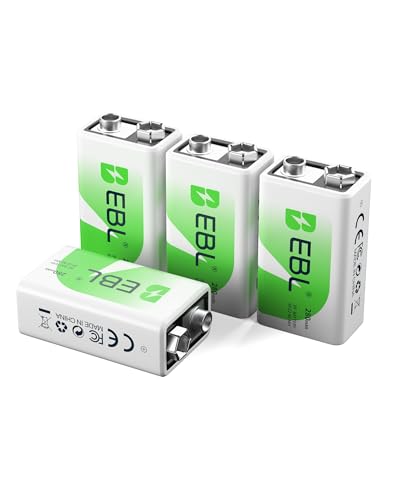 1. EBL 9V NiMH Rechargeable Batteries, 280mAh, 4-Pack | Check price on Amazon | |
 2. Powerex Precharged MHR9VP, 9.6V, 230mAh | Check price on Amazon | |
 3. Tenergy Centura 9V NiMH, 200mAh, 2-Pack | Check price on Amazon | |
 4. Amazon Basics 4-Pack Rechargeable 9 Volt Ni-MH, 200mAh | Check price on Amazon |
Key takeaways
- The best 9V NiMH rechargeable battery picks compared on real capacity, voltage, self-discharge and cycle life — true NiMH cells only, no lithium substitutes.
As an Amazon Associate we earn from qualifying purchases.
Affiliate Disclosure: This article contains affiliate links. If you buy through a link on this page, we may earn a commission at no additional cost to you.
A 9V battery looks simple, but the rechargeable version of it is one of the most misunderstood products in the battery aisle. Search for a rechargeable 9V today and most of the loudest listings are not NiMH at all. They are lithium-ion cells with a built-in regulator, or USB-charged lithium packs quoting huge numbers in milliwatt-hours that make them look several times stronger than they really are in a device that simply needs steady voltage. If your keyword, your device manual, or your own preference specifically says NiMH, those lithium products are not an answer to the question you asked.
This guide stays strictly on brief. Every pick below is a genuine nickel-metal hydride 9V battery: the same chemistry, the same snap-terminal block shape, and the same basic behaviour your devices were designed around. We will also be upfront about the limits of this category. True 9V NiMH capacity is modest, the rated voltage is lower than a fresh alkaline in most cases, and one well-known model in this roundup actually runs slightly higher than standard. Those details matter far more than any headline capacity figure, so we explain them before we rank anything.
What a 9V NiMH Battery Actually Is
A traditional 9V battery is not a single cell. Inside the rectangular case is a stack of smaller cells wired in series. In a NiMH version, that usually means six or seven nickel-metal hydride cells. Six cells at a nominal 1.2 volts each produce about 7.2 volts, seven cells produce about 8.4 volts, and one specialist model below uses eight cells to reach 9.6 volts. This is why two batteries that both say “9V” on the wrapper can behave quite differently in the same device.
Capacity is the second point of confusion. A good 9V NiMH cell holds roughly 175 to 280 milliamp-hours. That sounds tiny next to the numbers printed on lithium 9V products, but those lithium listings often quote milliwatt-hours instead, or quote the capacity of the internal lithium cell at its own lower voltage before conversion. Converted honestly, the gap narrows a great deal, and NiMH keeps advantages that matter in this format: predictable discharge, no internal electronics to fail, tolerance of the simple chargers most households already own, and a long track record in safety-sensitive devices.
The third point is self-discharge. Older NiMH cells lost their charge on the shelf within a few months. The low self-discharge generation changed that, retaining most of a charge for a year or longer in storage. For a battery that may sit in a smoke alarm, a guitar, or a spare drawer, that retention figure is arguably more important than raw capacity.
A Necessary Warning About Smoke Alarms
Several picks below are marketed for smoke alarms and detectors, and low self-discharge NiMH cells are commonly used in them. But a rechargeable battery is only appropriate in an alarm if the alarm manufacturer allows it. Some detector makers specify alkaline or sealed lithium batteries only, and some local codes and landlord rules say the same. A NiMH cell also gives a shorter low-battery warning window in some alarms because its voltage curve falls differently near the end of a charge. Check the manual for your specific alarm first. Where a rechargeable is not approved, do not fit one, whatever any battery listing suggests. For approved uses, test the alarm after fitting and keep a dated rotation schedule so a cell is swapped and recharged before it runs flat in service.
Our Picks at a Glance
- EBL 9V NiMH Rechargeable Batteries, 280mAh, 4-Pack (LN-8171) — the highest honest NiMH capacity in this group, for microphones, alarms and everyday devices.
- Powerex Precharged MHR9VP, 9.6V, 230mAh, 1-Pack — the specialist high-voltage option for professional audio and instruments that feel weak on standard rechargeables.
- Tenergy Centura 9V NiMH, 200mAh, 2-Pack — the low self-discharge workhorse, built for slow drains and long storage.
- Amazon Basics 4-Pack Rechargeable 9 Volt Ni-MH, 200mAh — the simple, pre-charged household option for low-to-moderate drain gear.
1. EBL 9V NiMH Rechargeable Batteries, 280mAh, 4-Pack
EBL’s Everyday 9V is the capacity leader among true NiMH options that are widely sold in the United States. The listing rates each cell at 280 milliamp-hours, the pack contains four batteries, and the model number is LN-8171. In a category where 175 to 200 milliamp-hours is the norm, that extra capacity is the main reason to choose it: a wireless microphone, a TENS unit, a multimeter or an active guitar simply runs longer between charges.
EBL describes this cell as a low self-discharge design that maintains most of its charge over long storage, with the brand’s documentation citing retention of about 80 percent after three years of non-use, and a cycle life figure of up to 1,200 recharges. Treat cycle claims from any brand as best-case numbers achieved under gentle conditions, but even a fraction of that life makes a four-pack a long-lived purchase for a household that rotates cells sensibly.
The voltage story is standard NiMH: a nominal rating in the 8.4-volt class rather than the 9 volts printed large on the wrapper, which is normal for this chemistry and fine for the vast majority of devices. Where this battery earns its place is in mid-drain equipment that gets used in sessions — microphones at events, instruments at rehearsals, test gear on a workbench — because that is where the extra milliamp-hours are actually felt. For a smoke alarm that must sit untouched for a year, the retention-focused picks below are the more tailored choice, and the alarm maker’s approval still comes first.
One honest limitation: EBL also sells 9V lithium-ion rechargeables with much larger numbers on the box, and the two lines are easy to confuse on a search results page. If you want NiMH, check that the listing you are on says NiMH or Ni-MH and 280mAh. The lithium version is a different product with a different ASIN.
2. Powerex Precharged MHR9VP, 9.6V, 230mAh
The Powerex Precharged MHR9VP, made by Maha, is the connoisseur’s 9V NiMH and the only pick here that solves the chemistry’s biggest weakness head-on. Most rechargeable 9V batteries feel slightly soft in demanding devices because their nominal voltage sits below a fresh alkaline. The MHR9VP uses an eight-cell stack rated at 9.6 volts nominal, with 230 milliamp-hours of capacity and a stated minimum capacity of 215 milliamp-hours. That higher voltage is why wireless systems, in-ear monitor packs, high-end microphones and some medical and test devices that complain about ordinary rechargeables often behave properly on this cell.
The trade-offs are equally clear. It is sold as a single battery, it is a premium specialist product rather than a household multipack, and a 9.6-volt nominal battery is not automatically right for every device: check that your equipment tolerates the slightly higher voltage, particularly with older or sensitive electronics. Powerex rates the cell for up to 1,000 recharges, describes it as low self-discharge with retention of up to 85 percent of capacity after a year in storage, and notes compatibility with its own MH-C490F and MH-C1090F chargers. Any good-quality NiMH charger with a proper 9V programme is the general requirement; a smart charger that terminates correctly will always treat these cells better than a crude timed one.
For a working musician, a sound engineer or anyone whose 9V device has ever cut out mid-session on a standard rechargeable, this is the pick that exists precisely for you. For a drawer of household spares, it is more battery than you need.
3. Tenergy Centura 9V NiMH, 200mAh, 2-Pack
Tenergy’s Centura line was built around one idea: a rechargeable battery should still be charged when you finally reach for it. The Centura 9V is a low self-discharge NiMH cell rated at 200 milliamp-hours and 8.4 volts, sold here in a two-pack, pre-charged and ready to use. Tenergy states that the cell retains up to 85 percent of its capacity after a year stored unused, and rates it for a very long cycle life. The physical cell follows the standard 9V footprint at roughly 48 by 26 by 16 millimetres.
That profile suits the jobs this battery is marketed for: smoke alarms and detectors where permitted, clock radios with battery backup, irrigation controllers, remote controls and other slow, patient drains where the battery works a little every day and must not quietly empty itself in between. In a high-drain device the 200 milliamp-hour capacity runs down sooner than the EBL above, and that is simply the design bargain: retention and cycle life first, capacity second.
Two practical notes from the product’s long history on sale. First, rechargeable 9V blocks from several brands can be a fraction larger than a disposable cell, so if a battery compartment or alarm housing is unusually tight, check fit before committing a whole house to one model. Second, pair it with a proper 9V NiMH charger; Tenergy’s own TN141 two-bay smart charger is the matching accessory most often sold alongside it, though the battery itself is the pick here, not the charger.
4. Amazon Basics 4-Pack Rechargeable 9 Volt Ni-MH, 200mAh
The Amazon Basics 9V is the plain, does-the-job option: a four-pack of pre-charged Ni-MH cells rated at 200 milliamp-hours each, described by Amazon as rechargeable up to 1,000 times and as maintaining about 80 percent of capacity through long storage, with figures of up to 24 months quoted in product summaries. There is no specialist voltage trick and no category-leading capacity. What you get is a standard-voltage, standard-capacity NiMH block from a house brand with consistent manufacturing and easy availability.
That makes it a sensible default for the undemanding 9V population of a home: remote controls, toys, walkie-talkies, bathroom scales, stud finders and the backup slot in clocks and controllers. It is also a reasonable first rechargeable 9V to try if you are leaving disposables behind, because the four-pack lets you run a simple rotation — some cells in devices, one on the charger — without managing different brands and capacities.
The limitations mirror the Centura’s, since the headline capacity matches it: high-drain audio gear will exhaust it faster than the EBL, and devices that are picky about voltage will prefer the Powerex. No charger is included, which is normal at this level but worth remembering if this is your first rechargeable 9V purchase. As with the Tenergy, verify the exact listing before buying: Amazon Basics also sells a non-rechargeable alkaline 9V four-pack with similar packaging, and only the listing that says rechargeable Ni-MH is this product.
How to Choose the Right 9V NiMH Battery
Start with the device, not the battery. Read what the device maker allows. If the manual specifies alkaline only, that settles the question. If rechargeables are allowed, note whether the device is voltage-sensitive: pro audio and some instruments are, most household gadgets are not.
Match capacity to drain. Capacity in this category runs from about 175 to 280 milliamp-hours. High-drain, session-based devices benefit from every extra milliamp-hour, which points to the EBL. Low-drain, always-on devices care more about self-discharge, which points to the low self-discharge designs from Tenergy, Amazon Basics and Powerex.
Understand the voltage you are buying. A standard NiMH 9V is really an 8.4-volt nominal battery, a budget stack can be 7.2 volts, and the Powerex is 9.6 volts. All three are sold as “9V”. Devices with a low-battery warning calibrated for alkaline may warn earlier on an 8.4-volt cell even while useful energy remains, which is another reason alarm use needs the manufacturer’s blessing.
Buy the charger as part of the system. A smart NiMH charger that detects a full charge and stops is the difference between a cell that lasts for years and one that is cooked within a season. Never charge NiMH cells on a lithium 9V charger programme, and never attempt to recharge a disposable alkaline 9V.
Be suspicious of giant numbers. If a rechargeable 9V advertises a capacity several times higher than everything in this guide, it is almost certainly a lithium product quoting milliwatt-hours, or quoting an internal cell at a different voltage. That does not make it a bad battery, but it is not a NiMH battery, and it should not win a comparison it is not really entering.
Care Habits That Make NiMH 9V Batteries Last
Rotate cells in pairs of jobs rather than leaving one battery in a device until it is completely flat; NiMH tolerates shallow cycling well. Store spares cool and dry, ideally partly charged rather than empty, and recharge stored cells before important use even when the retention figures say they should be fine. Keep the snap terminals clean, never mix an old and a new cell in the rare device that uses two, and retire any cell that becomes hot, swollen or noticeably short-running. Recycle retired cells through a battery collection point rather than household waste.
Frequently Asked Questions
Can I use a 9V NiMH battery in any device that takes a 9V alkaline?
Usually, but not always. The size and terminals match, yet the nominal voltage is lower on most NiMH models, and a few devices — plus some smoke alarms by rule — require alkaline or a specific battery type. The device manual is the authority.
Why does my rechargeable 9V show less than 9 volts?
Because a standard NiMH 9V stack is nominally 8.4 volts, rising above that just after charging and falling as it discharges. That is normal chemistry, not a faulty cell. The Powerex MHR9VP is the exception, built to a 9.6-volt nominal rating.
How long will a 9V NiMH battery run my device?
It depends on the device’s current draw. A low-drain alarm or clock backup can run for many months; a wireless microphone may run for a single long event or a working day. Capacity between 200 and 280 milliamp-hours is the honest range for this chemistry.
Do I need a special charger?
You need a charger with a 9V NiMH programme, ideally a smart model that stops at full charge. A basic, reputable 9V NiMH charger is enough for the household picks; professional users often prefer the battery maker’s own analysing chargers.
Are lithium rechargeable 9V batteries better?
They are different, not simply better. Lithium 9V products offer higher quoted energy and a regulated output, but they contain electronics, behave differently at the end of a charge, and are not NiMH. If your requirement is NiMH — for charger compatibility, device approval or simple preference — the picks above are the relevant shortlist.
Verdict
The 9V NiMH market is smaller and more honest than the wider rechargeable 9V market, and that is a good thing. Choose the EBL 280mAh four-pack for the longest runtime in everyday and mid-drain gear, the Powerex MHR9VP when a demanding device needs true 9-volt-class voltage, the Tenergy Centura for slow drains and long storage, and the Amazon Basics four-pack as the straightforward household default. Whichever you pick, confirm your device allows rechargeables, pair the cells with a proper NiMH charger, and you will stop feeding a steady stream of disposable 9V batteries into landfill.